
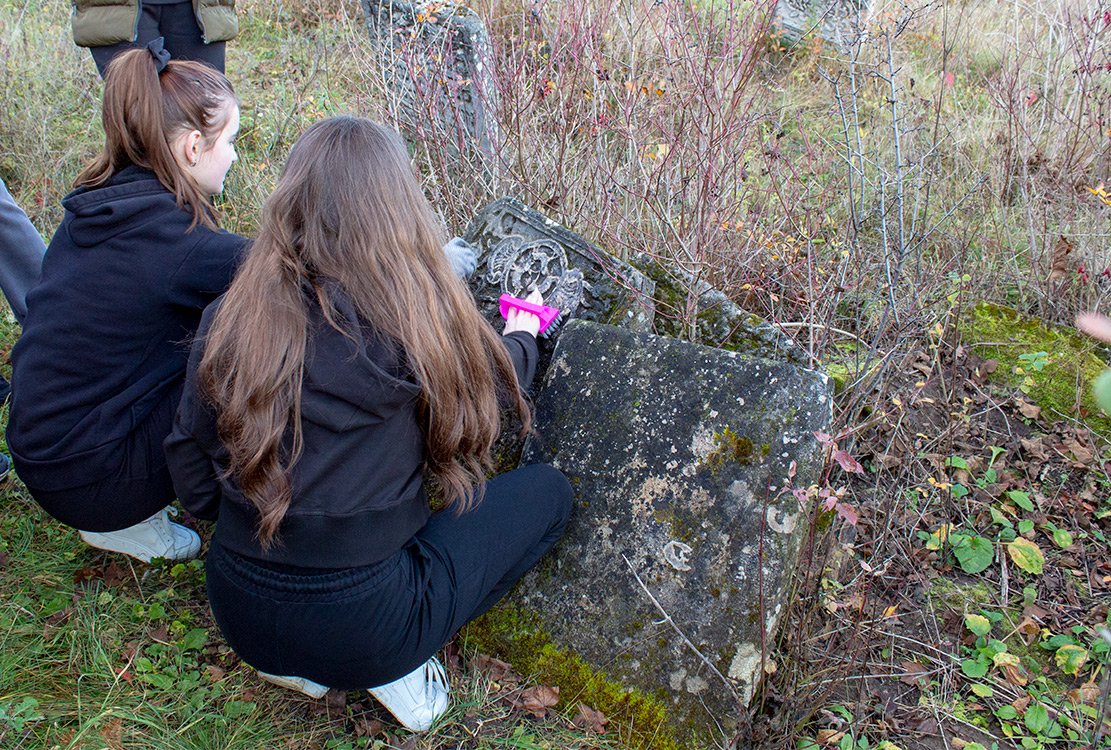
(JHE) — Some exciting discoveries have been made recently in Jewish cemeteries in western Ukraine — including by local high school students carrying out research in the Jewish cemetery in Horodok who revealed a matzevah bearing the rare “Three Hares” image that was thought to have been destroyed more than a decade ago during botched cemetery clean up.

JHE friend Dmytro Polyukhovich, who drew our attention to the students’ work, writes that he himself also made a discovery — when he stumbled across a previously undocumented gravestone bearing the Three Hares image while leading a group of tourists at the Jewish cemetery in the village of Kupyn, near Horodok.
The tourists, he writes, were from the major industrial center of Kryvyi Rih, a frontline city hard hit by Russian missiles, who were taking a break over the New Year holidays in a relatively safer part of the country.
The matzevah he found marked the grave of one Menachem (or Tanchum) son of Yehuda, who died on Adar 4, 5577 — or February 20, 1817.
Until this discovery, the Three Hares motif — a motif found in many places of the world in non-Jewish contexts — was only known to be found in a very few Jewish cemeteries, including those in Sataniv, Horodok, and Smotrych. It was also found in the painted decoration of the wooden synagogues of eastern Europe, which were destroyed in World War II — including that in Horodok.
Polyukhovich is not Jewish but has long been active in documenting and writing about Jewish heritage and history and advocating for the preservation of Jewish cemeteries.
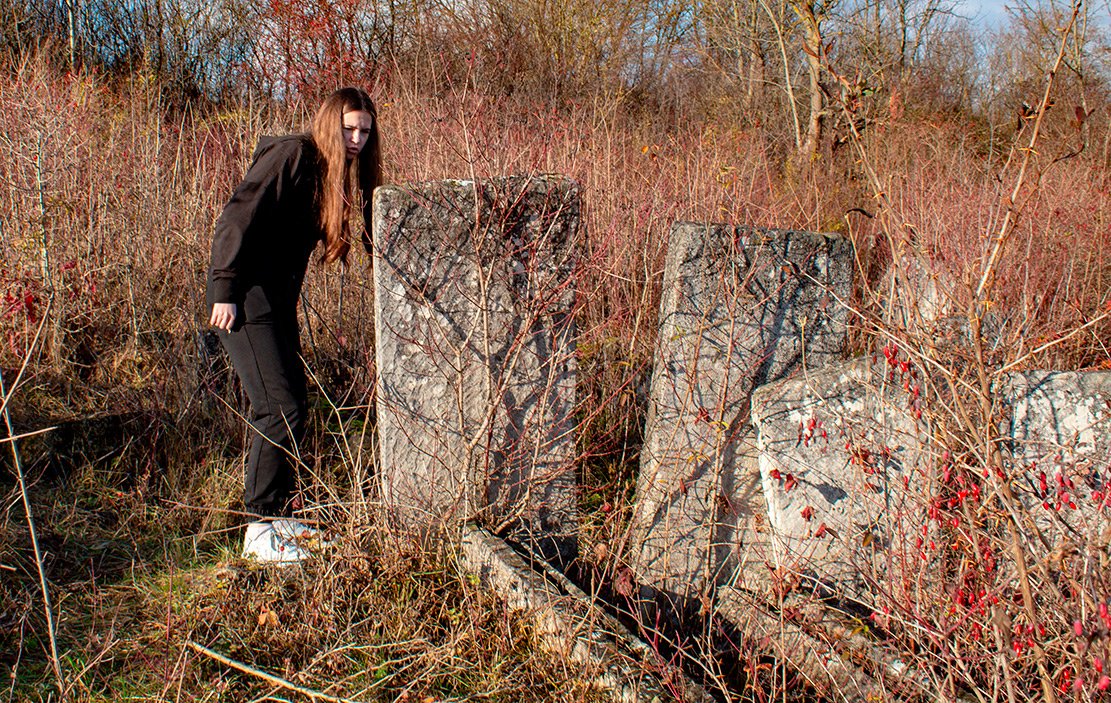
It was an exhibition in September at Horodok’s G-Museum of Polyukhovich’s elaborated photographs of the carved decoration of the matzevot in the historic Jewish cemetery of Sataniv that sparked the students’ interest in researching the Horodok Jewish cemetery, 11th grader Yuliya Kuksa wrote in local media.
Thanks to the exhibition, she wrote, “I discovered for myself the amazing world of the culture of the people who lived next to Ukrainians for more than a century. “
My friends and I were interested, is there something similar in the old Jewish cemetery of Horodok? As it turned out – there is! The Horodok Jewish cemetery is not as old and large as in Sataniv, but it is also very interesting. And the oldest tombstones in it date back to the beginning of the 18th century.
“I am very glad that the exhibition of my works dedicated to traditional Jewish art, which is still on at the “G-museum”, had such an effect,” Polyukhovich, who became a consultant to the project, told JHE. “After all, it is simply wonderful that the exhibition interested schoolchildren to explore the Jewish cultural heritage of the city of Horodok.”
The students, all from Horodotsky Lyceum No. 1, began their research after history teacher Zhanna Maksimova, who is also the director of the Center for the Professional Development of Pedagogical Workers, suggested that they carry it out within the framework of the international competition for high school students on Jewish cemeteries organized by the European Jewish Cemeteries Initiative (ESJF) and Centropa.
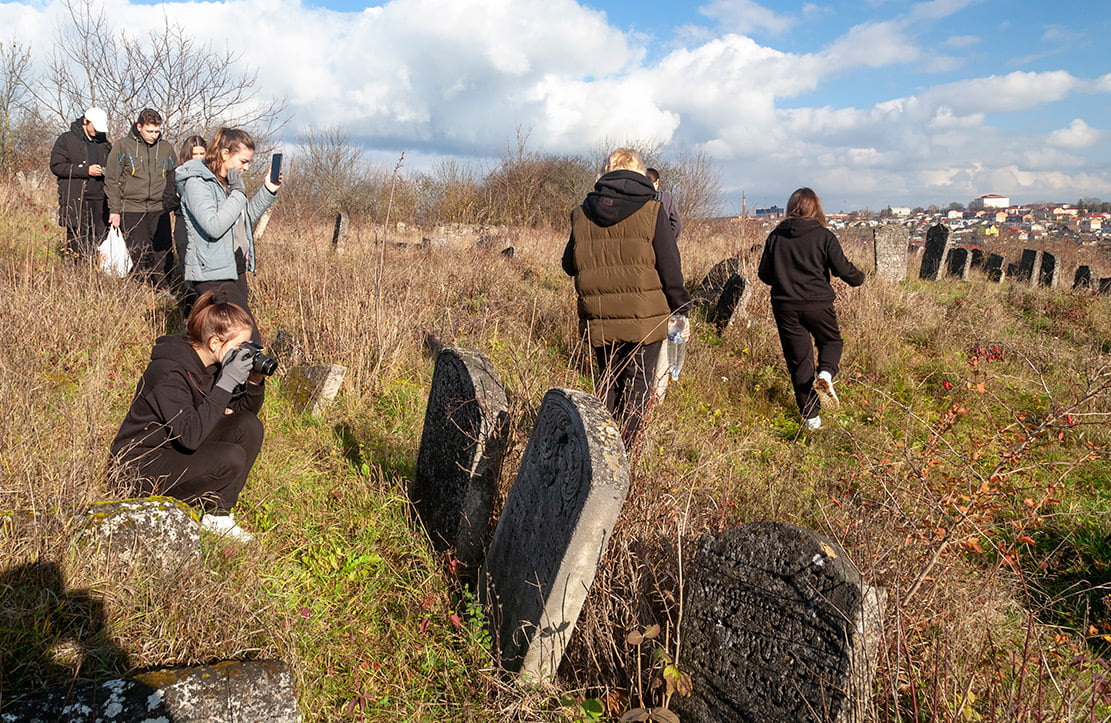
“For me, the Jewish cemetery of Horodok was a real discovery, ” participant Ilya Gudyma told local media
Of course I knew that it was there, but I had never been here before. Unicorns, lions, predatory griffins are very beautiful and colorful, reminiscent of illustrations for chivalric novels. I had only seen such before in books and on TV. And they, it turns out, are right next to each other – real and ancient.
The project has involved photo documentation and cleaning matzevot. In addition, the students carried out research on the iconography found on the richly carved gravestones.
Yuliya Kuksa in particular carried out research on the Three Hares motif, which the students discovered on a gravestone that had been documented in 1993, but had been believed to have been destroyed when Haredi Jews carrying out work in the cemetery in 2010-11 burned heaps of branches and vegetation amid the gravestones, reducing a number of them to rubble.

“This is a tombstone on the grave of Elimelech Pelet, son of Yitzhak, who died in 1823,” she wrote. “The tombstone was thickly covered with moss and lichen, so it took a lot of work to clean it.”
She ended up writing a lengthy research paper on the topic, which she submitted to the Small Academy of Sciences and summarized in an article.
The students have been supported in their project by the Department of Culture, Nationalities, Religions and Tourism of the Horodok City Council, which has helped with consultations and provided reference material.
“When I had questions that were too complicated, they passed them on to the scholars of the Hebrew University in Jerusalem, and I was helped with the translations of the epitaphs by Evgeny Schneider from the city of Dnipro, a well-known researcher of Judaics,” Kuksa wrote. “G-museum” employee Pavlo Zalutsky also helped me a lot in my work.”
Local authorities said the students’ work in uncovering Jewish heritage was important for the region, which hopes to develop tourism, including Jewish heritage tourism, once peace comes again after the Russian war against Ukraine.
Polyukhovich told JHE that Neonila Andriychuk, head of Horodotsk Territorial Community, noted to him in conversations the importance of the number and significance of Jewish heritage sites in the Horodok area, including the former shtetls of Horodok, Kuzmin and Kupyn, besides their historic cemeteries have traditional Jewish buildings, including a synagogue from Kuzmin from the first half of the 19th century.
Click to read an article by Dmytro Polyukhovich about the students’ project
Click to read Yuliya Kuksa’s article describing the students’ project and her research
Click to see our post about Polyukhovich’s exhibition in September
1 comment on “Ukraine: Exciting discoveries — including the Three Hares motif on gravestones — as high school students research the Jewish cemetery in Horodok”
Very interesting. I’m planing to visit Ukraine in about 6 weeks to look for my great grandfather’s grave in Podwoloczyska.