

(JHE) — A photographic art exhibit based on the carved designs of the centuries old gravestones in the historic Jewish cemetery in Sataniv, Ukraine is currently mounted in a recently opened museum in Horodok, western Ukraine.
The exhibit, called The Stone Lace of Ancient Matzevot features 37 enhanced photographic images by the historian Dmitry Polyukhovich.
Its aim is to highlight both Jewish art and heritage and entwined Jewish/Ukrainian history.
It opened Wednesday, just ahead of Rosh Hashanah, at the G-Museum in Horodok, and will run for a month before touring elsewhere in Ukraine.
“With my images, I wanted to show the beauty of the traditional folk culture of the Jews of Ukraine as clearly as possible,” Polyukhovich told JHE. “The average Ukrainian knows nothing about it.”
Each image is based on the carved decoration found on the matzevot from the 18th and 19th centuries in the Jewish cemetery in Sataniv, Ukraine, which dates back to the 16th century, and which Polyukhovich has documented for a number of years.
(He was instrumental in alerting JHE to the damage inflicted last year by a Haredi activist who uprooted gravestones and set them in concrete, claiming to “restore” the cemetery.)
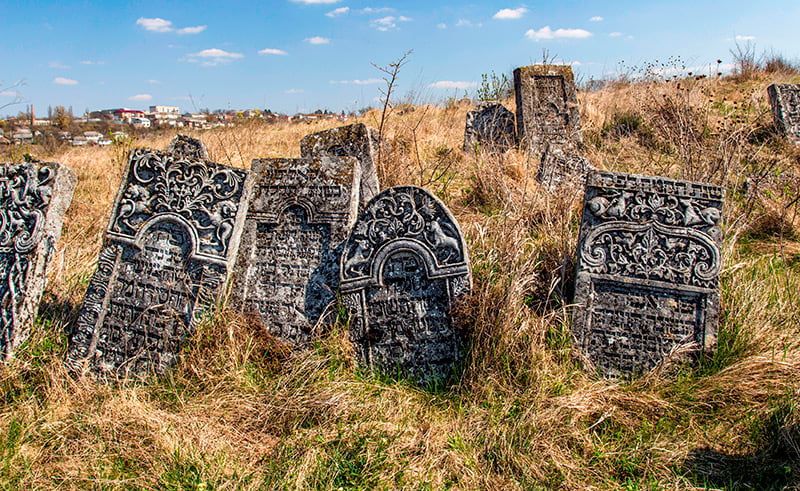
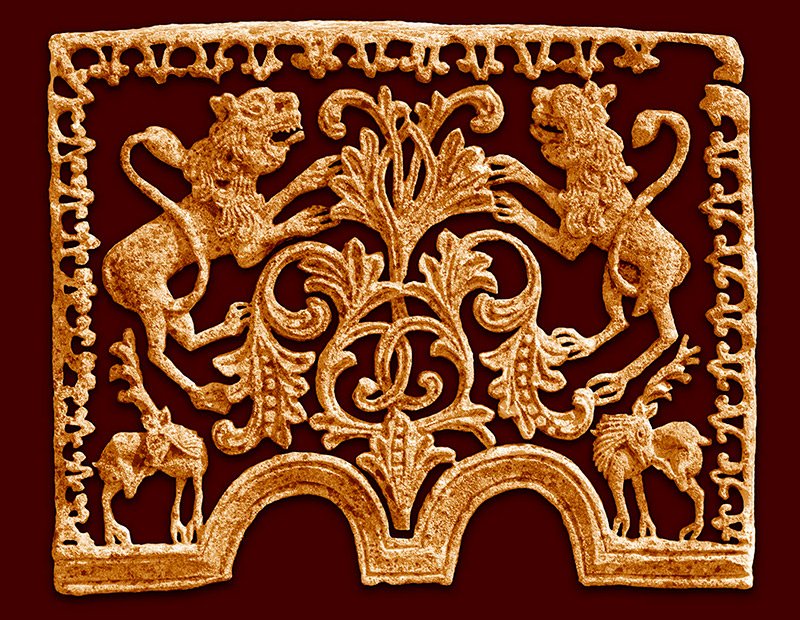
The images for the exhibition focus on specific details of the carved iconography, which combines religious tradition with folk art — floral motifs, animals (and imaginary animals), symbols, religious allegories, and more.
To create the exhibition pieces, Polyukovich manipulated his original photos of the matzevot in Adobe Photoshop, cutting away everything except for the specific detail of the carving that he wanted to highlight and then adding color.

Some present the carved detail in gold, standing out on a dark background. Others add color to the features, basing the colors chosen on the colors of the paintings that once decorated the interiors of the ornate wooden synagogues in eastern Europe that were destroyed during World War II (and which can be seen today in the replica of the destroyed synagogue of Gwozdziec, at the Polin museum in Warsaw.
“The pictures themselves are not important,” he told JHE. “The main goal is to show the traditional art of the Jews. ”
He added:
Today, Jewish cemeteries are the only places where you can still see the unique masterpieces of traditional art of the Jews of Eastern Europe in their “natural environment”,and not in museum showcases. The murals of wooden synagogues of the 17th-18th centuries are considered to be the most striking examples of [this are]. Alas, all of them burned down in the bloody fires of the Shoah, and only old photographs and tombstones remind us of them — the stone-cutters [who created the gravestones] used what they saw on the walls and vaults of synagogues as their models.
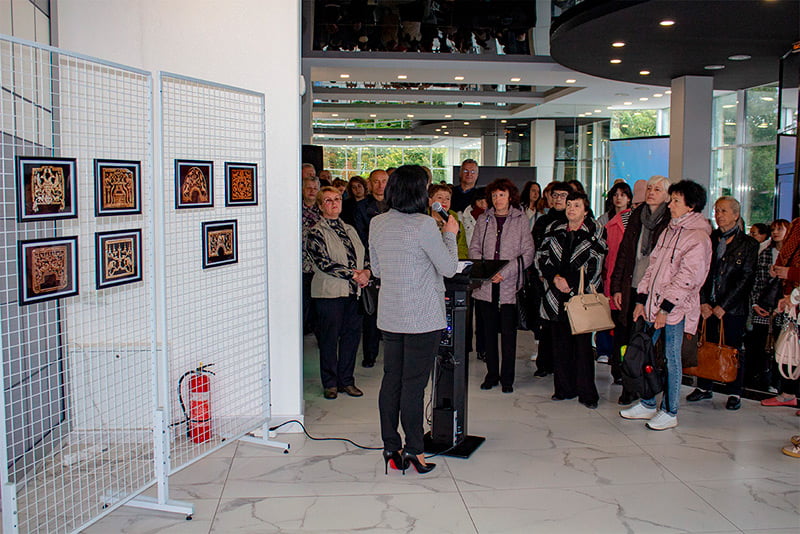
The exhibit was organised at the initiative of the Department of Culture, Nationalities, Religions and Tourism of the Gorodotsk city council. Local officials and Jewish representatives took part in the opening, which was also attended by a number of Jews who had been evacuated to western Ukraine to escape the Russian invasion and ongoing war in the east.
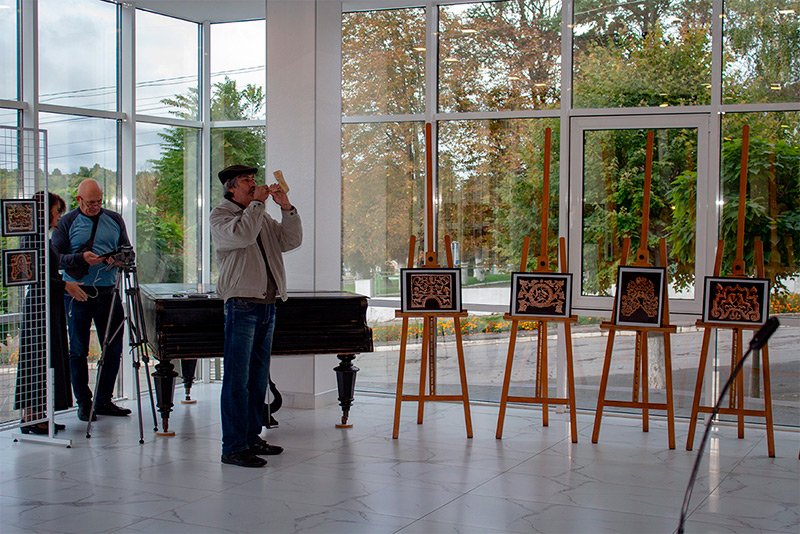
Chief Rabbi Moshe Asman and art historian Sergey R. Kravtsov, of the Center for Jewish Art in Jerusalem, addressed the opening by video, and a shofar was blown to herald the upcoming New Year.
Oleg Fedorov, Head of the Culture, Nationalities, Religions and Tourism Department, said the exhibition was not meant simply to show interesting photographs. “The main thing is to show the culture of the people who lived next to us for centuries and became part of our common history and culture. ”
 The event also held political importance during wartime, officials said.
“This event is of great political importance,” Neonila Andriychuk, head of the Gorodotsk united territorial community, said. “Firstly, it is aimed at strengthening mutual understanding between Ukrainians and Jews, at strengthening interethnic unity in the face of Russian aggression. Secondly, this exhibition destroys one of the main theses by which Russia justifies its aggression against Ukraine – about allegedly victorious Nazism. What kind of Nazism can we talk about in Ukraine when ethnic Ukrainians organized such an interesting event dedicated to traditional Jewish culture?”
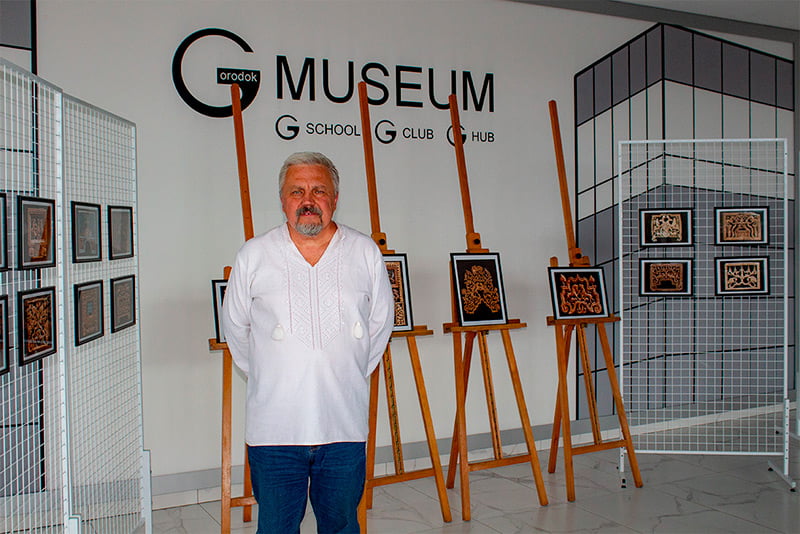
Polyukhovich, who is not Jewish, described to JHE his interest in Jewish heritage and motivations in documenting and writing about Jewish heritage and history.
“For me, Jewish historical monuments are an integral part of the history and culture of my native Ukraine,” he said. “Moreover, the culture and history of Jews and Ukrainians are very closely intertwined.”
He said he had a special attitude towards Jewish cemeteries.
My first independent local history expedition was to the local Jewish cemetery. About what made the boy at the age of 7 go on a long and dangerous journey (there were many cows grazing in the valley of the Smotrich River at that time and it was scary for a city child) we will keep silent…. The unknown and unprecedented culture that opened up to me at that time shocked and surprised me. All the lions, unicorns, griffins, bears… Incomprehensible letters (I knew the Latin and Cyrillic alphabets, but these ones I didn’t) It was very interesting and unusual…

His choice of which gravestones and iconography to highlight in the artistically manipulated photos, he said, was based solely on what he liked.
As for attempts to use different colors, he said
I started from the colors in the murals of the Sataniv synagogue and the flowers in the reconstruction of the murals of wooden synagogues. In the cemetery itself, traces of paints have been preserved in only one place – a blue background on one of the tombstones from the late 19th century and traces of ocher on the lions from the very beginning of the 19th century. The painted tombstones [in the exhibit] are more of an attempt to imagine what it might look like, and it can hardly be considered scientific. Rather, it is a way to show the general public that matzevot used to be polychrome.

