

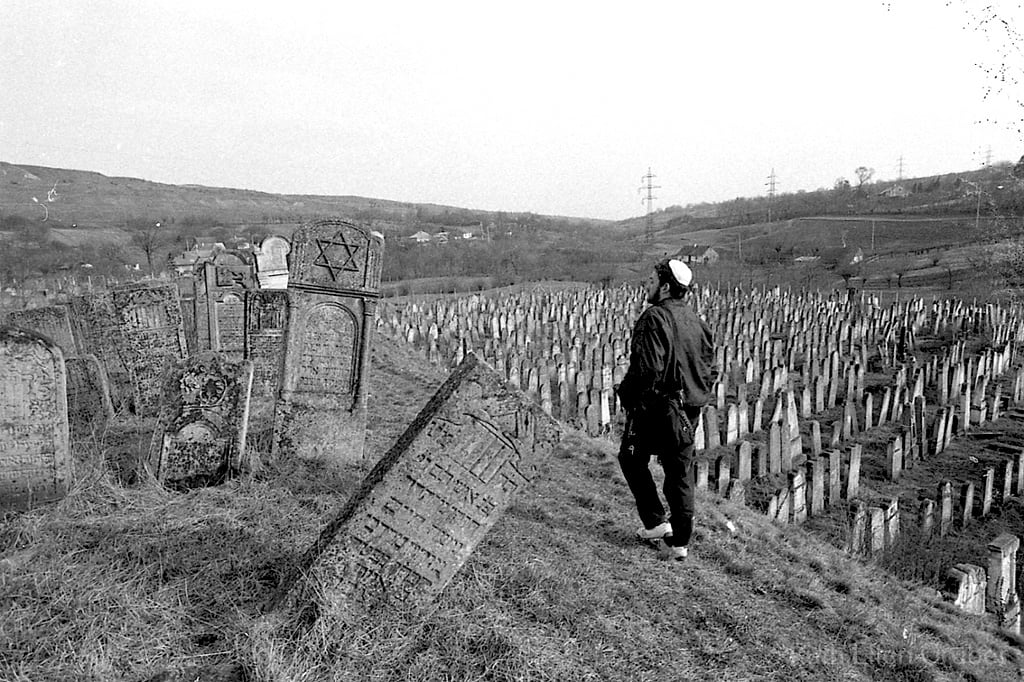
The three adjacent Jewish cemeteries in Siret, in the far north of Romania on the border with Ukraine, form an extremely significant complex of Jewish burial grounds dating back centuries.
The elaborately decorated matzevot from the Old Jewish Cemetery (in use most likely from the 16th century until the 19th century) and the “Middle” Jewish cemetery (in use from 1830-1935) have now been fully documented and uploaded for online consultation on the web site of the Jewish Galicia and Bukovina Organization (JGB). (The 20th century New Jewish cemetery is not part of this documentation.)
A team of experts and volunteers organized by the JGB completed documentation of the two cemeteries this past summer, and also carried out clean-up work. The team consisted of 11 Israeli volunteers and two staff members – Dr. Boris Khaimovich and Dr. Ilia Lurie. This year as in previous years, the JGB said
despite the ravages of war across the border in Ukraine, our regular partners – the Ukrainian community leaders Yitzhak Perelman from, Ivano – Frankivsk and Yitzhak Karasik from Slavuta – helped us with all the logistical and organizational matters, and we thank them from the bottom of our hearts.
In both cemeteries, the team photographed each headstone and created a detailed map and online catalog that includes the photographs, the name and death date of the person commemorated, as well as GPS coordinates for each stone, transcription of the Hebrew epitaph, and dimensions of the stone; plus photo galleries of the most elaborately carved stones, to demonstrate magnificent examples of stone-carving art.
The catalogues are arranged in chronological order (which with a click can be read in both directions). Headstones with no legible date are placed at the end of the lists.

In all, the team documented 300 gravestones in the Old Jewish Cemetery, which the JGB describes as “the most ancient and significant monument of Jewish heritage in South Bukovina (Romania).”
Of particular value are the unique richly ornamented gravestones of the 18th and early 19th centuries, which are true works of stone-cutting art.

The Old Cemetery, which extends up and around a small, steep hill, “most probably” dates from the 16th century, the JGB says, but the earliest stones in its catalogue date from 1750.
The latest are those of an “important woman” named Meyte from 1842 and one Zvi Hirsch from 1863. (Meyte’s gravestone, broken off an apparently lying on the ground was documented by the Romanian scholar Silviu Sanie in his book about the cemetery Dāinuire Prin Piatrā. Monumentele cimitirului medieval evreisc de la Siret, published in Bucharest in 2000).
Click HERE to access the online catalogue of the Old Cemetery, and HERE for the photo gallery of the stones with the most outstanding carved decoration. Click HERE for the detailed online map.
The “Middle” Jewish cemetery (also regarded as the historic part of the “New” Jewish cemetery) is described by the JGB as “an outstanding monument of Jewish art of the 19th century.”

The carved grave steles preserved on it are unparalleled in Eastern Europe both in terms of the richness of the images and ornaments presented and in terms of the artistic level of stone carving. The scale of this monument, its unusual artistic richness, and variety of epitaphs testify to the economic and cultural power of the city’s Jewish community in the 19th and early 20th centuries.
The JGB team “cleaned, photographed, and deciphered” around 1,300 gravestones. Click HERE to access the detailed map of the cemetery and HERE to access the fully indexed online catalogue .
The oldest legible matzeva is dated December 17, 1830 and honors a woman named Tsirl, daughter of Yaakov Kopel. It is decorated with two birds flanked a vegetal motif that could represent the Tree of Life.
Click HERE to access the photo gallery of some of the masterpieces of sculptural carving found on the gravestones, revealing the magnificent carving of animals, floral and vegetal motifs, Jewish iconography, and exquisite carved calligraphy.