

(JHE) — A new Holocaust memorial in Poland by the artist Janusz Marciniak is a subtle combination of land art and commemoration.
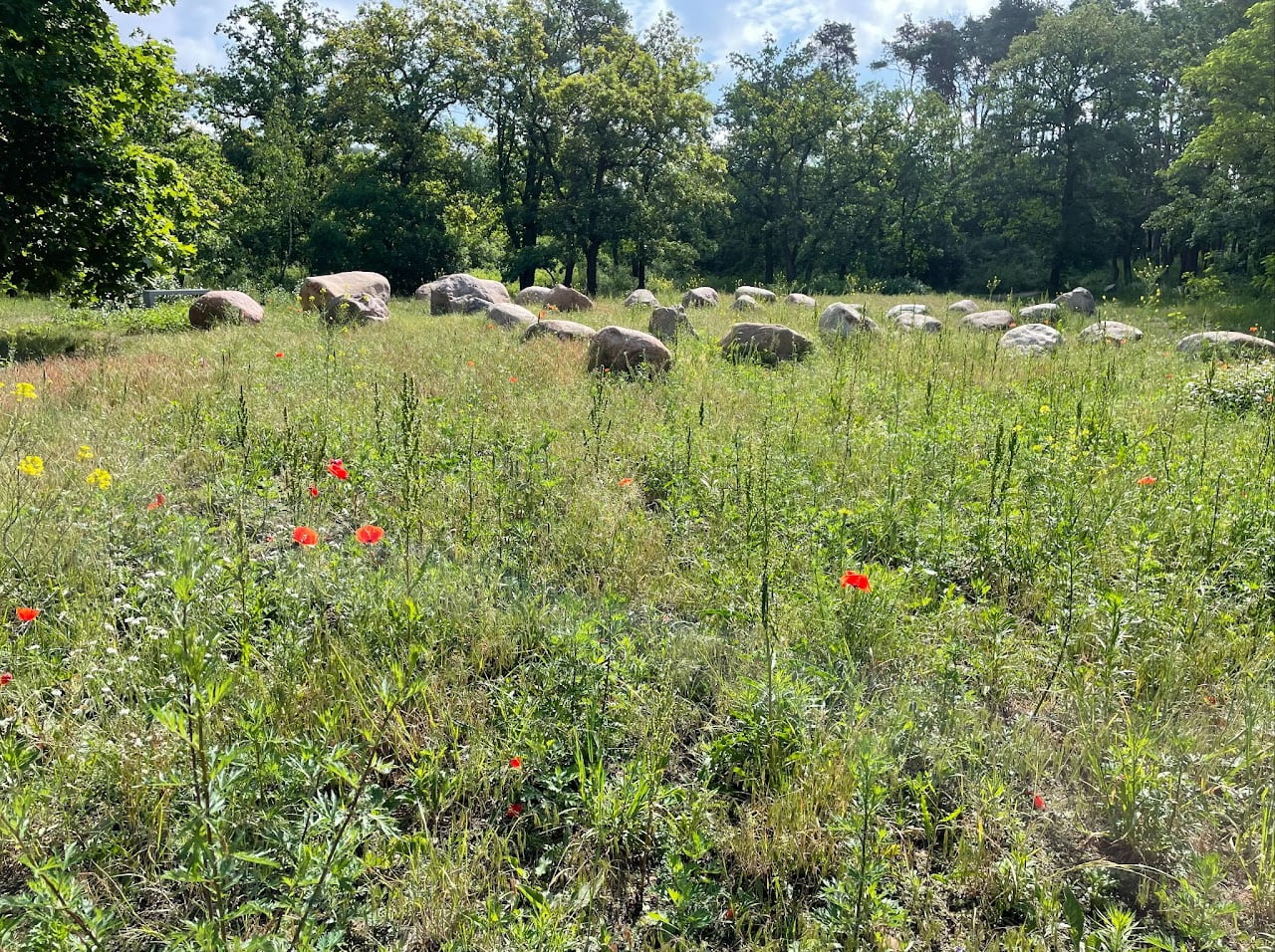
Dedicated with a ceremony last week, it is located at the site of the destroyed Jewish cemetery in Oborniki Wielkopolskie, near Poznan, and uses large, rough stones to form a Star of David in the center of the site, which is now a wild, grassy meadow.
One of the stones was cut in half, with inscriptions on the polished sides.
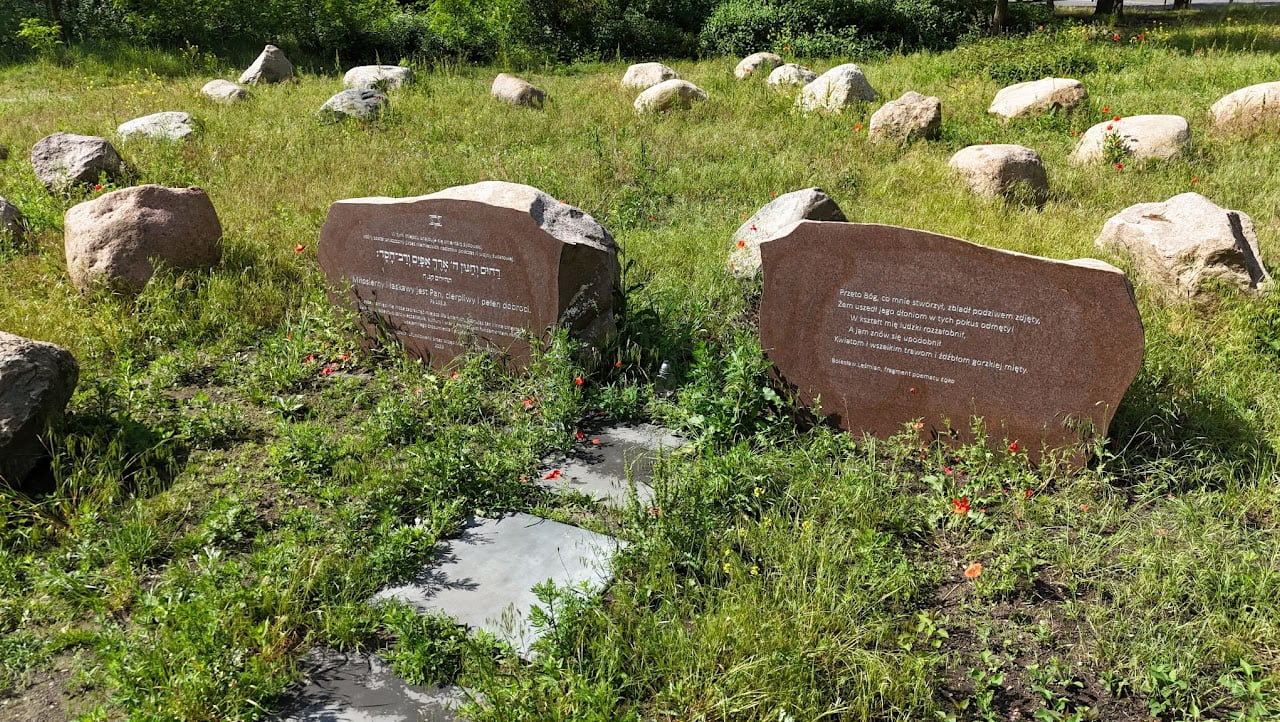
One commemorates the Jewish community destroyed by the Nazis during the Holocaust and bears a verse from Psalm 103 (in Hebrew and Polish) and a text reading, in Polish: “There must be a place in our memory for the dead. By respecting this and other cemeteries, we bear witness to humanity, culture, and faith. Memory is the foundation of love, mutual understanding and the future.”
The second half of the stone bears a fragment of the poem “Łąka” (Meadow) by the Polish Jewish poet Bolesław Leśmian. In the poem, Marciniak says, “the meadow is a tribute to eternal love. This love that ‘will break and conquer everything’ – even death.”
The monument was a project of the Oborniki Wielkopolskie municipality and carried out in cooperation with the Poznan Jewish community, and with the approval of Poland’s chief rabbi and the Commission for Jewish Cemeteries.
According to Virtual Shtetl, there was a Jewish presence in Oborniki already in the 15th or 16th century. Most Jews left Oborniki after the end of World War I, when the town became part of Poland (from Prussia); in 1921, 137 Jews lived there, constituting 3.3% of the population. “Before the outbreak of World War II,” Virtual Shtetl writes, “only 60 Jews remained there. All of them were resettled by the Germans to the General Government in 1939. In 1940, a forced labor camp was established in Oborniki, to which Jews were brought from all over the area.”
Marciniak, who is not Jewish and who is now a professor at the University of Arts in Poznan, has focused his art work on the Jewish heritage end memory in Poznan for many years.
“I tried to ensure that the commemoration of the cemetery combined the religious and secular dimensions in an understandable and aesthetic way and was the best testimony in terms of intention and form to the culture of remembrance of the deceased,” he said on a web site he created for the new memorial monument. He noted that the construction of the monument did not violate Jewish law regarding disturbing the ground in cemeteries.
‘In my opinion,” he added, “the most important and beautiful element of commemorating this cemetery is the respect of the inhabitants of Oborniki for this holy place for Jews and the understanding of the importance of remembering all the deceased. In a community that cares for this memory, independent of all differences, what is good in us is expressed. By remembering the dead, we also prolong our good memory and promote the culture of remembrance. Let us allow this place where the monument was placed to be a blooming meadow – a metaphor for the state of our memory of the dead and, at the same time, the love of life.”
In 2018, we posted about Marciniak’s commemorative installation called “Pavement of Memory” at the site of the destroyed Jewish cemetery in Poznan. The memorial places on a wall in a corner of the site 30 pieces of matzevot that were used as paving stones in the city’s streets for several decades, along with three commemorative plaques with text in Polish, Hebrew and English.
One of his early commemorative works, two decade ago, was called “Atlantis” — a performance and installation in 2004 inside the former synagogue in Poznan, which the Nazis had turned into a swimming pool — and which at the time was still being used as such: 600 burning memorial candles shaped into a huge Star of David were set floating on the surface of water, while 100 memorial candles lit the entrance leading to the interior and 200 torches with blue light were distributed to the audience.
See the website about the memorial created by Marciniak

2 comments on “Poland: A new Holocaust memorial by the artist Janusz Marciniak combines land art and commemoration.”
I visited this memorial yesterday. It is a somber experience. After over thirty years of life as a Canadian, i returned to Poland. It takes me now no more than ten minutes to drive from my home in nearby village called Dabrowka Lesna to reach this historic place.
Great emotion to see this monument