
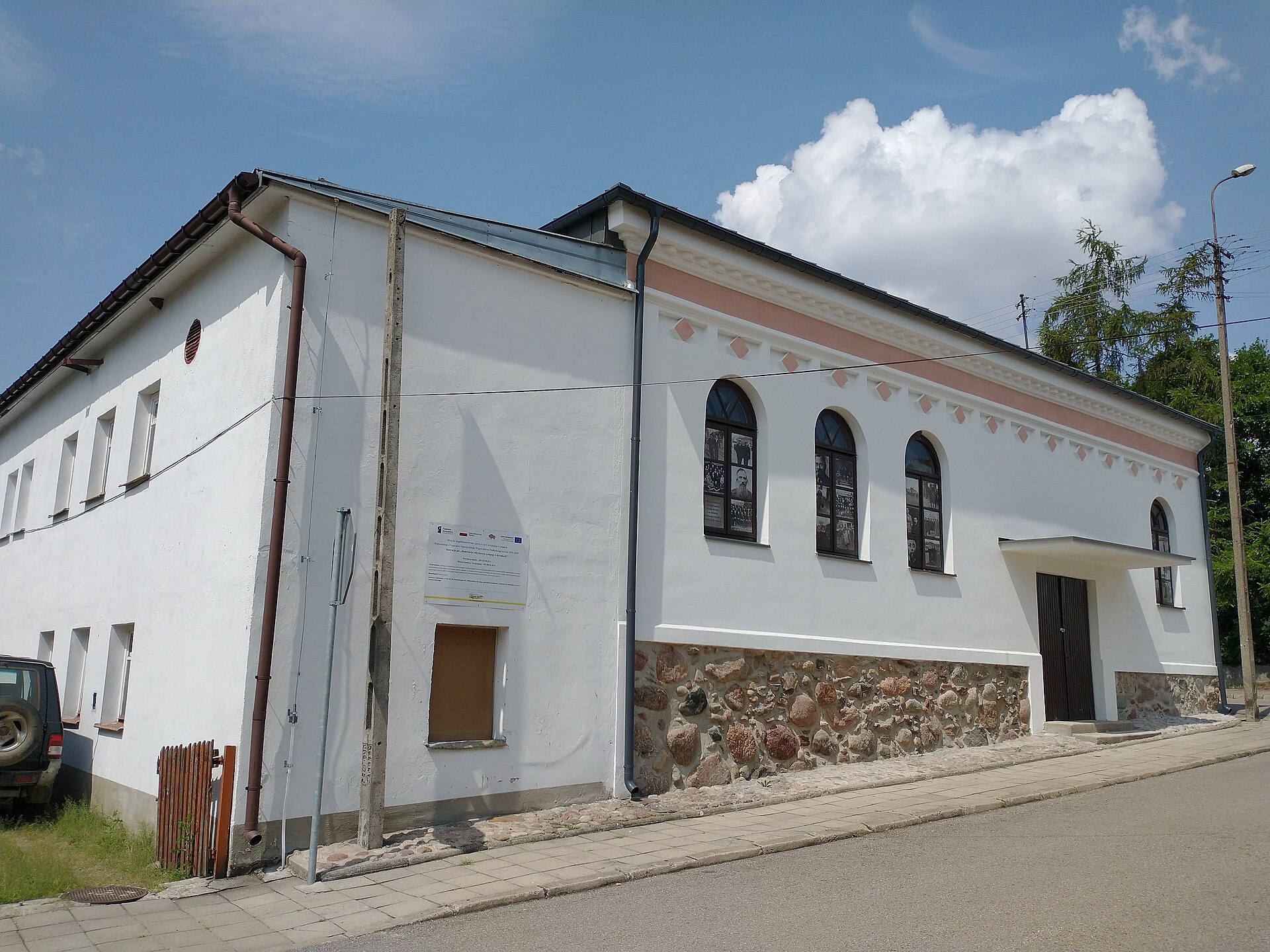
The recently completed renovation of the 19th century former Kaukaska Synagogue in the eastern Polish town of Krynki has been nominated for an architectural prize.
The synagogue, listed as a monument, dates from around 1850 — and owes its name to skins from the Caucasus imported by merchants for local tanneries. Its interior was radically altered in the 1960s when it was turned into a cinema; since the mid-1990s it has served as the Municipal Center for Culture and Sport.
Plans for the renovation had been announced in early 2020 — just ahead of the COVID-19 pandemic.
First the exterior was restored, and then interior work was carried out through 2025, completed in early 2026. During the interior renovation, fragments of the original synagogue window frames and elements of the original synagogue wall paintings were discovered and preserved.
According to isokolka.eu, the renovation has been nominated for the National Construction Competition “Modernization of the Year and Construction of the 21st Century,” a prize, now in its 30th edition, that rewards “the best modernization, renovation and new construction facilities in Poland.”

The aim of this year’s competition, the prize web site says, “is to select construction projects: modernization and new facilities completed until the first quarter of 2026, distinguished by special quality, functional, urban and aesthetic values.”
The competition promotes the functionality of modernized and rebuilt buildings and structures, the modernity of technology and design solutions, the use of new techniques, modern effective and safe equipment, high quality of construction and conservation works, ecological effects, and in the case of historic buildings, care for architecture and protection of cultural heritage.
Results of the competition will be announced later this year.
Krynki lies on today’s Polish border with Belarus, but before World War II was in the center of what was then Poland. Jews settled there in the 17th century, and Krynki grew to be an overwhelmingly Jewish town, the center of a thriving leather industry that was a hotbed of Jewish political activity and the site of one of the first Jewish labor unions in Russia.
The Kaukaska synagogue, with low eaves and a sloping roof, is one of three in the town for which traces remain.
The Great Synagogue, built in 1754, is a huge pile of rubble; nothing is left but its foundations. The synagogue of the Slonim Hasidim is a two-story structure in two-tone brick, long used as a warehouse.
There is also an extensive Jewish cemetery, established in the 17th century