
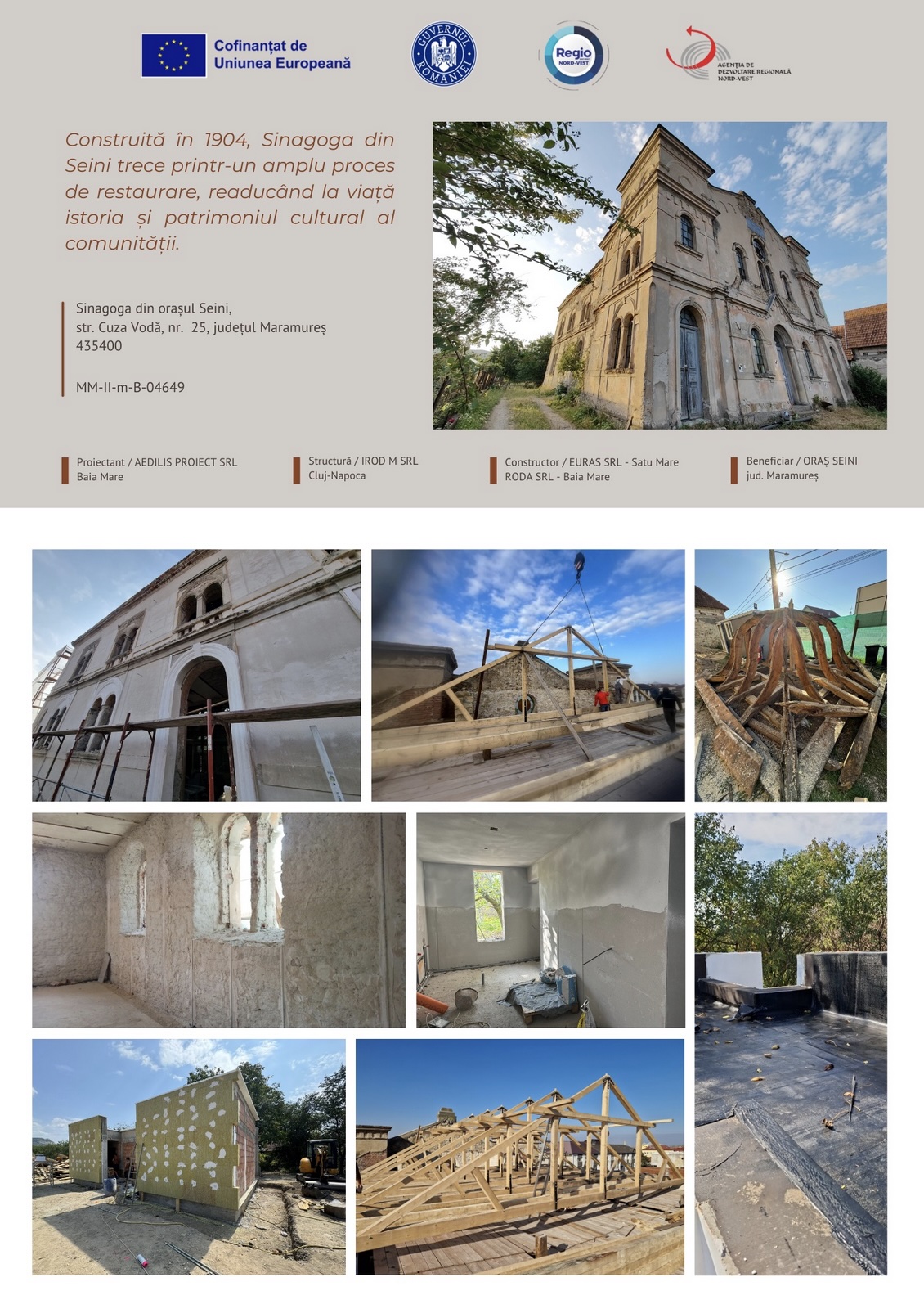
The restoration of the synagogue building in Seini, in northwest Romania, is proceeding. As we posted in 2023, the €2.4 million project will transform the long-disused building complex into a Museum of the Jews of Transylvania, concert hall, and cultural space.
A local TV report from early November shows much of the exterior work has been completed and also shows work going on inside. Early plans were for the work to be completed in 2025, but the latest estimate is May 2026.
“[T}he Synagogue of Seini is in an extensive restoration process, aimed at returning its former identity and architectural value, after a long period in which the building was left undervalued,” Mayor Gabriela Florica Tulbure said in a Facebook post on November 20. “The works are taking place both inside and outside, and together with the contractor, we have discussed and prepared the stages of the project completion.”
The town of Seini — located between Satu Mare and Baie Mare — obtained ownership of the dilapidated synagogue building in 2019, and already published plans for the project, including cost estimate, in April 2021. The project is mainly financed via EU funding, with also a grant from the state.
It said the goal is to bring back as much as possible, from an architectural standpoint, the condition of the synagogue as it was when built in 1904, but to install up-to-date tech and facilities such as modern lighting, a sound system, heating and air-conditioning, and other components.
The plans also call for the restoration of the synagogue’s annex, once the kosher butcher shop, into an administrative space that also would host storage, a cloakroom, restrooms, and the like. And the synagogue’s yard is to be restored as a small public park with paths, benches and a fountain.
A web site for the project posts updates on the restoration process, with the latest to date detailing the work carried out between April and September 2025.
According to 2mnews-ro, under communism in 1984 the FEDROM (Federation of Romanian Jewish Communities) sold the synagogue to a local cooperative which used it as a warehouse. The cooperative sold it to a private person in 1998, and the municipality purchased it in 2019 after this owner’s death.

The Jewish community in Seini dated from the late 18th century, and the town became a major centre of Jewish printing in the first half of the 20th century. Its Jewish population — around 615 people — was deported to Auschwitz in 1944; some survived and reestablished the community after the war, but virtually all eventually emigrated.
See our earlier posts HERE and HERE, with our pictures of the synagogue and Jewish cemetery from our visit in 2024 HERE.