

Structural restoration of the magnificent Great or Grain Merchants’ synagogue in Bacău, Romania, is nearing full completion. Only some exterior work, landscaping, and installation of a fire prevention remain.
If all goes well, the local Jewish community hopes that all will be ready in late November when the synagogue will host this year’s “Bereshit” –Romania’s annual national get-together that draws hundreds of Jews from around the country.

On her recent visit to the synagogue, JHE’s Ruth Ellen Gruber was informed by Jewish community President Hainrich Brif that the work to date has entailed repair of the exterior of the building and the roof, as well as the flooring and the heating and electricity systems.
The approximately €800,000 cost of these repairs was covered mainly by the state, with contributions from the Federation of Jewish Communities (FEDROM), the city, and the Caritatea Foundation, a partnership of the World Jewish Restitution Organization (WJRO) and FEDROM.

The Jewish community is still seeking a further approximately €160,000 to complete the work on the yard and fire prevention system.
The synagogue is the only one of the city’s pre-war 22 synagogues to survive — the others fell victim to communist dictator Nicolae Ceausescu’s “systemization” scheme that razed much of the city’s original architecture. One of the few surviving historic buildings in the city, it is surrounded by the apartment blocks and other buildings put up under Ceausescu.
Dating from around 1900, the synagogue was extensively rebuilt after a fire in the 1920s. It is noted especially for the extraordinary paintings that decorate the walls and dome created in 1926-27.by the artist Avram Mendel Grünberg (or Grinberg), from Iasi, who died a year later.
Listed as a historic monument, the synagogue is still used on special occasions by the small local Jewish community, which ordinarily uses a prayer room in a nondescript building that also houses a small permanent exhibit about local Jewish history and heritage.
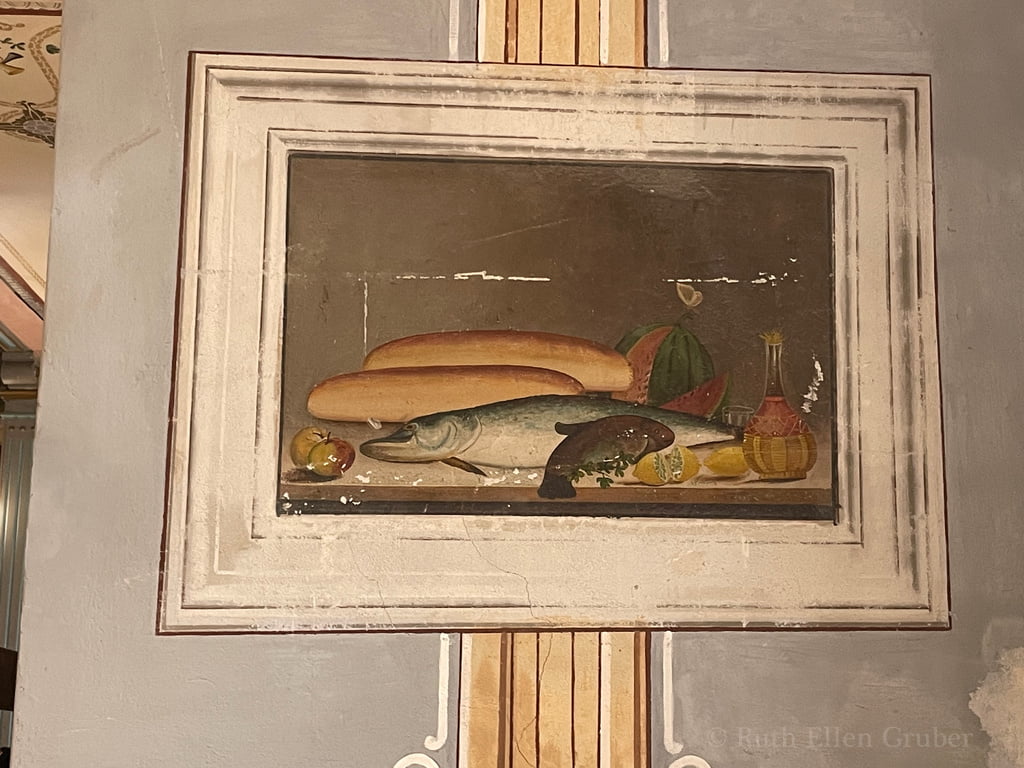
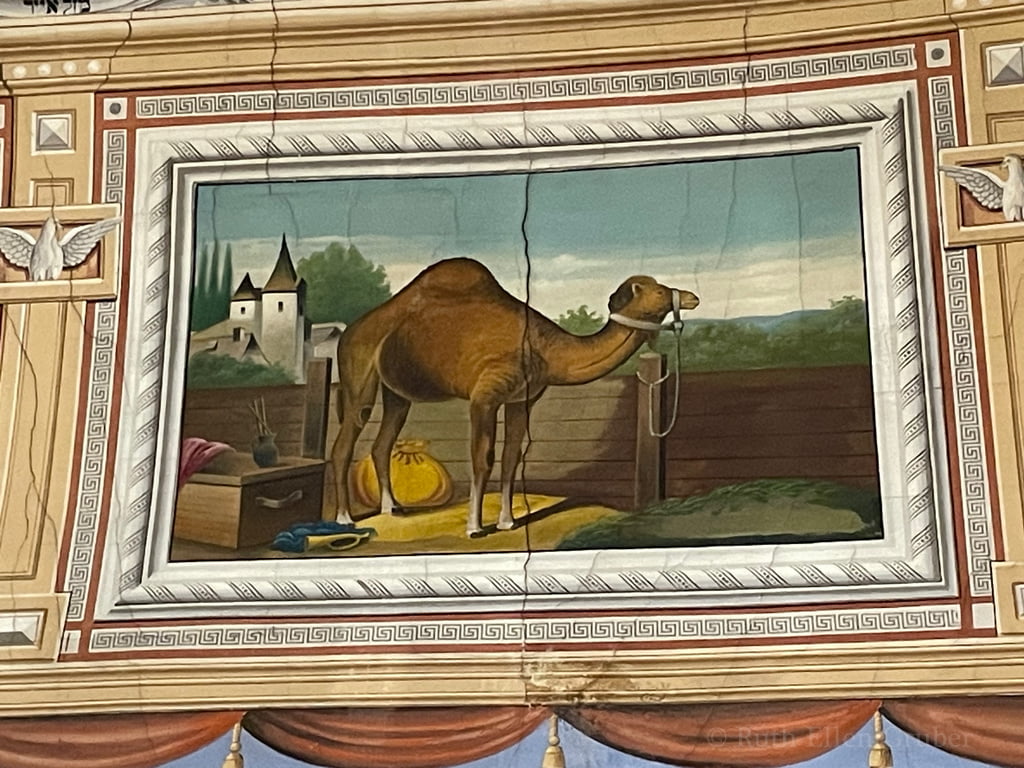
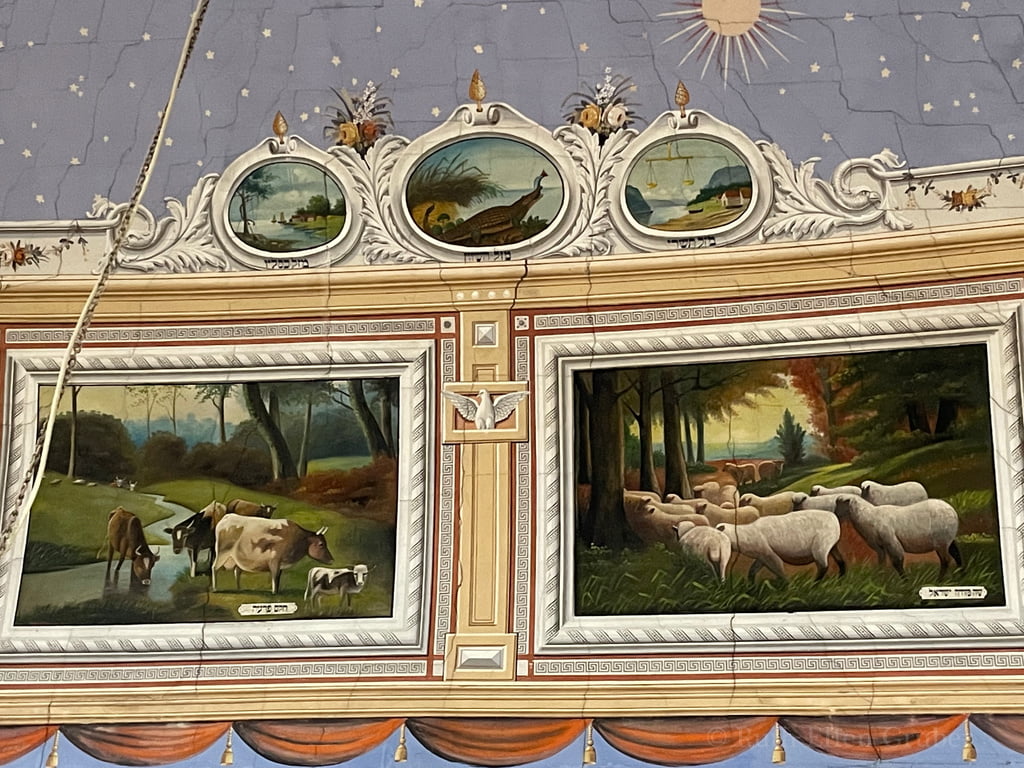
Brif said there are currently no plans to carry out fullscale restoration work on Grünberg’s paintings that cover the walls and inner dome of the Grain Merchants Synagogue with vivid portrayals of biblical scenes, representations of Zodiac signs, animals including lions, sheep, cows, deer, antelopes, camels, crocodiles, images of places in the Holy Land, and also plant and geometric motifs.
Most appear to be in good condition, though paint can be seen flaking on some of the pictures.
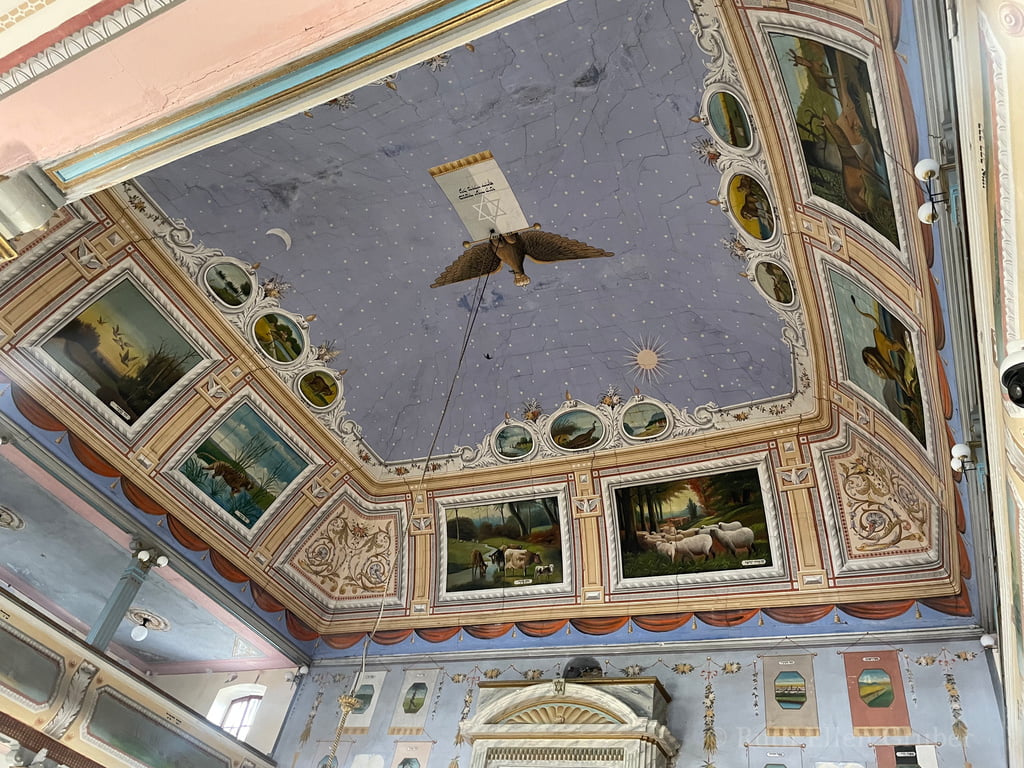
Among the paintings around the base of the dome is one that includes the extremely rare depiction of a human figure in synagogue decoration.
It shows a child surrounded by animals — a lion, sheep, a cow, and apparently a leopard — all arrayed peacefully together. The child, dressed in a robe, carries a palm frond. Below is an inscription in Yiddish, reading משיחס צייטען “messianic times”.

According to the Center for Jewish Art, the scene is a visual representation of Isaiah’s prophecy: “The wolf also shall dwell with the lamb, and the leopard shall lie down with the kid; and the calf and the young lion and the fatling together; and a little child shall lead them” (Isaiah 11, 6) and was modeled on a early 20th century postcard that was “equally popular among Jews and Christians.”
The scholar Ilia Rodov, of Bar Ilan University, has written that Grünberg decorated dozens of synagogues in the region — few of which have survived.
He discussed Grünberg’s work in an article titled “With Eyes towards Zion”: Visions of the Holy Land in Romanian Synagogues.
“In early-20th century synagogue paintings, the depictions of musical instruments which the Jews in the Babylonian abstained from playing as a gesture of their mourning for Zion, became a common complement to the images of Jerusalem. In Moldavia, the concept of the Babylonian exile and redemption in the Holy Land was spectacularly implemented by Mendel Grinberg of Iaşi,” he wrote.
On the northern wall in the Grain Merchants’ Synagogue in Bacău, he painted the instruments on trees against a sunset and inscribed the panel in Hebrew “Upon the willows in the midst thereof we hanged up our harps” (Psalms 137:2). On the southern side of the hall, he depicted the Dome of the Rock in Jerusalem and captioned it, “The Holies [sic!] of Holies with the Foundation Stone”.

The two large facing paintings are prominently distinguished among the numerous murals in the prayer hall: the views of Babylonia and the Holy Land appear in the center of a wall and are framed by naturalistically painted theatrical red curtains. This scenery on either side of the synagogue worshippers might evoke in them a sense of existence in transition from the past and present exile to future redemption, from routine to miracle, and from profane to holy.

The emphasis placed on this pair of paintings in the synagogue interior is reinforced by the artist’s signature in the top of each of them. Above the local paysage standing for the “rivers of Babylon” Mendel Grinberg advertizes himself in Romanian as a pictor decorator and provides the address of his workshop in Iaşi. He uncustomarily spells his family name “Grünberg” (with the u-umlaut as the first vowel), perhaps purporting his reputation as a master of a prestigious foreign, German or Austro-Hungarian mode of decorative painting.In contrast, the text in Hebrew and Yiddish above the vista of Jerusalem is the dedication of a Jew who devotes his skills to glorifying the place of Godly worship.Now the artist omits his family name, but expands his given name to its full form that is used mainly on ritual and commemorative occasions.
Although loosely observing religious laws in his everyday life, when painting in a synagogue he introduced himself by a quotation in Hebrew from Isaiah’s prophesy, “the work of my hands, wherein I glory” that implies his association with God’s righteous people, who “shall inherit the [Holy] Land for ever” (60:21). The difference between the Romanian and Jewish versions testifies to the duality of Grinberg’s self-identity, European and Jewish, and to his dual attitude to art as both livelihood and mission. Thus the artist’s signatures personalized the message of the images they embellish.
Here are some more images of the synagogue wall and ceiling murals:


2 comments on “Romania: Structural restoration of the Great or Grain Merchants’ synagogue in Bacău, Romania, is nearing full completion. The interior paintings are magnificent!”
Thanks for that special article. I am adding it to our Virtual Museum about the Romanian Jews în general and also specifically from Lecca of Bacău. Again credit to you for that important article.
יוסף אבני
ישראל
Just an outstanding article … and many thanks for the photos of these remarkable paintings. The small advertising blocks on the top of 2 panel are just perfect — it’s great that we know the artist. I look forward to reading more about Grünberg. I wish I could help with the restoration and be there for the BREISHIT ceremony.
I am always hoping that some vestige of the shul in Stanesti de jos — my grandfather’s Bukovina birthplace has survived. All I have is a crude line drawing from the Yahrzeit book dedicated to the Jews of Unter Stanesti.