

Archaeologists excavating at the site of the ancient Greek city of Phanagoria, on Russia’s northern Black Sea coast, have discovered what they believe are the remains of an synagogue from the late Second Temple period that functioned from the first century CE until Phanagoria was sacked and burned by invaders five centuries later.
The discovery was announced Tuesday by the Institute of Archaeology of the Russian Academy of Sciences and Oleg Deripaska’s Volnoe Delo Foundation, which has funded the research.
They said the remains of what had been a richly decorated building represented the oldest synagogue discovered in Russia and one of the oldest known globally.
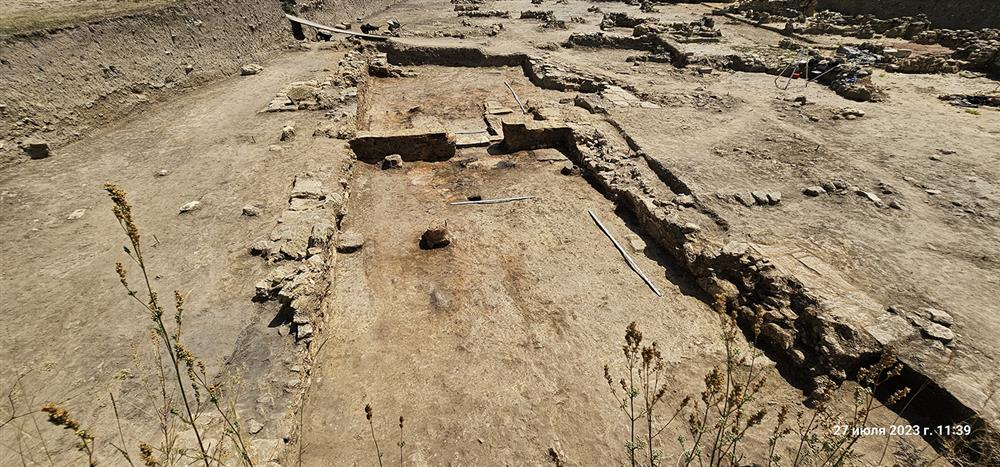
The synagogue had been a complex of two rooms, each with an area of more than 60 square meters, that occupied a rectangular building that the Volnoe Delo Foundation said was 21 meters long and six meters wide.

Its walls were covered by painted plaster and marble tiles, and
Inside there were marble columns with beautiful capitals, as well as a place fenced with bars for an ark with Torah scrolls and a place equipped for reading the Scriptures.
Finds included at least three richly decorated marble menorahs as well as other artefacts, including several marble tables apparently for ritual use. In addition there were several inscriptions in Greek, one of which mentioned the word “synagogue.”
Phanagoria was a major city in ancient times, and excavations have been going on there for decades.
Archaeologists had long found evidence, including gravestones marked with menorahs, that a Jewish community had existed there at least from the first century CE.
The synagogue had apparently functioned until it was almost completely destroyed by fire when Phanagoria as a whole was burned and plundered by invading tribes in the middle of the 6th century. The excavations showed that most of the rest of the buildings in the city also had been destroyed by fire.
Read the Institute of Archaeology announcement
Read the Volnoe Delo Foundation announcement