
This week marks the 83rd anniversary of the so-called Kristallnacht pogrom — Reichspogromnacht — the night of November 9-10, 1938, when the Nazis launched coordinated violent attacks on Jews, Jewish property, and Jewish places of worship all over Germany and German-occupied territory; more than 1,000 synagogues were torched.
Many commemorative events will be taking place.
We highlight here three events on November 9 that have a somewhat broader focus.
SIEGEN, GERMANY: VIRTUAL RECONSTRUCTION OF THE SYNAGOGUE IN SIEGEN

The German multimedia artist Gabriela von Seltmann and her international team will virtually resurrect the synagogue in Siegen, 130 km north of Frankfurt, with an animated video and sound installation on the outer wall of the Hochbunker (Aktives Museum Südwestfalen), which occupies the site of the domed synagogue — built in 1904 and torched and destroyed on Kristallanacht.
The event, presented by the Siegerland Society for Christian-Jewish Cooperation, will be shown on livestream, between 17:00 and 21:30 CET. Click HERE to access the feed on the project’s web site.
Based on historical photographs from the collection of the Siegerländer Heimat- und Geschichtsverein (the Siegerland society of local history) and the Aktives Museum Südwestfalen (Active Museum of South Westphalia), the two- and three-dimensional video animation pieces together the ruins of the Siegen synagogue.
At the end of the installation, the building will reappear as it was from 1904 to 1938 before its destruction, projected onto the wall of the elevated bunker built on the synagogue site in 1941. The images are accompanied by historical and modern recordings of synagogal chants.
Watch a trailer for the installation:
The Siegen project follows on from von Seltmann’s multimedia virtual reconstruction of the Great Synagogue of Warsaw. The Great Synagogue was built in 1878 and demolished in the Warsaw Ghetto by the SS on May 16, 1943.
During the November 9 event, the Siegen Synagogue projection will alternate on the wall of the Hochbunker with the video installation for the Great Synagogue Warsaw.
Access the project’s web site for further details
DOBOJ, BOSNIA-HERZEGOVINA: “BROTHERHOOD AND JUDAISM,” OPENING OF AN EXHIBITION ON HOLOCAUST MEMORIALS IN B-H
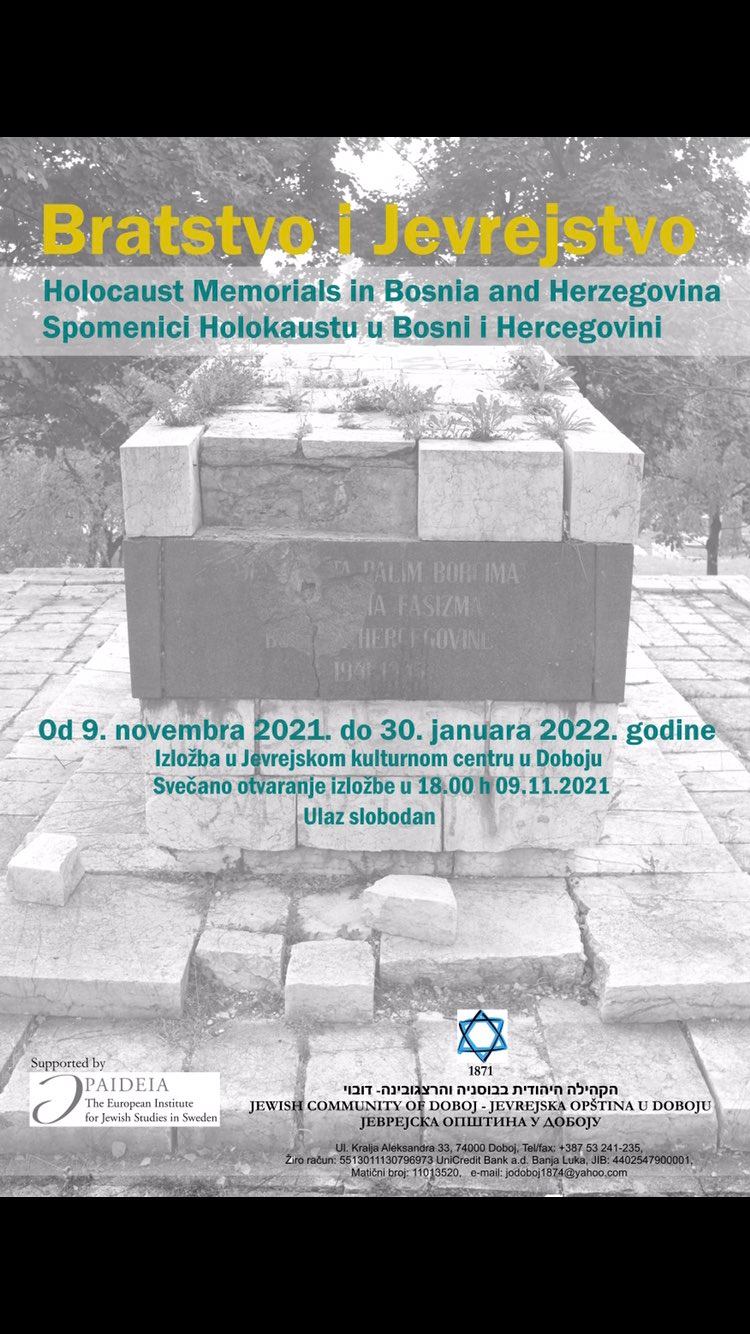 An exhibit on Holocaust memorials in Bosnia-Herzegovina opens on November 9 at the Jewish Cultural Center in Doboj. The exhibit runs until January 30, 2022.
The exhibit is based on thesis research by Michael Ilg, who knows of more than 20Holocaust memorials in BiH. It was curated by Ilg and Katja Grosse-Sommer and it was supported by Paideia – The Institute for Jewish Studies in Sweden.
The exhibit consist of seven roll-up panels with English and Bosnian text, accompanied by historical images that document the development of Holocaust commemoration in Bosnia. Present-day photos taken by Michael Ilg illustrate the state of the Holocaust memorials as they can be found today. The exhibit also includes a map with the known locations of memorials to the Holocaust in Bosnia.
The first memorial in today’s BiH was the memorial on the Jewish cemetery of Sarajevo, opened in 1952 by the Federation of Jewish Communities in Yugoslavia, which reflected the socialist practice of naming victims of fascism, but designated them as Jewish fallen fighters of national liberation. Its location on a Jewish cemetery and integration of Jewish symbols further emphasized the Jewish identity of the victims.
The exhibit traces larger narratives and developments in commemoration in post WW2 communist Yugoslavia, but also after the death in 1980 of postwar leader Marshal Josip Brok Tito.
It also explores Holocaust commemoration after the violent breakup of Yugoslavia in the early 1990s, in which remembering the atrocities during the Bosnian War have become linked with World War II. Examples such as commemoration in the city of Brčko, which over time had six memorials, four of which are still standing today, illustrate the changes in Holocaust memorialization.
BRATISLAVA, SLOVAKIA: ANNUAL CONFERENCE ON JEWISH CULTURAL HERITAGE IN SLOVAKIA
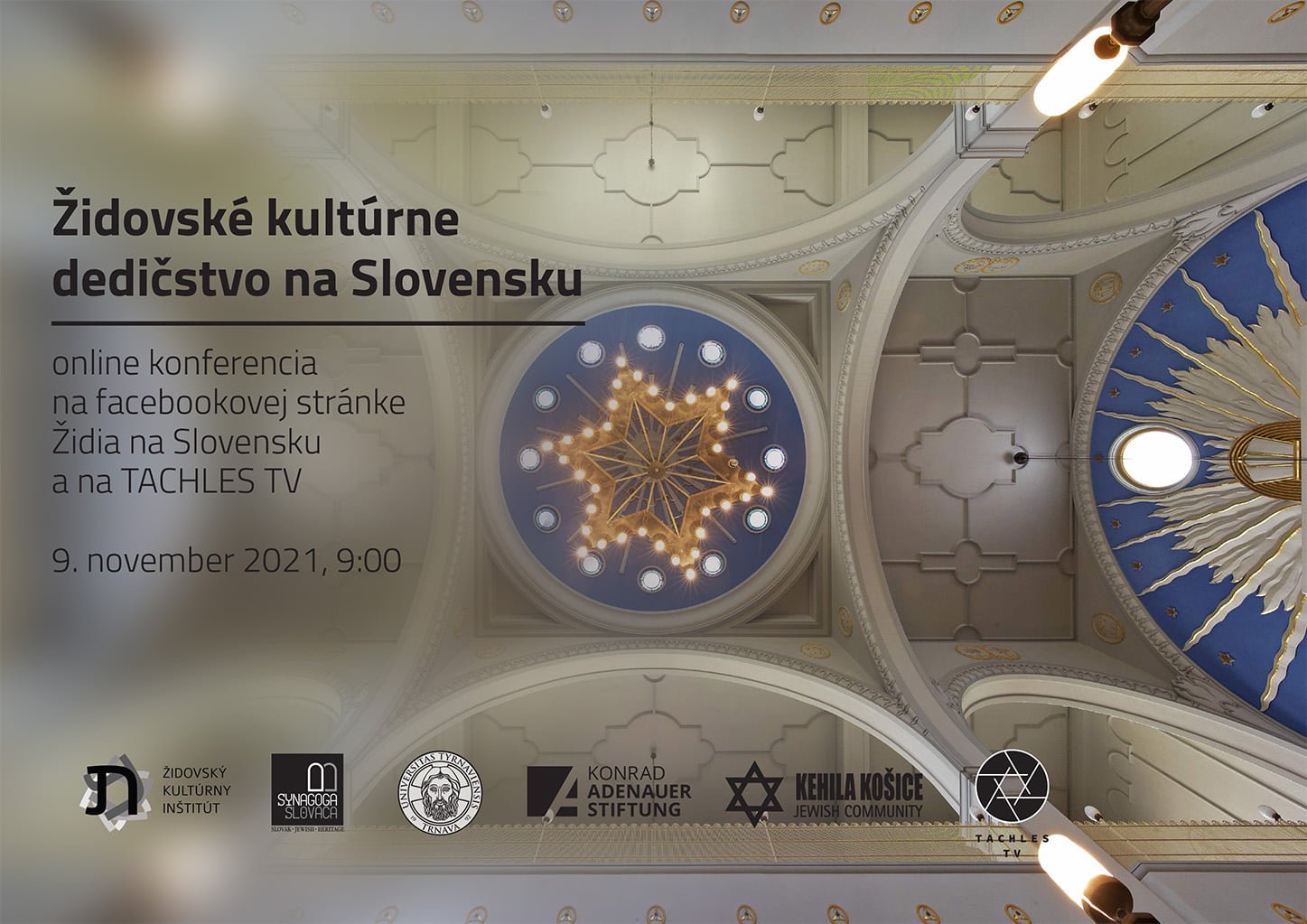 Organized by the Union of Jewish Communities in Slovakia, the conference has the aim is of facilitating exchange of information about planned and already-implemented projects to preserve and restore Jewish heritage in the country.
Participants include representatives of public and Jewish community institutions as well as civic activists and professionals working in the field of heritage preservation in Slovakia.
As part of observances it awards the Eugen Bárkány Prize for activities of great significance in the preservation of Jewish heritage in Slovakia.
Eugen Bárkány, for whom the award is named, founded the Slovak Jewish Museum in Prešov in 1928 and settled in Bratislava in 1955. There he worked as the custodian of the Judaica collection in the Jewish community and planned the establishment of a Jewish museum in the Rybné Square synagogue — the twin-towered Neolog synagogue that was demolished in 1969 to make way for a new bridge over the Danube River.
The Judaica collection is now preserved in the Jewish Community Museum, which opened in 2012.
For the second year, because of the pandemic, the conference will be held online, from 9 a.m. til noon CET — It can be viewed on the Zidia na Slovensku Facebook page
Program:
