

(JHE) — Heartfelt wishes from JHE for a joyous and meaningful Pesach (with Seders — virtual or not — full of delicious food and lively stories and conversation).
Passover celebrates freedom, but for many if not most, this year will be another Seder under pandemic restrictions.
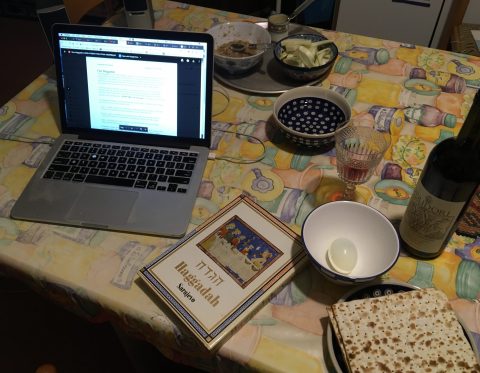
Last year, we posted a series of links to “virtually Pesach” resources that can help you enjoy — and learn about — the holiday.
They focused mainly on Haggadot — including a video enabling you to follow the seder page by page in a medieval Haggadah from Catalonia.
Click here to find our list of virtually Pesach resources
Throughout the Passover week, we eat matzo — and at the Seder we are enjoined to drink four cups of wine and dip herbs in salt water.
Many of our Seder menus also include fish: in particular gefilte fish in Ashkenazi homes.
In honor of these traditions, we post here some images of Seder table installations, matzo-baking facilities, and also images of fish, grapes (for wine, of course….) and herbs (or at least vegetation) found in Jewish built heritage.
Hag Sameach!
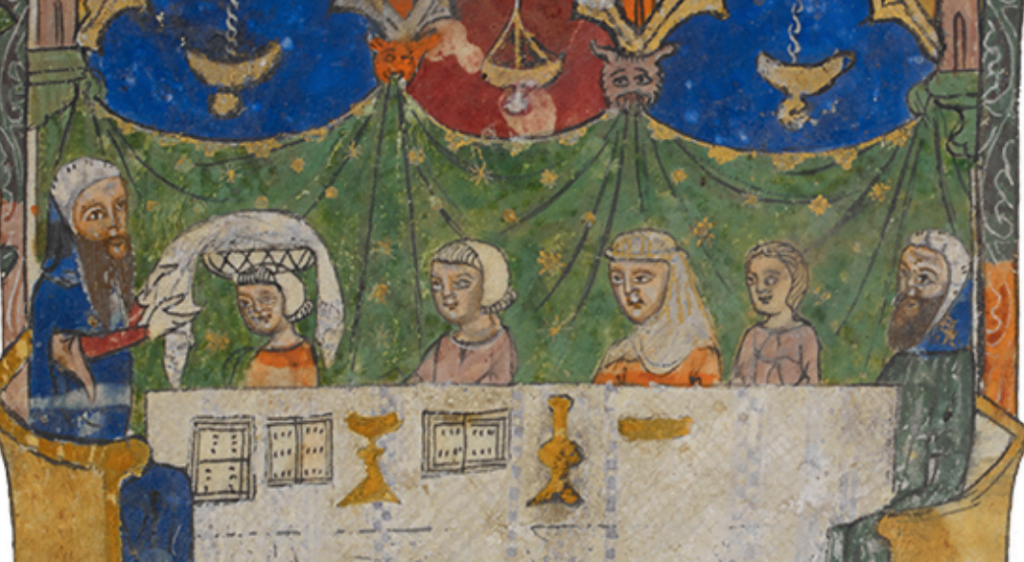


This is a display in the Jewish museum in Pitigliano, a picturesque hill town in southern Tuscany. The museum encompasses the synagogue, dating from 1599 and rebuilt in the 1990s, as well as other parts of the former Jewish quarter, some of them — like the matzo oven shown below — that are underground chambers carved into the rust-colored tufa rock on which the town is built.

Pitigliano was known as a “little Jerusalem” because of its once-flourishing Jewish community. In her landmark 1981 book The Classic Cuisine of the Italian Jews, Edda Servi Machlin — a native of Pitigliano — describes in vivid terms how matzo was baked in the oven, which was opened just once a year, for Passover.

Here’s another matzo baking facility, in the basement of the centuries-old synagogue in Carpentras, France:

In addition to eating matzo, we also dip herbs into salt water — here’s some synagogue decoration that remind us of herbs…

We also drink wine at the Seder — four glasses.
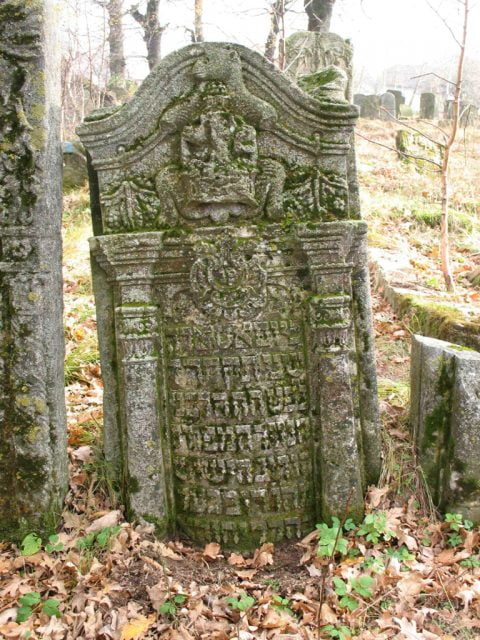
In retelling the story of the Exodus, we recall how Moses led the Jews from Egypt. About a year or so afterward, Moses sent out 12 scouts to explore the land of Canaan. Two of them came back carrying an apparently huge bunch of grapes. As the King James version put it: “And they came unto the brook of Eshcol, and cut down from thence a branch with one cluster of grapes, and they bare it between two upon a staff; and they brought of the pomegranates, and of the figs.” (Numbers 13:23)

Unfortunately, all but two of the scouts — Joshua and Caleb — gave a negative report that frightened the Israelites and persuaded them not to go forward and take the land.
The Lord punished them by making the entire people wander in the wilderness for 40 years, until almost the entire generation of skeptics had died. Joshua and Caleb were the very few of that generation allowed to enter the Promised Land.
Dov Ber Birkenthal, a wine merchant and Jewish community leader in Bolechow (today Bolekhiv, Ukraine), lived from 1723 to 1805 and was also known simply as Ber of Bolechow.
Ber made frequent, and sometime harrowing, wine-purchasing journeys from his native Galicia to the Tokaj wine-producing region of northern Hungary — and not long before his death he published a memoir recounting his trials and adventures.
He described how he sought out and drove hard bargains on wine, and he detailed the perils of the road — everything from complicated currency exchanges and customs duties, to drunken wagon drivers, icy, unfordable rivers, double-dealing business partners, flea-ridden inns, and even occasional attacks by roving bandits.

At the end of the Seder, we say — “New Year in Jerusalem!” The image of Jerusalem (and particularly the western wall) figures in the decoration of synagogues.
Below is a version — recently restored — in a private synagogue in Bedzin, Poland.

Click here to see our list of “Virtually Pesach” resources and videos