

(JHE) — Plans seem to be moving forward to unearth the ruins of a major 15th century synagogue in Budapest’s castle district that were discovered in 1964 but have lain buried under sand and concrete after preliminary archaeological work more than half a century ago.
On Monday, workers from Budapest’s 1st District pulled up the concrete slabs that covered the ruins of the Buda Great Synagogue, finding underneath great amount of sand filling the space of the buried sanctuary. According to the Hungarian news agency MTI, the goal was to assess the condition of the surviving columns and walls, but this was not possible due to the sand.

“A lot of extensive digging is needed as the floor of the synagogue is some 4 meters down,” Andras Mayer, an activist from the “Let’s Dig It Out!” movement told JHE. Linking various associations and NGOs, “Let’s Dig it Out!” has been a major advocate in recent years for the excavation and reconstruction of synagogue.
“For this, they will need a permission from another [administrative] office,” Mayer added. “The actual removal of the sand is probably only going to begin in the spring. What’s a few months after 334 years?”
The Great Synagogue was built in 1461 by Jakab Mendel, representative of the Jews of Buda, during the reign of Matthias Corvinus. Built in gothic style, the synagogue was used in its original form until 1526 and was partially restored in 1541 after it was damaged during the Siege of Buda, after which the Ottomans established control over central Hungary for around 150 years.
Architectural historian Samuel D. Gruber describes the synagogue, in his blog:
The synagogue interior originally measured 19 x 9 m., and after 1541 it was extended to 26.5 x 10.7 m., twice as long as the Altneushul in Prague. The synagogue is believed to have three supporting piers set on its longitudinal axis, dividing the interior into two equal naves. As in Prague, the piers were octagonal and supported Gothic rib vaults, thus creating a space of either six or eight bays. The women’s area adjoined the men’s on the south and was connected to it by windows. On the same side a large entrance arch opened into the men’s section.
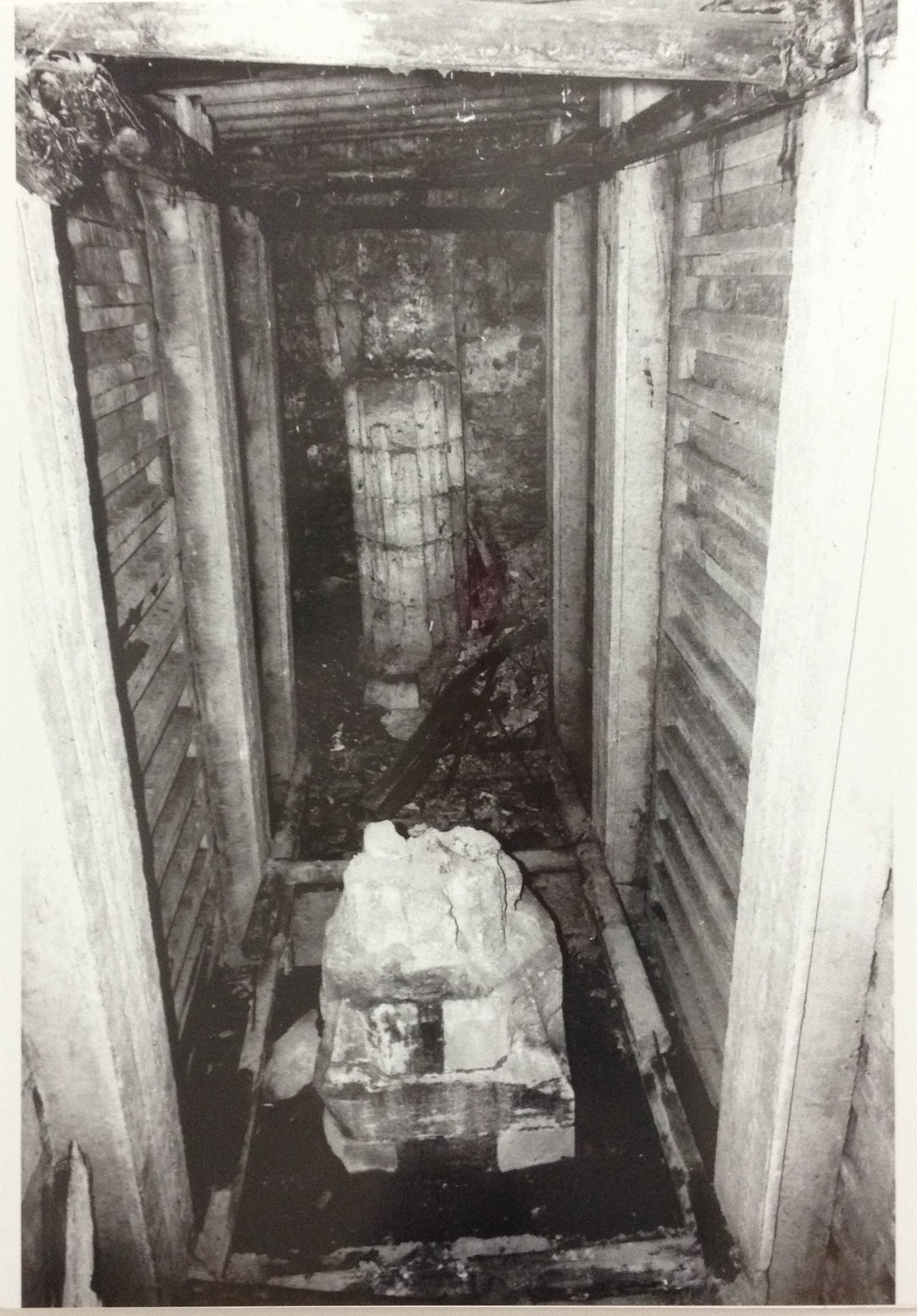
The Great Synagogue was burnt down on September 2, 1686, during the Hapsburg reconquest of Buda. It was discovered by chance in 1964 by Hungarian archaeologist László Zolnay and his team, who were working on the renovation of the nearby castle. The excavations revealed evidence of the siege, including several skeletons of Jews who apparently had sought refuge inside the synagogue. Zolnay hoped to fully excavate the site (and apparently had obtained pledges of funding from American sources), but the communist regime at the time refused this option. As a consequence, the year after it was discovered, the ruins were professionally reburied under sand and concrete slabs.
Today, the synagogue is owned by Budapest’s 1st district, which owns the building and garden at Táncsics street 21-23, under which it lies. The Budapest History Museum, housed in the nearby Buda Castle, will be in charge of the new excavation works, under the supervision of the architect Szabolcs Bánszky, who has already prepared a preliminary study for the synagogue’s restoration.
MTI quoted Péter Kirschner, the president of MAZSIKE, the Hungarian Jewish Cultural Association, said the long-term goal, beyond the preservation and excavation works, is to open the synagogue to visitors.
MAZSIKE plays an active role in “Let’s Dig it Out,” one of several Jewish and civic movements that since the fall of the communist regime three decades ago have called for the restoration of the synagogue. These included long-time efforts by Aurel Budai, a colleague of Zolnay, who wrote extensively about the building before his death in 2012. Until now, however, there have been no concrete results, in part, Mayer said, because of opposition to excavation plans by the previous 1st District local government.
A conference about the synagogue and possible plans for it, with an exhibition of some of the material found in the 1960s, was held in Budapest in 2015.

In September 2016 “Let’s Dig It Out!” placed a plaque on the external wall of the property behind which the synagogue is buried. The movement led a memorial tour of the site on September 2, 2016, the 330th anniversary of the synagogue’s destruction in 1686.
Watch a video of the tour, with descriptions of the synagogue’s history (there are English subtitles).
The buried Great Synagogue is one of the two 15th century synagogues in the Castle district. The other, excavated and restored in the mid-1960s, is a tiny prayer house within an apartment building at number 26 Táncsics st. This synagogue, which features some 17th century frescoes, is open to the public (from May to October) as part of the Castle Museum, and displays some medieval Jewish gravestones. It also hosts religious services, as in 2018, it was rededicated as a synagogue run by the EMIH, the Unified Hungarian Jewish Congregation – Chabad.
1 comment on “Hungary: Preliminary work takes place toward the excavation of the buried medieval Great Synagogue in Budapest’s Castle District”
Any news on this project since last fall? Did work continue during the pandemic? Has anymore of the Great synagogue been uncovered?