

For eight years, the photographer and writer Jason Francisco has been been photographing and writing about the complications of the site of the Płaszów Nazi labor/concentration camp in Kraków.
In a new text-and-photo essay on his web site, his discusses recent changes at the site — in particular new signage. Recently, he notes, the Krakow Historical Museum, in collaboration with the City of Kraków and with the consent of the Jewish community, announced it “was undertaking a large-scale commemorative project for Płaszów. The project would include a series of ‘stations’ installed at the site, containing historical information and narrative accounts of the camp’s inmates, along with demarcation of archaeological relics. An accompanying exhibition would be mounted […] including items found in an archaeological dig conducted during the spring and summer of 2017.”
Francisco calls the essay “Clear and Not Clear Enough” — it’s a discussion both of the new steps being taken to commemorate, educate, and restore the site and memory of the site to the landscape and remembered history of the city, and also of the ambiguities in doing so.
Płaszów is the city’s most important Holocaust site, but its status as a memorial site remains highly ambivalent. Several markers and monuments to the site’s genocidal history have been erected, but efforts at thoroughgoing and encompassing memorialization have repeatedly failed. The result is a space that is both a known territory of genocide and a de-facto public park, popular among dog-walkers and hikers, and in the warm months among sunbathers, picknickers and drinkers.

Here are some excerpts from his essay, discussing in particular new memorial signage — 19 large signboards, installed at various locations around Płaszów in November 2017, as a “temporary” step toward the realization of the planned memorial complex:
Given the situation that has prevailed at Płaszów, the sheer fact of these new signboards represents an improvement. Just seeing them from a distance, I felt a palpable sense of victory––that after 70 years of neglect and avoidance, at least now there is rudimentary in-situ historical information placed there. However, that sense of victory was tested by the contents of the signboards themselves […]
The boards are design collages comprised of three main elements: a large historical photograph filling the frame, over which float two sets of text––an excerpt from a first-person narrative of a Płaszów inmate or survivor, and information written in the impersonal voice of the Museum authority. Both types of text are presented in Polish and English, and in general the contents of the boards pertain to the particular location in the former camp.
The use of historical photographs is to me a good decision, except that the black and white images are presented in an altered form, with selected figures colored gold––sometimes prisoners, sometimes guards. I do not understand this manipulation, either aesthetically or museologically. It looks to me like an effort to animate or vivify––unfortunately using a hallmark technique of amateurish digital art––photographs that the Museum’s curators fear would otherwise be seen as heavy and dispiriting, if not overlooked altogether. In my view, the heart of the challenge at Płaszów is changing the perception of the site among locals, whose behavior attests to an incomprehension of the site’s genocidal history––and functionally a denial of it. If so, the transformation of historical photographs into historical illustrations based on photographs is a step in the wrong direction. In attempting to teach history visually, the manipulation instead has the effect of casting that history into the realm of the semi-fantastical, reinforcing the semi-recognition that prevails among local attitudes. Or to ask differently: would the same technique of digital manipulation be necessary or appropriate at Auschwitz-Birkenau, where historical photographs made in the camp have likewise been installed? If not, why not?
Beyond this, I notice important problems with the signboards, in the texts written by the Museum authority.
He addresses several instances where he finds the text “clear and not clear enough.” Among them, the main informational signboard. (Click HERE to read his analysis of the other signage.)
The English text on the board begins as follows:
The German Nazi concentration camp Plaszow, established in October 1942 on the grounds of Jewish cemeteries. Initially, it was a forced labor camp (Zwangsarbeitslager) and was intended for approx. 4000 inmates––Jews from the Krakow ghetto liquidated in March 1943. In the years 1943-1944, the Jews from liquidated ghettos in Bochnia, Tarnów, Wieliczka, Rzeszów, Przemyśl and a camp in Szebnie were put in Płaszów.
In July 1943, the Germans established a labour education camp for Poles within the territory of KL Plaszow. The inhabitants of Krakow and victims of punitive military actions in towns and villages of the Krakow region were kept here.
This text is clear and not clear enough. It is not just that the camp was intended for Jews from the Kraków ghetto. The violent liquidation of the ghetto on 13-14 March 1943 alone sent thousands of Jews to the camp, about 8,000 according to the Polish historian Ryszard Kotarba. Indeed, Kotarba notes, “[t]he Płaszów camp was an ‘extension’ of the Krakow ghetto.” Companies operating in the ghetto were moved to the camp, as were the power structures and social hierarchy, all of which “distinguished Płaszów from typical concentration camps.”
Clear and not clear enough: Płaszów’s uniqueness significantly consisted in the wanton terror and sheer sadism of the camp’s leadership, particularly the notoriously brutal commander Amon Göth––a situation that actually improved when Płaszów was given concentration camp status in January 1944. None of the signboards forthrightly address the extraordinary level of brutality (even for the Nazis), which was a defining feature of the camp’s history. […]
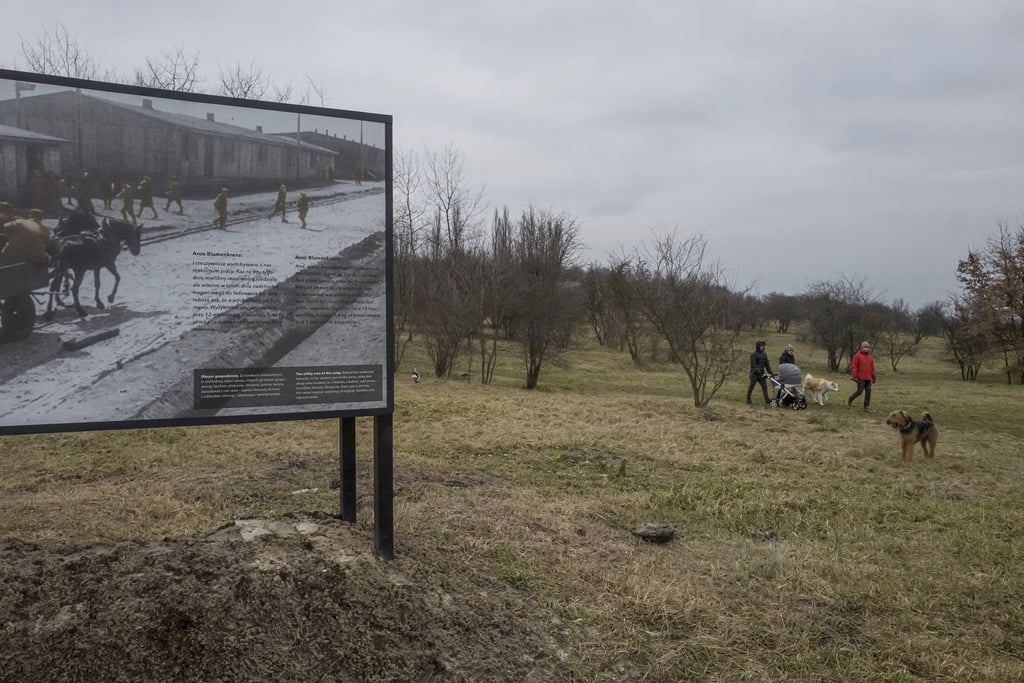
Francisco is also concerned about a signpost that is lacking.
Finally, and not least, the new signage does nothing to address the question of what are appropriate and inappropriate behaviors at Płaszów. I, for one, do not think it is so difficult to do. The memorial complex to the mass murder sites in the Paneriai forest in Vilnius, for example, and Berlin’s Memorial to the Murdered Jews of Europe, both post simple rules, including no dogs, no cycling, no littering, no drinking.
To my eyes, not explicitly addressing behavioral expectations smacks of a denial that inappropriate behavior exists at Płaszów. […] In the same way, not addressing behavioral expectations is a compromise of silence over the continued desire of many citizens to use Płaszów as a recreational site, even when they understand its history.
There are those who see ethical coercion and eventual ethical disengagement as the consequence of framing Holocaust sites as places apart from the activities of everyday life. But this argument must, I think, contend with what has prevailed at Płaszów for decades, namely a state of convenient neglect, and a don’t-ask-don’t-tell situation in which a genocidal site has quietly become an attractive greenspace and even a pleasure-ground for residents of nearby high-density housing (itself largely built on the grounds of the former camp, outside the barbed wire, where Germans had their residences).
Clear and not clear enough: just as you cannot pay a debt in tears, good intentions are not enough to undo ignorance. And if ignorance is largely what a person or a group chooses to ignore, the Museum, the city and the Jewish community are not at liberty to ignore the mistakes of this “temporary” memorial work. Płaszów belongs to all its victims, who deserve to be described as accurately as possible. And Płaszów belongs to all its visitors, who deserve to know what happened there as clearly as possible, from which point they can begin the long task of figuring out for themselves what it meant and continues to mean.