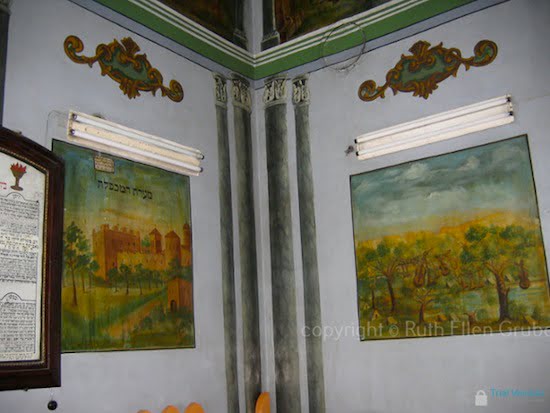
The current issue of the online Jewish studies journal Quest includes a detailed article by Ilia Rodov on the paintings of Jerusalem and elsewhere in the Holy Land dating from the mid-19th to the mid-20th century that are found in the richly decorated synagogues of northern Romania.
Quest is the online journal of Milan’s Center for Contemporary Jewish Documentation (CDEC) Foundation, and Rovov’s article is one of 10 essays in a monographic issue devoted to Travels to the “Holy Land:” Perceptions, Representations and Narratives.
Rodov writes:
These images implied the sanctity of the biblical land and the belief in its messianic revival by the Jewish people. Some synagogue artists ‘domesticated’ their paintings of a never-seen land by depicting those remote places according to features characteristic of familiar local landscapes. […]
The views of the Holy Land in the synagogues of Romanian Moldavia originated in the prints, souvenirs, and ephemera that were, either truly or reputedly, physical messengers from the distant places they depicted and thus would have been accepted as reliable eyewitnesses. The reoccurrence of the same images in various media available to Romanian Jews not only reinforced the viewers’ sense of the reliability of the depictions of holy places, but also – using Walter Benjamin’s definition – was able “to bring things ‘closer’ spatially and humanly” and thus to overcome “the uniqueness of every reality by accepting its reproduction.” The process of assimilation of the remote reality in Moldavian synagogues becomes better discernible when the artists had to expand their paintings of holy places to the areas that lay beyond what they could consult in their samples.
The essay includes a photo gallery that shows both examples of paintings and also the published illustrations from various printed sources that inspired the work.
Rodov devotes part of the lengthy article to the synagogue painter Mendel Grinberg of Iaşi (d. 1928), who decorated dozens of synagogues in the region — and sometimes signed his work. In particular, he writes how Grinberg “spectacularly implemented” the concept of the Babylonian exile and redemption in the Holy Land.
In early-20th century synagogue paintings, the depictions of musical instruments which the Jews in the Babylonian abstained from playing as a gesture of their mourning for Zion, became a common complement to the images of Jerusalem. […] On the northern wall in the Grain Merchants’ Synagogue in Bacău, [Grinberg] painted the instruments on trees against a sunset and inscribed the panel in Hebrew “Upon the willows in the midst thereof we hanged up our harps” (Psalms 137:2). On the southern side of the hall, he depicted the Dome of the Rock in Jerusalem and captioned it, “The Holies [sic!] of Holies with the Foundation Stone”. The two large facing paintings are prominently distinguished among the numerous murals in the prayer hall: the views of Babylonia and the Holy Land appear in the center of a wall and are framed by naturalistically painted theatrical red curtains. This scenery on either side of the synagogue worshippers might evoke in them a sense of existence in transition from the past and present exile to future redemption, from routine to miracle, and from profane to holy.
The emphasis placed on this pair of paintings in the synagogue interior is reinforced by the artist’s signature in the top of each of them. Above the local paysage standing for the “rivers of Babylon” Mendel Grinberg advertises himself in Romanian as a pictor decorator and provides the address of his workshop in Iaşi.
Paintings of the Holy Land, of course, were not limited to the synagogues in northern Romania and nearby regions now in Ukraine and Moldova, but were a frequent motif in synagogue decoration Poland and elsewhere in eastern Europe. The scholar Boris Khaimovich, of the Center for Jewish Art, has explored east European synagogue painting in his book The Work of our Hands to Glorify, which is primarily devoted to the mid-20th century murals by an unknown artist in the Beit Tefilah Benyamin synagogue in Chernivtsi, just across the border from Romania in Ukraine, but which also provides extensive background on synagogue painting in general.