
Several news stories this past week have highlighted the important archeological excavations going on in Cologne, Germany that are uncovering the city’s historic Jewish quarter — as well as the controversy and strained relations surrounding the €52 million project.
An article in Haaretz by Ofer Aderet as well as an article on AFP by Etienne Balmer quote Dr. Sven Schuette, who since 2006 has been director of the Archaeological Zone / Jewish Museum Project in Cologne, as describing both the ambitious — and important — project, which will include a museum tracing 2000 years of Jewish history in Cologne, as well as opposition to the plan, which centers on the use of public funds for the project but also has revealed what some see a anti-Jewish prejudice.
AFP notes that the opposition conservative Christian Democrats (CDU) on the local council have attacked spending for the project as “madness.” “Cologne cannot allow itself to build a new museum,” it quoted leading local CDU politician Volker Meertz as saying. He also questioning how it would stand out from the Jewish museum in the German capital. Moreover, it said, “Some 2,800 people have signed a broad-based petition against the museum.”
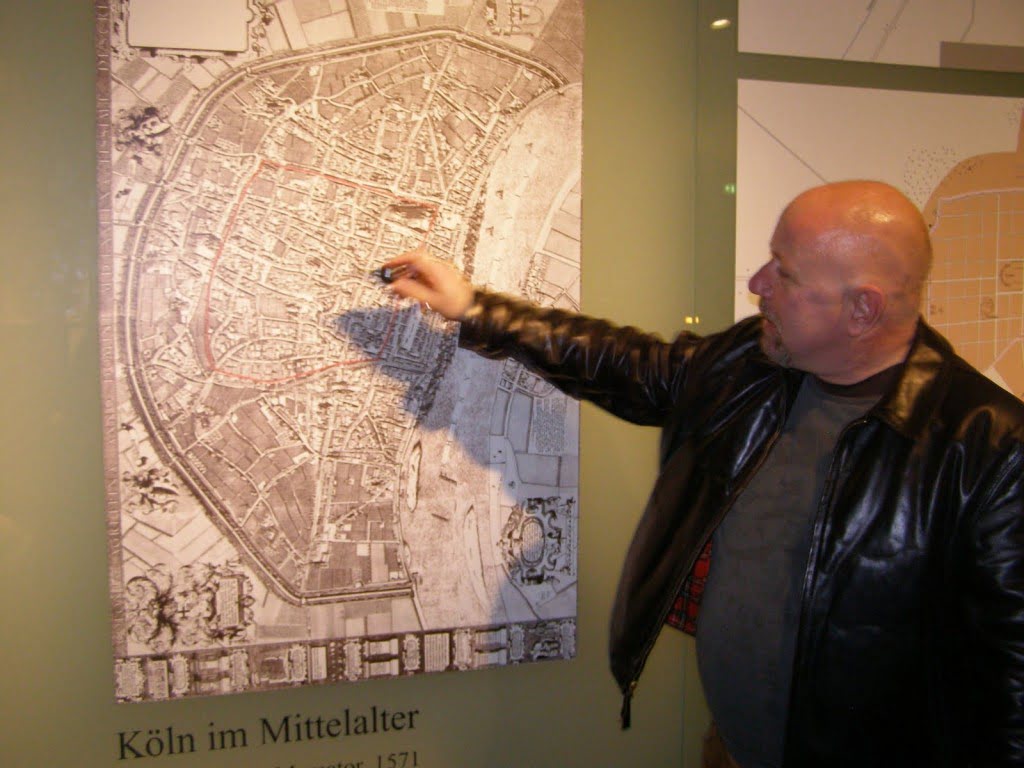
“We are fighting over history here,” Schuette told Haaretz,] “They claim the Jews fell from the sky, that they are merely guests here, who came and left. But what can you do, the findings we discovered in the field prove otherwise,” he added excitedly, as he pointed out the ancient synagogue and ritual bath that were uncovered in the heart of the city in recent years. […]
Schuette believes that those opposed to the excavations are motivated also by latent anti-Semitism, of the sort he says that’s common in Germany. “They think it would be more appropriate to build a nice plaza here, rather than a Jewish museum,” as is planned, he adds. Some people have tried to sabotage the dig and have left suspicious items − such as a suitcase that was feared to have had explosives inside − at the entrance to the excavation; others send him threatening letters. “They are not neo-Nazis, just foolish people who do not understand history,” Schuette says.
Nonetheless, excavation work goes on at full speed on the 10,000 square meter site. To date, more than 250,000 artifacts have been recovered.
Haaretz describes a visit to the site at the end of March.
At the center of the site were remains of a synagogue that was destroyed in the pogrom against the town’s Jews in 1349, beneath which were discovered floors of structures from earlier periods, including the remnants of the oldest Jewish synagogue north of the Alps to be identified to date. But whereas the earliest known written sources for the institution dated it to the 11th century C.E., the excavations allowed its age to be extended by more than 200 years, to sometime before the year 800.
“This is the largest group of Jewish structures preserved in Central Europe,” Schuette says. “We are pouring new life into the oldest Ashkenazi Jewish site in the world.”
In his blog on Jewish art and monuments, Samuel D. Gruber has written extensively about some of the important finds during the Cologne excavations, as well as the controversy.
The project’s extensive web site is a rich resource on the history of the site, the progress of the excavations and plans for the museum.
Schuette will be addressing these issues in a presentation at a conference on managing Jewish built heritage, to be held in Krakow April 23-25.
2 comments on “Archaeology Uncovers Cologne Jewish Quarter — and Controversy”
Sven is very outspoken, perhaps too outspoken in the new Germany. He is being accused of calling some of the project’s opponents latent antisemites. However, the Ha’aretz interview, which led to his sacking, does not ascribe these words to him verbatim.
There is a suspicition that his outspoken manner has made him enemies who have the power of political and economic connections to exert pressure on the cash-strapped mayor of Cologne.
The mayor of Cologne is substituting people with no track record whatsoever in Jewish history or archeology, rather than openly advertising the post.
Sven was relieved of his duties on the afternoon of April 10, 2013.