
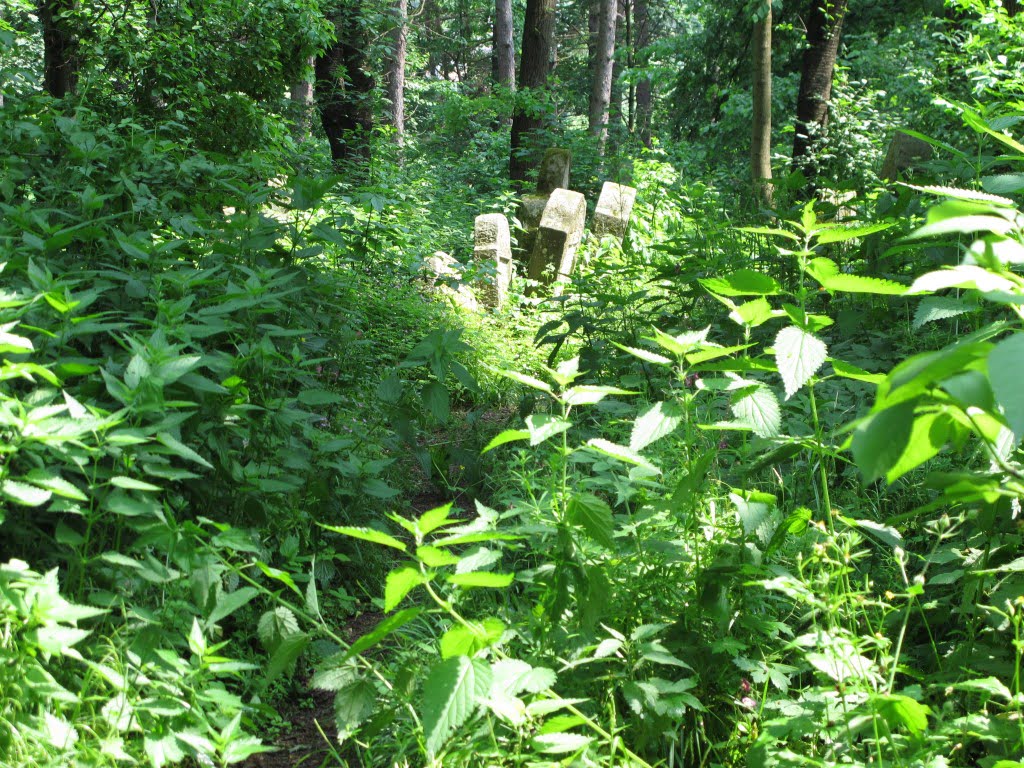
JTA runs a story about the burdens of caring for Jewish cemeteries in Europe. The issues are familiar to readers of this web site — and anyone involved in the field, and it is good that they are getting this publicity. The article names several initiatives that preserve cemeteries.
Across Eastern Europe, hundreds of Jewish cemeteries are disintegrating as the small communities entrusted with their care focus their limited resources on reestablishing a living presence after long years of communist suppression and the near annihilation of the Holocaust.
Following the fall of communism in the early 1990s, control of cemeteries in several countries of the former Eastern bloc reverted to the Jewish community. In Slovakia, Poland, the Czech Republic and elsewhere, this resulted in communities of a few thousand people suddenly becoming responsible for vast burial grounds that before the Holocaust had been administered by congregations dozens of times larger. Some 90,000 Jews lived in Slovakia before the war; today the community numbers about 3,000.
These will be among the issues to be discussed at a conference on managing Jewish built heritage, sponsored by a group of international foundations, to be held in Krakow April 23-25. There will be about 90 participants from about 20 countries.
The meeting will be a follow up to the working seminar on Jewish heritage management held in Bratislava, Slovakia, in March 2009 that was attended by Jewish community representatives and experts from more than a dozen countries. Participants in the Bratislava meeting formulated a series of “best practice” recommendations regarding the care and management of Jewish historic properties — the JHE web site was one of the outcomes of this meeting.
The goals of the Krakow seminar are:
- to review the Bratislava statement’s recommendations;
- to encourage strategic thinking, collaborative partnerships and co-operation regarding Jewish heritage on the local, national and international levels;
- to learn about and analyze successful strategies involving the care, conservation, management and use of historic Jewish properties; and
- to network and exchange expertise.
Participants will include people directly involved in the decision making process regarding Jewish property, as well as those directly involved in the care, conservation, management and use of Jewish historic sites: people within Jewish communities, as well as grassroots activists, civic representatives and other stakeholders.