
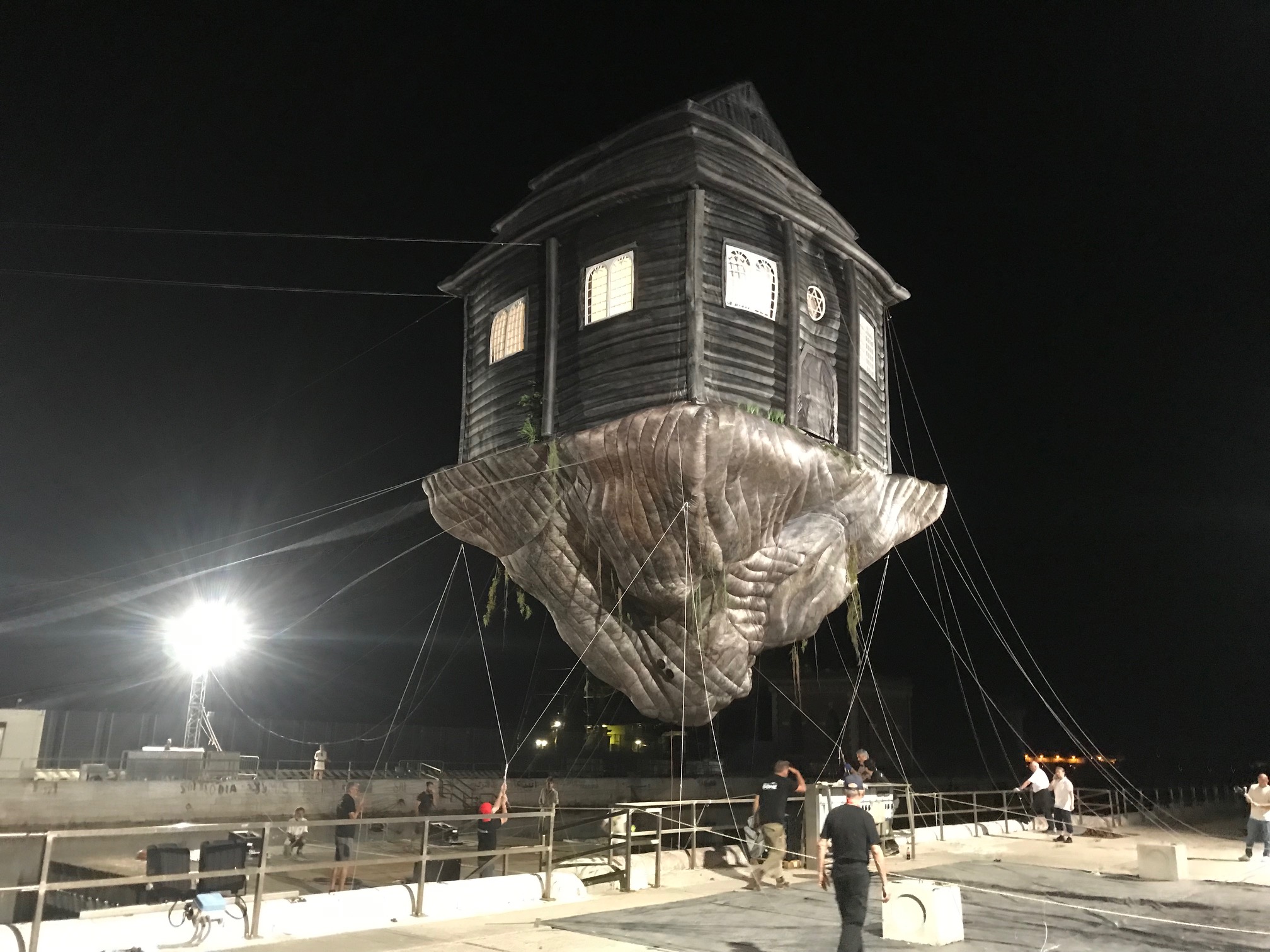
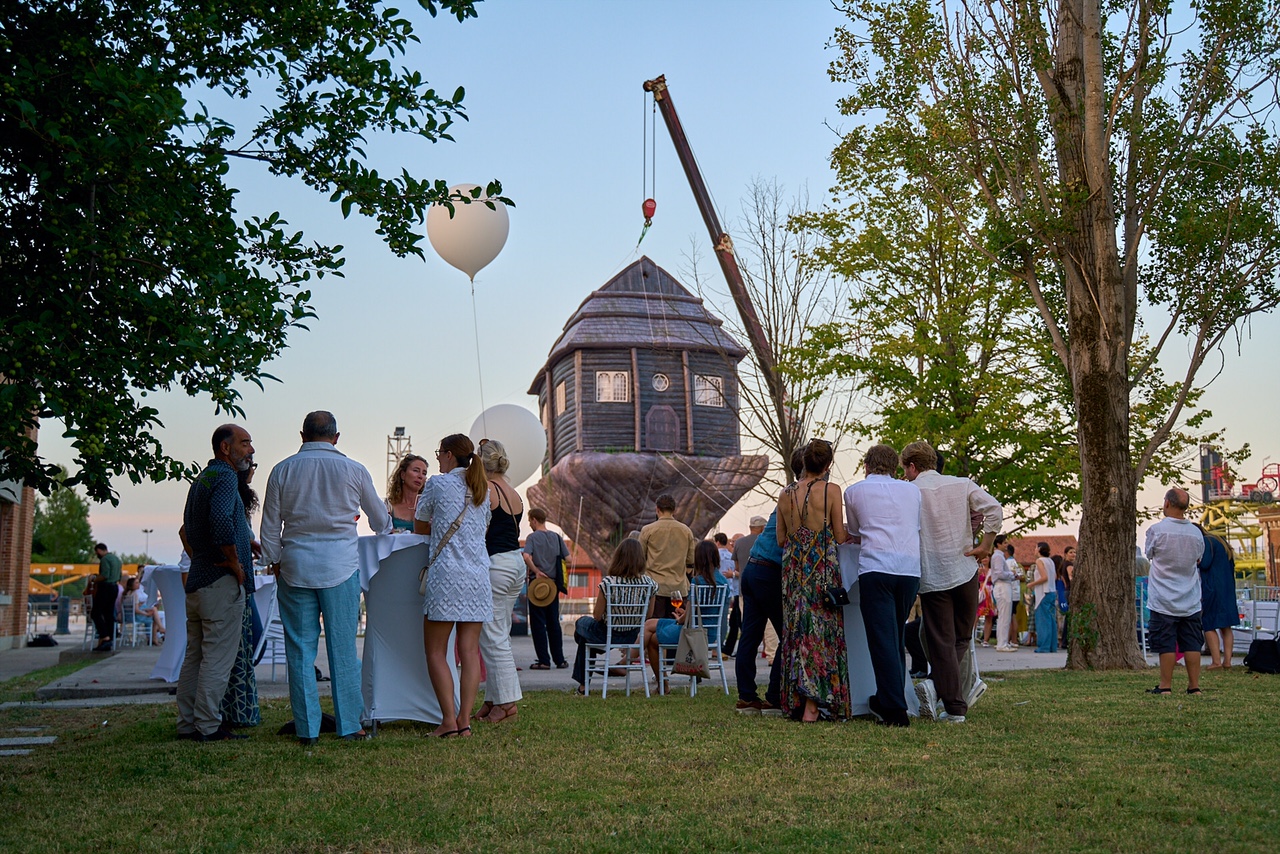
Nabatele — a huge hot air balloon representing an Eastern European wooden synagogue — was launched last week over the Venetian lagoon, as a collateral exhibit of the sprawling 61st Venice Biennale international art exhibition.
Designed by the Ukraine-born architect, artist, and Jewish heritage curator Anna Kamyshan, who is based in New York and London, Nabatele was hoisted into the air July 16 during a launch event that participants described as “magical.”
The balloon, which represents a wooden synagogue perched on a rocky base, floated in the air temporarily, but was then was taken down for adjustments.
Eastern Europe was once home to hundreds of often elaborate wooden synagogues, almost all of which were destroyed before or (mostly) during World War II.
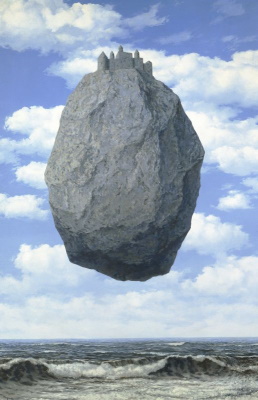
Le Chateau de Pyrenees (The Castle of the Pyrenees), 1959 The Israel Museum, Jerusalem
The Nabatele installation is formed by a double-membrane helium-filled balloon that the project says will be able to rise up to 25 meters into the air. It recalls (and was inspired by) the 1959 painting The Castle of the Pyrenees, by René Magritte.
According to the project, its movement will “follow the rhythm of the atmosphere—ascending, descending, drifting.” It will settle on the surface of the water on windy days, while in calmer conditions it will float freely, “sometimes low towards its mooring, sometimes high in the sky, in constant dialogue with the atmosphere.”
“The metaphor of a home without ground of course describes Jewish history in very powerful terms,” says Venetian Jewish scholar Shaul Bassi, a professor at the city’s Ca’ Foscari University.
In Venice it has potentially another connotation — Venice is also a hotspot of climate change. Venice is being threatened by sea level rise, and the tradition of Jews being always ready to be looking for another place, to carry their home, their culture with them match with the culture of Venetians knowing how to negotiate constantly between land and water, between different environmental conditions.
The project — due to run until September 16 — is curated by Maria Veits and Yevgeniy Fiks, and organized by the Montreal Jewish Museum.
Nabatele, the project description states, “is a Yiddishized word of Slavic and Semitic origin meaning ‘call attention to’ or ‘alarm in times of danger.’”
“Nabatele explores the tension between gravity and buoyancy, the gentle effort of existing uprooted,” Kamysan says.
Whether the structure ever had roots or a foundation, or instead always floated freely above the ground; whether it seeks a place to land or prefers its airy autonomy… these questions remain a mystery. The constant light from the synagogue windows symbolizes for me that inner flame that is not extinguished by any turbulence, and that persists in instability.
Curators Veits and Fiks have developed an independent, non-national curatorial and artistic “Yiddishland” platform “shaped by Yiddish experiences of diaspora, migration, and doikeyt (hereness), advancing Yiddishland as a political and cultural proposition.”
The Yiddish diminutive -ele “softens nabat – a word spanning Slavic and Semitic languages – shifting it from warning to quiet presence,” they said in a statement.
Referencing lost wooden synagogues of Eastern European shtetls and the non-territorial idea of Yiddishland, the work evokes continuity through memory and transmission rather than land. In dialogue with Venice’s Ghetto history, Nabatele exists neither as monument nor memorial, but as a gentle presence that holds unresolved belonging without claiming permanence.
See Montreal Jewish Museum web site
See Prof. Shaul Bassi’s full statement on Instagram