
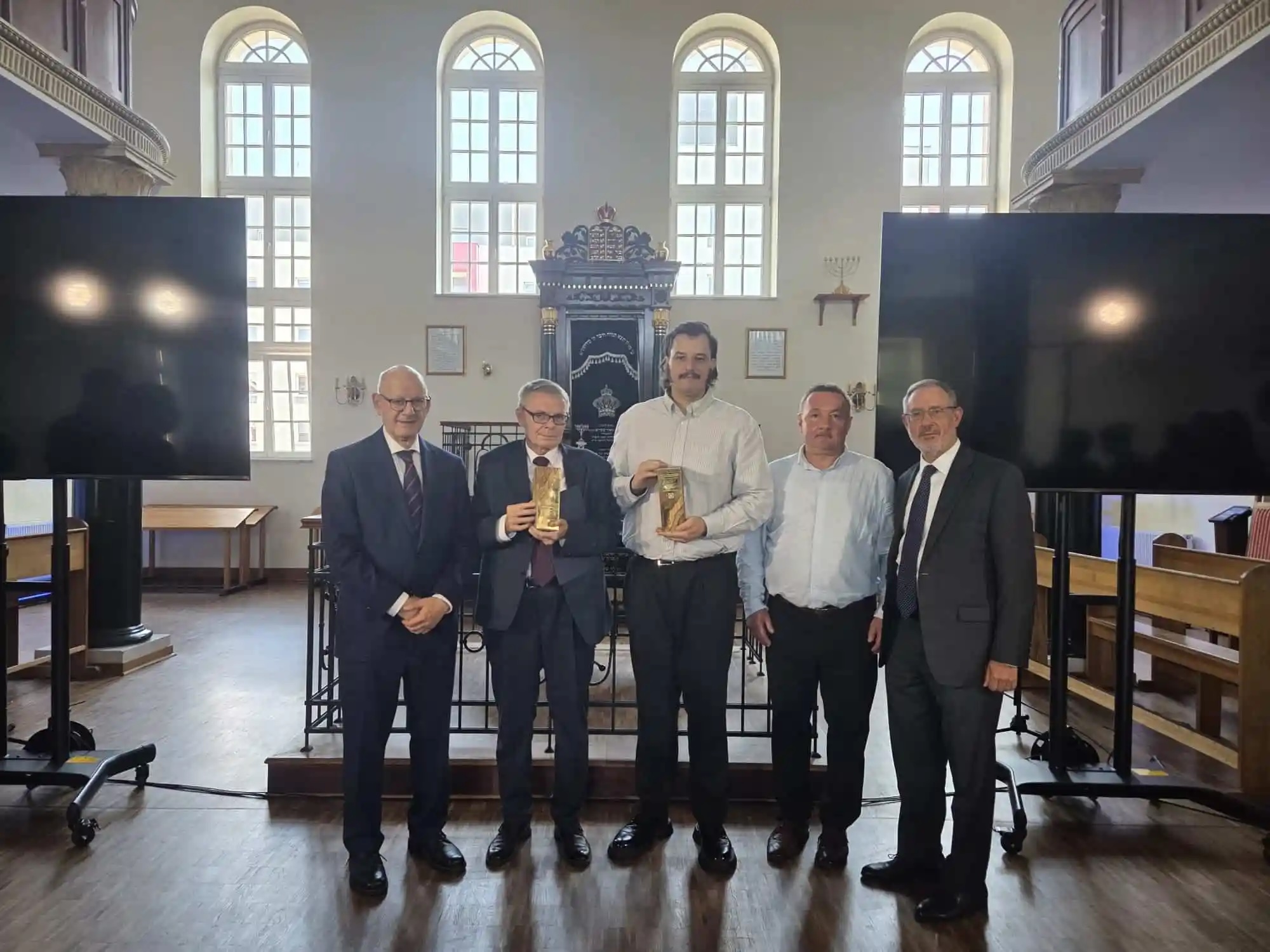
B’nai B’rith International has presented its 2026 Gratitude Award honoring Polish citizens who have shown commitment to preserving Jewish heritage in Poland and cultivating Jewish-Polish relations.
Presented June 28 in Lublin at the Yeshivat Chachmei Lublin, the awards went to Wojciech Michał Lemański, Zbigniew J. Nita and Jakub Wójcik in the Individual Category, and to the Sitwa Organization in the Institutional Category.
Wojciech Michał Lemański, a Roman Catholic priest, was recognized “for more than two decades of weekly commemorations honoring Holocaust victims at sites including Treblinka, Szczuczyn, Radziłów, Wąsosz and Bzury, as well as for his steadfast advocacy of Polish-Jewish dialogue despite conflicts with church authorities.”
Zbigniew J. Nita, a historian, journalist and photographer, was recognized “for years of consistent work to preserve Jewish memory in Poland and promote shared Polish-Jewish heritage through historical research, photography and educational initiatives. He is the initiator and co-founder of the Ławeczka Dialogu (Dialogue Bench) Association, which works to protect Jewish memorial sites, preserve historical heritage and deepen Polish-Jewish dialogue.”
Jakub Wójcik, a local activist from Grójec, Poland, was recognized for documenting the city’s Jewish history, organizing Jewish cemetery cleanups and leading annual ceremonies commemorating the liquidation of the Grójec Ghetto.
Sitwa is a grassroots organization that was recognized “for its efforts to combat anti-Semitism and anti-Zionism in Poland through public engagement, outreach to local authorities and community initiatives.”
This was the fourth edition of the Gratitude Awards, which are named in honor of the late Marian Turski, a Polish-Jewish journalist, historian, Holocaust survivor, and a member of the B’nai B’rith Poland lodge, who died last year at the age of 98.
Several awards are presented each year to Poles who care for and preserve Jewish heritage and memory; the longest-running is the Preserving Memory Award, established by Michael Traison in 1998.