
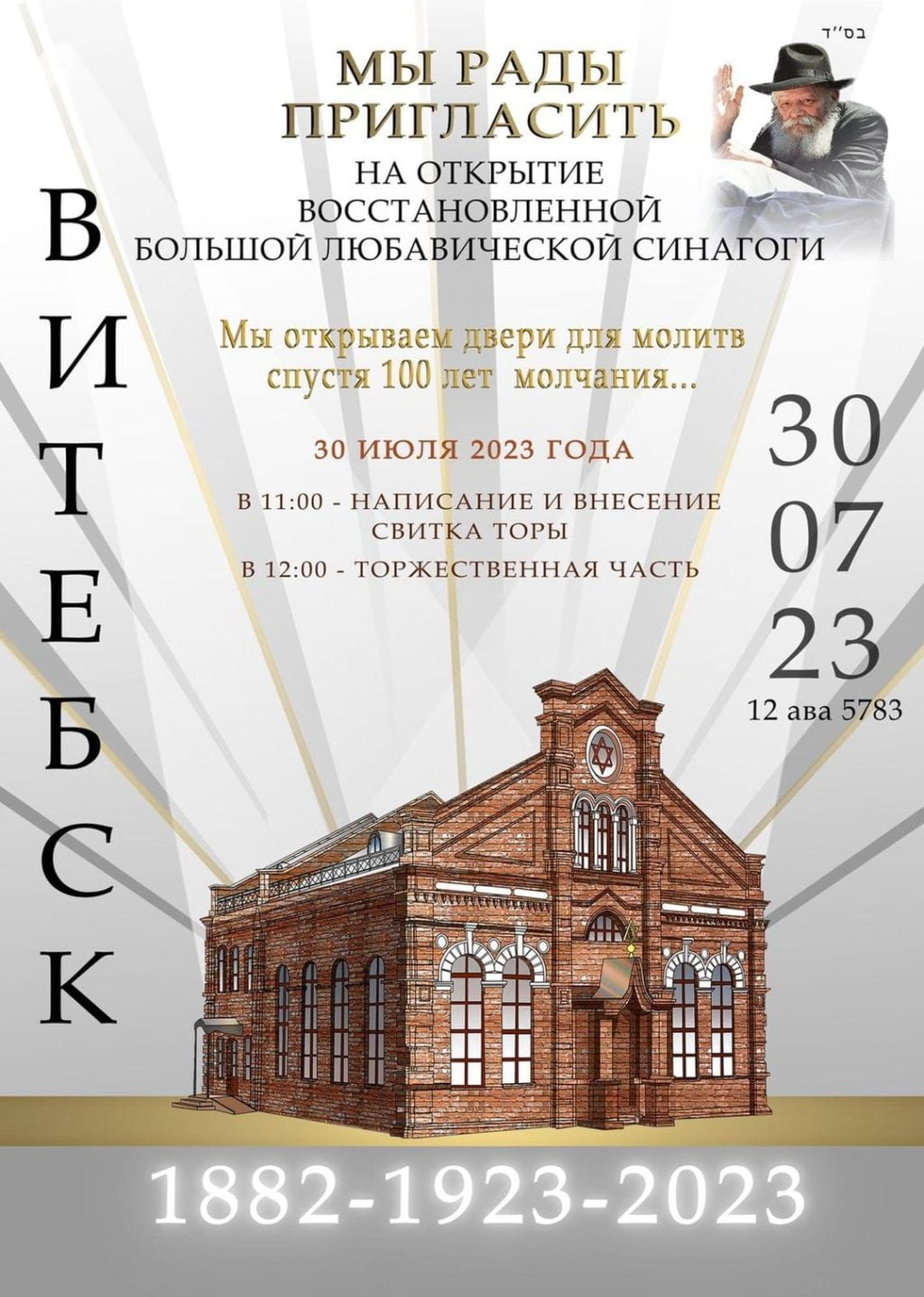
 (JHE) -- The Great Lubavitch Synagogue in Vitebsk, the hometown of the artist Mac Chagall, will be rededicated on July 30 following its total reconstruction from a roofless shell.
The restoration, a joint project of the Chabad Synagogue on Bronnaya in Moscow and the Moscow-based Shemini Foundation, aims to bring the long-ruined building back to its original appearance. It will be used both for worship and as a visitors' attraction.
A recently recovered parochet and torah mantle from the synagogue will be installed, the Foundation said (no further details were given).
As we posted in 2021, the authorities in Vitebsk had offered to sell the roofless ruin for a nominal price — or give it away free — to whoever would invest in the conservation of the ruins or restoration of the building, which is listed as a historic monument.
According to the Shemini Foundation, the asking price was €9 -- but, once the Synagogue on Bronnaya and the Shemini Foundation expressed interest, the city instead withdrew the sale and donated the building to the Jewish community in Vitebsk.
Almost immediately, work began on the preparation of project documentation and land allocation procedures

A Facebook page for the project documents the reconstruction process in photographs and videos.
Recent posts show the completed facade, which appears to exactly reproduce its original state, as well as videos showing the interior.
The synagogue was built in 1904, a time when there were more than 80 synagogues and prayer houses in the town, according to an article by Konstantin Karpekin, of the Vitebsk Region state archives.
Marc Chagall, born near Vitebsk in 1887, lived with his Hasidic family near the synagogue and prayed there, according to documentation by the Center for Jewish Art.

Under the Soviet regime following the Bolshevik Revolution, the synagogue was closed in 1929, after its silver ritual objects were confiscated in 1922.
According to a report in the vitebsk.cc web site, before World War II, “the building first housed an aero club, and then a house of culture for woodworkers. After the war, a pharmacy warehouse was set up in the former synagogue, and then the building was completely abandoned, and it gradually deteriorated and fell apart.”
According to the article by Konstantin Karpekin:
The conversion of the religious building into a [wood workers'] club lasted from December 1929 to June 1930. In the synagogue, instead of a prayer hall, an auditorium with a stage with a movie booth appeared, as well as a library. After [World War II], the building was used as a warehouse, and then completely abandoned.

This post updates our post from February 2, 2021
Read the description of the restoration project and see pictures on the Shemini Foundation web site
Follow the Facebook page of the project and see photos and videos
See a photo documentation of the ruined building by the Center for Jewish Art
See a detailed description of the ruins (in English) by the Center for Jewish Art