
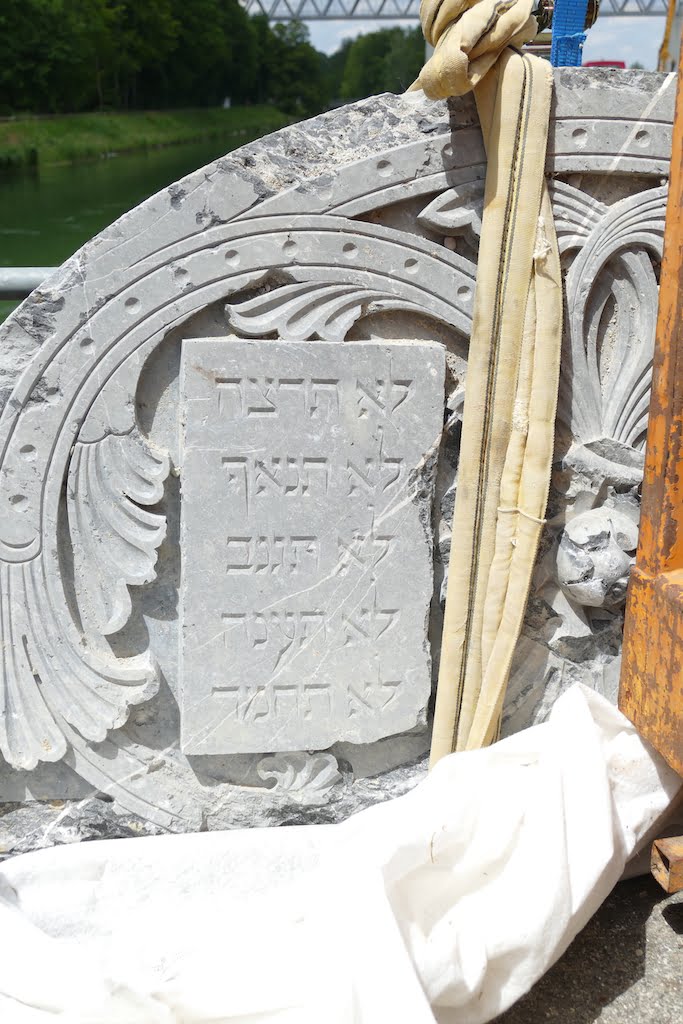
Fragments of the Munich’s magnificent main synagogue, which Hitler personally ordered demolished in June 1938, have been found in the Isar river, which runs through the city.
Construction workers discovered the fragments, which include massive pieces, decorative carving, and a nearly intact stone tablet of the Ten Commandments, while carrying out repair work on a weir in the river.
Material from the destroyed synagogue had been used to reinforce this low dam in the 1950s.
Experts and Jewish community representatives called the find sensational.
Seeing the recovered remains was “was one of the most moving moments in my 30 years of working in Jewish museums,” Bernhard Purin, director of the Munich Jewish Museum, told JHE. Especially moving, he said, was seeing the stone plaque of the Ten Commandments, which had been positioned above the Ark. Less than a quarter of the plaque was missing, he said.

The synagogue was designed by the prominent architect Albert Schmidt and inaugurated in 1887. It was recognised as a major city landmark.
“Anyone who reads the sources can guess the enthusiasm that must have prevailed in Munich in 1887 because of the new [synagogue] building in a prominent position,” the Munich Merker news site wrote.
And anyone who knows about this history will also understand what the find that workers made a few days ago on the Isar near the Großhesseloher Bridge means today – for the Jewish community, for Munich’s city history.
Hitler personally ordered the synagogue’s destruction — the first synagogue to be destroyed before the November 1938 Kristallnacht pogroms — to make way for a parking lot. He reportedly called the grand neo-Romanesque building an “eyesore.”
This is how the Jewish Telegraphic Agency JTA reported on the synagogue’s destruction, five months before Kristallnacht:
Chancellor Hitler, after an inspection tour of Munich, yesterday ordered demolition of a synagogue which is one of the most famous landmarks in the city, the Daily Telegraph reported today, adding that the razing of the building had already begun.
The rabbi of the congregation was given a few hours’ notice, the report said, and hundreds of members of the Jewish community worked throughout the night to remove holy scrolls and other property. The correspondent understands that the Nazis offered a small sum for distribution among needy Munich Jews for compensation for the synagogue, which is valuable freehold property.

The synagogue was razed by the Leonard Moll building company, which then stored the tons of rubble until the 1950s, when it was used (along with rubble from bombed out buildings) to reinforce the weir.
Charlotte Knoblauch, the 90-year-old head of the Munich Jewish community, attended services in the synagogue as a young girl. “I really didn’t expect fragments of the old main synagogue to survive, let alone see them,” she told the Munich Merker news site. “It’s all still very unreal.”
Read the Munich Merker article
2 comments on “Germany: Sensational discovery — fragments of the main Munich synagogue that Hitler ordered demolished in 1938 found in the Isar river. Used in the 1950s to reinforce a weir”
So amazing. I Hope more pieces can be found and this part of history retold.
Foundations stones of the old destroyed synagogue of Freiburg im Breisgau (Germany) were brought back to light on the occasion of the construction of a water basin (fountain) in 2016. Despite the wish of the local jewish community of Freiburg to keep these stones untouched but to integrate them visibly and properly in the new project, the Lord Mayor Dr Dieter Salomon decided immediately to remove all upper disturbing stones and continue to build the planned water basin which immediately after its inauguration became a paddling pool.
There is still currently a refusal of the city administration to install a menorah with some foundation stones at its foot in the middle of thé New basin in order to remember thé meaning of a synagogue.
The city administration of Freiburg i. Br. still currently refuses to build along the water basin remembrance and memorial stones engraved with the names of the 351 jewish victimes of the Shoah