

(JHE) — An intrepid art historian acting on a hunch hiked along the perimeter of Budapest’s vast Kozma street Jewish cemetery to make an exciting discovery — a long forgotten sculptural monument by the noted architect Béla Lajta that marks the mass grave of people whose remains were transferred to Kozma street from an earlier Jewish cemetery.
Lajta (1873-1920) was one of the most important Hungarian architects of his day. His work foreshadowed art deco and modernism, and he designed a number of important buildings in Budapest.
He also designed more than 30 tombstones and family vaults in the Kozma street and Salgotarjani street Jewish cemeteries. He had a formal relationship with the Chevra Kadisha from the end of 1903 and eventually served as permanent technical adviser for the cemeteries.
The rediscovered monument is a stele surmounted by the carving of a willow tree that resembles an upside down menorah. Its sides bear stylized carved floral motifs. It was erected in 1912 at the site of the mass burial of remains from a Jewish cemetery that had been closed down.
According to the 1999 book Jewish Budapest: Monuments, Rites, History, it bore an inscription reading:
“1912. This is the common resting place of the mortal remains of those who were originally buried in the Jewish cemetery on the old Váci út later Lehel út, which was opened in 1808, closed in 1874 and, due to an official decree, liquidated in 1910. They were exhumed by the Chevra Kadisha and reburied here with due respect. Blessed be their ashes.”
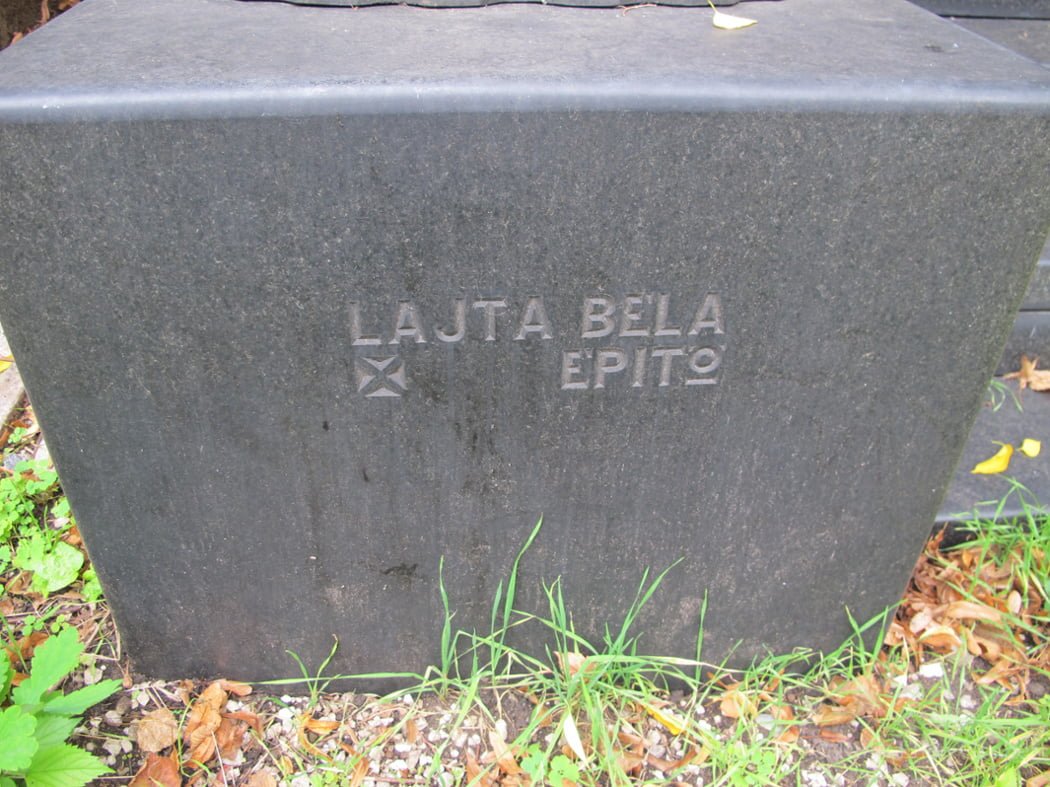
Old photographs of the monument existed, but its location had long been forgotten.
Art historian Tamás Csáki, who completed his PhD on Béla Lajta’s important sculptural tombs and funerary architecture in 2019, told JHE that it was the only one of the tombs designed by Lajta that he had been unable to find during his research. He said he had even suspected that the monument may have actually never been built and that the old photographs may have shown a model.
Late last year, however, he took another look at the old photos — and decided to make another attempt to find the monument.
“I realized that it must have been erected near the cemetery walls, and knowing that around 1910 the cemetery was much smaller than today, it was clear that it can only be somewhere in the remotest southern-southeastern corner of the cemetery,” Csáki told JHE in an email.
This feeling sent him on a quest.
“I indeed walked along that part of the cemetery perimeters — it is an eery, completely abandoned, but not vandalised space — and found the mass burial place with the monument,” he said. “It was completely covered by ivy, but still easily recognizable.”
Csáki spoke about the discovery and showed a picture of the monument at an online seminar on Jewish cemeteries in Hungary that took place last month (and for which JHE’s Ruth Ellen Gruber gave the introductory talk).
See our 2018 post about Lajta’s sculptural tombs (with pictures)