
The year 2022 marks the 10th anniversary of Jewish Heritage Europe. The theme of our birthday celebrations is the “Anniversary of Anniversaries” — that is, using JHE’s own anniversary to feature other significant or symbolic anniversaries.
Here we highlight the anniversaries of three synagogues in Germany: 70 years of the Erfurt New synagogue, the 200th anniversary of the Ermreuth synagogue, and 180th anniversary of the Bad Segeberg synagogue (plus the 60th anniversary of its demolition).
✡︎ ✡︎ ✡︎ ✡︎ ✡︎ ✡︎ ✡︎ ✡︎ ✡︎

ERFURT – 70th anniversary of the “New Synagogue”
The so-called “New Synagogue” in Erfurt celebrated its 70th anniversary with a public event August 31 that included a ceremonial service, a concert, a conference, and the unveiling by Mayor Andreas Bausewein of a scale model monument of the 1884 synagogue that stood where the “New Synagogue” was located until the Nazis torched it in 1938 during Kristallnacht.
The New Synagogue was inaugurated on August 31, 1952, and it was the first and only synagogue built in the former German Democratic Republic (GDR). Drafted by architect Willy Nöckel, the synagogue was designed to host a community of survivors. Today, thanks to immigration from the former Soviet Union, around 800 Jews live in and around Erfurt.
The architectural historian Dr. Samuel D. Gruber has written:

In 1946, the Jewish community council requested the city of Erfurt return of the property where the Great Synagogue had stood, and this occurred in 1947. Architect Willy Nöckel was engaged to design a new synagogue, and prepared drawings and a model […] His first two proposals were rejected, but finally construction began in 1951 on a more modest synagogue that was dedicated on August 31, 1952.
Nöckel’s first design of 1948 exploited the shaped of triangular shape of the plot, and he created a design focused on a domed sanctuary. Coincidentally, German-Jewish refugee architect Erich Mendelsohn was grappling with a similar solution for his Park Synagogue in Cleveland, Ohio. Nöckel’ domed design was rejected by authorities in 1950 on the grounds that the building with a circular prayer room would not fit into the city’s townscape. It was deemed both “too big” and “too sacral”. This was one of the first- perhaps the very first – instances of the new German Communist regime grappling with Jewish building needs. I’m sure a close reading of the meeting minutes – if they survive- would be revealing.
Take an online tour of the New Synagogue, with Thuringia state rabbi Alexander Nachama (it’s in German, but settings allow translation of subtitles into English and other languages):
The synagogue stands on the spot where the imposing, domed Great Synagogue stood from 1884 to 1938. The Great Synagogue was designed by Siegfried Kusnitzky, who also designed the synagogue on Börneplatz in Frankfurt am Main – also destroyed on Kristallnacht.
The anniversary ceremony included a klezmer concert and a performance by the dance group of the Jewish community of Thuringia, speeches from civil and religious authorities, and the dedication of the 1:68 scale-model monument of the destroyed Great Synagogue, in a park outside the synagogue .
The monument was created as part of a virtual reconstruction of the synagogue that had three formats base on digital data: a virtual reality environment for VR glasses, a web 3D model accessible on the Internet, and the 1:68 scale physical model — produced using 3D printing. According to the Erfurt Municipality web site, creating the monument by 3D printing enabled it to show
the finest structural details such as the Stars of David in the window structures and the Hebrew inscription meaning “For my house shall be called a house of prayer for all nations” (Isaiah 56 ,7). A layer of aluminum powder just 0.06 mm thick was applied around 6,000 times to a plate and selectively melted with two lasers.
The Free State of Thuringia State Chancellery funded the virtual reconstruction project in partnership with the University of Erfurt, the University of Applied Sciences of Erfurt, and the University of Jena, under the coordination of Dr. Annegret Schule of the Erfurt State Capital. It was officially made public in September 2021, on the occasion of 900 years of Jewish presence in Thuringia.
Erfurt today has three standing synagogues: the Medieval (dating back to 1270, with foundations dating probably to the 11th century), the Small orthodox synagogue , used as a cultural space (1840), and New Synagogue (1952). Moreover, the city also has a Medieval mikveh, discovered in 2007 and open to the public, a Jewish museum opened in the Old Synagogue in 2009, a Jewish cemetery dating from the 1870s and still in use, and the site of the destroyed Old Cemetery. Also, several dozen preserved gravestones from the medieval Jewish cemetery, which had been used as building material after the cemetery was razed following the expulsion of the Jews in 1458, are preserved and displayed at the Old Synagogue.
Click here to watch a local media video of the August 31 anniversary ceremony
See a brochure with details of the Virtual Reconstruction
See Jewish Life in Erfurt web site
See an Instagram Account about the virtual reconstruction of the Great Synagogue
ERMREUTH – 200th anniversary
The synagogue of Ermreuth, a village of 900 inhabitants in Bavaria, celebrated its 200th anniversary with a public event in June that included a concert, dance and theatre performances, a walk in the village’s Jewish cemetery, and a religious service organized by the Liberal Jewish community of Bamberg.

The ceremony was attended by local residents and people coming from Bamberg and Neunkirch, and it was organized by District Administrator Hermann Ulm and Neunkirchen’s Mayor Martin Walz.
Construction work at the synagogue started in 1819 and was completed in 1822. Conrad M. Wörner designed the synagogue, a two-story sandstone building with a hipped roof, on the site where a smaller one dating back to 1738 had stood. The synagogue was in regular use only until the early 1930s due to the dwindling of the Jewish community.
During Kristallnacht, the synagogue was devastated but not destroyed. After WWII, its owner changed various times. It was used for several purposes, including as a warehouse for agricultural supplies — a big barn door was cut into the facade, and a ceiling was installed to cut the sanctuary in half horizontally. It later stood abandoned for years.
Between 1987 and 1988, during the restoration of the roof, an extensive Genizah was discovered, and one year later, an association for its renovation and preservation was founded.
The building underwent significant restoration between 1992 and 1994 and opened to the public in 1994 as a Jewish Museum. Since 2019, the women’s gallery has hosted a new permanent exhibition on rural Jewish life in Germany, taking Ermreuth as an example. All the historical material displayed came from to the village’s Genizah or was donated by descendants of local Jews and is accompanied by audio-visual material.
Watch a video tour of the synagogue:
The Jewish cemetery is two kilometers away from the village, founded on a hill in 1711 and enlarged in 1862. The last burials took place in 1936 and 1937.
Access the web site of the Ermreuth Synagogue Museum
BAD SEGEBERG – 180th anniversary (and 60th anniversary of its demolition)
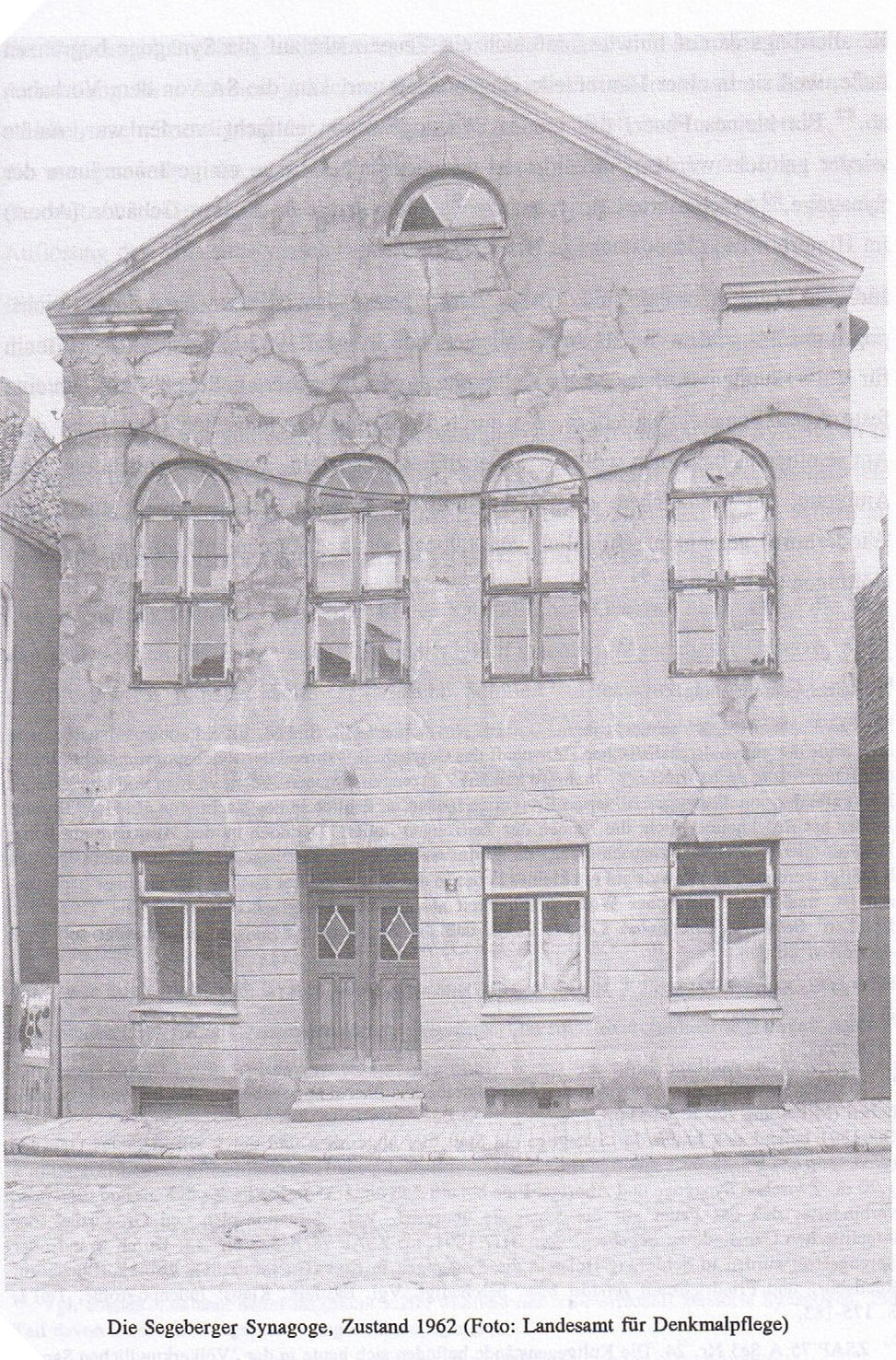
This year marked the 180th anniversary of the synagogue of Bad Segeberg, in northern Germany’s Schleswig-Holstein — and the 60th anniversary of its demolition in 1962.
Located in the town center, the was desecrated and ruined by the Nazis during the Kristallnacht pogrom, but not torched because of danger to nearby residential buildings. The Nazis used it for storage, and after WWII, it was used for a time as a refugee center before falling into disrepair and being demolished.
In 1988, on the 50th anniversary of Kristallnacht, a commemorative plaque was placed at the site of the synagogue.
But November in 2021, on the 83rd anniversary of Kristallnacht, the Jewish community erected a large, powerful memorial monument — a more or less full sized steel replica of the outline of the destroyed synagogue’s façade, eight meters wide and almost eleven meters high, with a large open entrance door and eight windows. The project cost was about €55,000, mainly collected through donations.
Watch a video about the creation and installation of the monument:
Jewish presence in Bad Segeberg dates from 1739, and there was already a small prayer room in the building that officially became the synagogue in 1842. The monument recreates the outline of the facade, with its peaked roof and row of arched windows on the upper floor.
After the arrival of refugees from the former Soviet Union in the 1990s, the local Jewish community revived. The first new synagogue to open in the Schleswig-Holstein State after WWII was inaugurated in Bad Segeberg in 2007.
In the town, there are also two Jewish cemeteries, the old one, founded in the 18th century and in use until 1936, and the new one, founded in 2002 to serve the needs of the rebuilt Jewish community, which today has 150 members.
Click here to visit the monument in 3D