

Researchers of the Jewish Galicia and Bukovina Organization have created a partial virtual reconstruction of the destroyed Old Jewish Cemetery in Lviv — creating an online gallery of historical photographs from the cemetery and detailed documentation of more than 50 tombstones from the 16th to the 19th century. The documentation includes the transcription of many epitaphs.
The cemetery was established as early as the 14th century — or earlier. The first documentary mention of it dates from 1414. It functioned until 1855, when the city’s historic old cemeteries were substituted by large modern cemeteries that included sections for the various religions, including Jewish.

After its closure, the cemetery — similar to the Old Jewish Cemetery in Prague — was maintained as a memorial site until the Nazi occupation in 1941. Devastated during WW2, with its gravestones removed for paving and other uses, the cemetery became the site of the Krakivsky Market under Soviet rule in 1947 — and (despite efforts over the years to remove it), it remains the site of the market today.
None of the ancient gravestones themselves survive intact, but there are photographs of many of them in archives and publications — the web site lists the sources and also links to historic maps of the cemetery.
“They enable us, even if in a very partial way, to restore some aspects of this national site and get a sense of the cultural greatness that it expressed,” writes Sergey Kravtsov, of the Center for Jewish Art. The researchers “have succeeded in restoring (not always fully) the epitaphs on those tombstones.”
Kravtsov describes the cemetery as a “Pantheon” of Galician Jewry.
The old Jewish cemetery in Lviv was one of the most ancient and important cemeteries in Europe. During 500 years of its existence the Jews of Lviv and the city’s surroundings buried there their dead: men and women, scholars and simple people, rabbis, community leaders, philanthropists, and beggars. Hundreds of impressive monuments created by genuine artists of various generations towered above the graves of prominent figures in the community. Over the years the site of the cemetery became a cultural pantheon of the Galicia Jewry, a symbol of its greatness and glory.
Some of the documented gravestones, he writes, include those of: Naḥman ben Isaac (d. 1616), the patron of the Nachmanowicz (the Golden Rose, alias Turei Zahav) Synagogue, his wife Roza bat Yakov (1637) whose name epitomizes the same synagogue, the martyrs Adela of Drohobych (1710) and the brothers Ḥayim and Jehoshua ben Isaac Reizes (1728), the rabbis and scholars Levi ben Yakov Kikines (1503), Joshua ben Alexander Ha-Cohen Falk (1614), Tzvi Hirsch ben Yaakov Ashkenazi (Ḥakham Tzvi, 1718), David ben Samuel Ha-Levi Segal (Turei Zahav, 1667), Ḥayim Ha-Cohen Rappaport (1771), Yakov Ornstein (1839), Abraham Kohn (1848), and others.
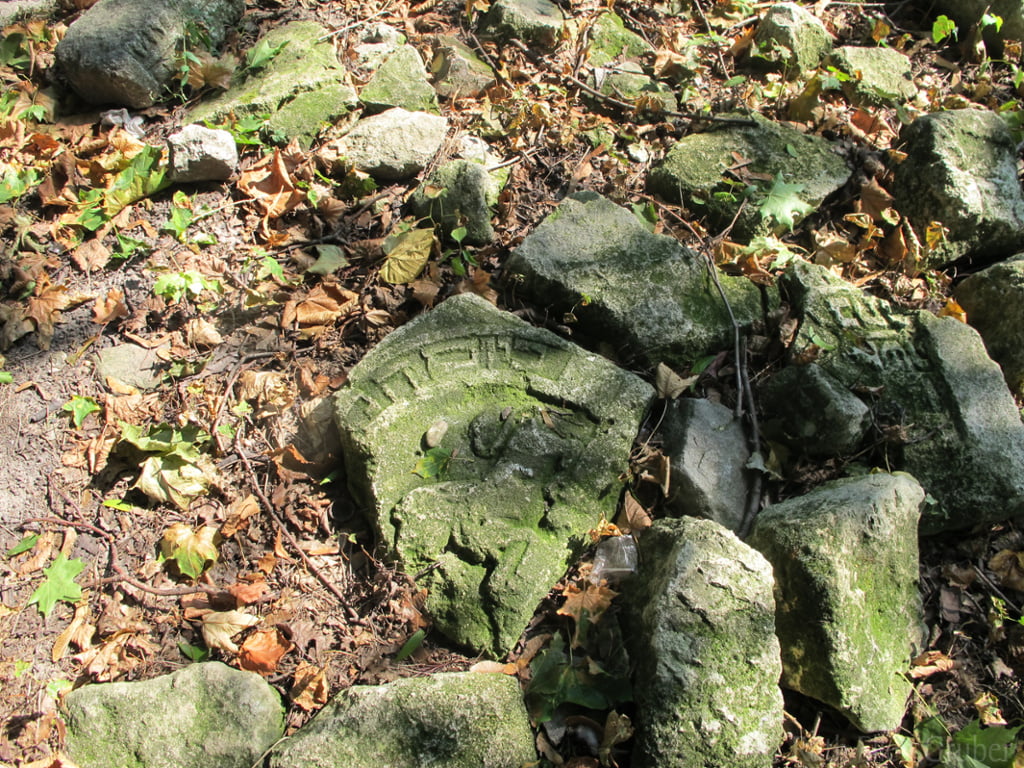
Today, only a small section of the cemetery is not covered by the Krakivsky market — it’s a park-like area on the grounds of the city’s maternity hospital, formerly the Jewish hospital. Fragments of matzevot can be found there.
This was one of the sites chosen in 2010 by the L’viv City Council, in partnership with the L’viv Center for Urban History and the German Society for International Cooperation, as part of an unprecedented design competition to mark three sites of Jewish history in the city.
The official brief was “to respond to the growing awareness of L’viv’s multi-ethnic past by contributing to the rediscovery of the city’s Jewish history and heritage through creating public spaces dedicated to the city’s historic Jewish community.” The winning designs for all three sites were chosen by an international jury in December 2010; JHE’s Ruth Ellen Gruber was on the jury.
To date, only one of the three commemorative sites has been built — the Space of Synagogues memorial, in front of the conserved ruins of the Golden Rose synagogue, which opened in September 2016.