

(JHE) — Krakow’s Galicia Jewish Museum has launched a mobile app that uses historic and contemporary photographs to tell the story of Polish Jews and their environments from the late 19th century to the present.
Called Photographs from Jewish Poland, the app aims to go beyond wellknown images, such as the pre-WW2 photos of Roman Vishniac and photographs of the Holocaust and its aftermath: the ghettos, the camps, the rubble and a handful of survivors.
“The imagery of the Jewish Poland spans well beyond that, from the 19th-century photographs of Ignacy Krieger and other ‘old masters’ to the most recent projects of contemporary photographers, both Polish and international,” the Museum states.
While in their work they sometimes do show or relate to the stories of suffering and destruction, just as often they testify to Jewish presence, the richness of Jewish culture, to continuity of Jewish tradition and to the rebirth of the Jewish community in contemporary Poland.

The Galicia Jewish Museum was founded in 2004 by the British photographer Chris Schwarz, with a core exhibition, Traces of Memory, that is a showcase of his photos of Jewish heritage sites around southeastern Poland, most of them abandoned or in ruins.
Schwarz died in 2007; his work was supplemented in recent years by photos by the American writer and photographer Jason Francisco. These included updated images of some of the sites photographed by Schwarz, as well as images from western Ukraine.
Over the years, the Museum has organized a number of photographic projects and exhibits.

For the app, a new photograph is added, every few days, and each photo is supplemented by text (in English) describing the images and also the circumstances around it.
The photos can be browsed by author or time period when it dates from. Users can also select photos to create their own collections.
Tomasz Strug, the Museum’s Deputy Director and Chief Curator, told JHE that there were a number of criteria involved in choosing the photos.
The aim is to cover as much of “photographed” Jewish Poland as possible. Thus we are/will be publishing photographs taken in the 19th century and those made recently, with all that is in between. All photographs are assigned to one of the periods (it is visible in the search tab): pre-1918, Interwar Poland, WWII, Communist Poland, post-1989. With time and subsequent photographs being published, we will have many images in each of those categories, and different issues for each period discussed.
Visual quality is of course also important, but more so that the photo will allow us to say something about Jewish Poland, a small bit with every photo, nothing over-complicated as far as single text goes, but with the goal to show the complex picture with multiple entries.
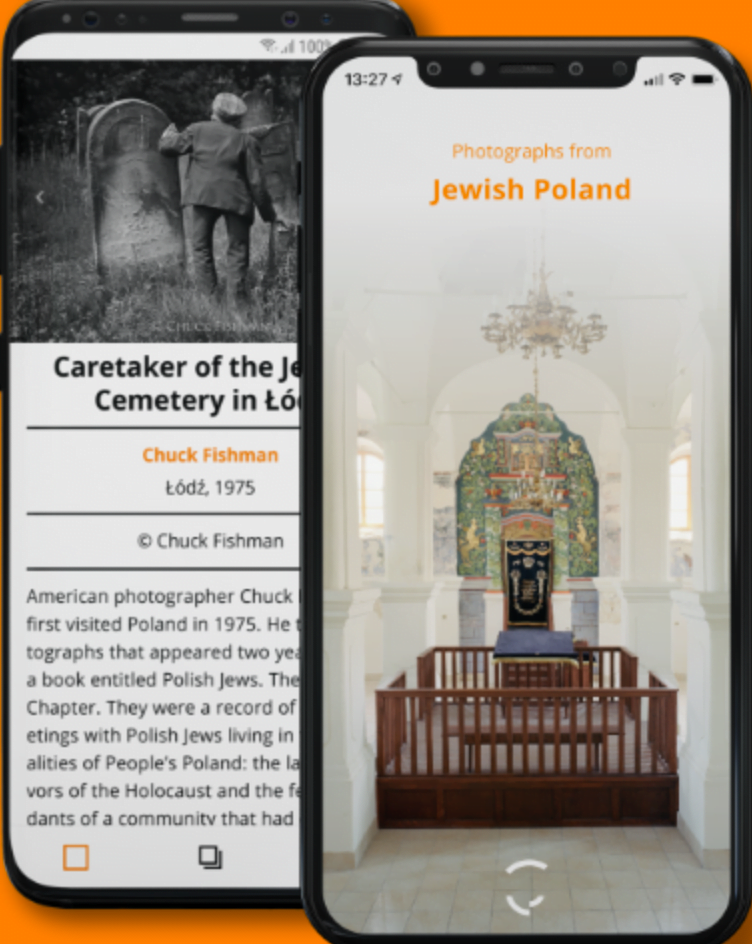 He said that the app aimed to include as many photographs as possible by the individual photographers, so that the app could also serve “as a database of photographers looking at Jewish Poland.”
He added, “The app is actually an educational tool, inspired by apps like DailyArt and other of such kind or even language learning apps that present small portion of the content on regular basis without overwhelming the user with too much information.”
Given the focus of the museum’s core exhibition of photos by Schwarz and Francisco, the photos uploaded to the app will include a growing selection of images of Jewish built heritage in Poland. Spanning the various time periods, the will be able to show changes in the sites over the years and decades.
Eventually, Strug told the news site TheFirstNews.com, “we’d like to go beyond just photographs and publish things like newspaper front pages, Yiddish theatre posters, important documents and suchlike. The goal is to build a database of images with accompanying texts that become a ‘go to’ reference for those interested in Jewish Poland.”
The app was created in partnership with the the Magnes Collection of Jewish Art and Life in Berkeley, CA, whose collections include the Roman Vishniac archive.
The app and a program of accompanying events is also a public project co-financed by the Ministry of Foreign Affairs of the Republic of Poland through the competition Public Diplomacy 2020 – A New Dimension.
(JHE director Ruth Ellen Gruber gave an online talk, illustrated with photos, as part of events accompanying the project — click here to view it.)
Click here to find links to download the app in both IOS and Android platforms
Read an article about the app in thefirstnews.com
3 comments on “Poland: Galicia Jewish Museum mobile app showcases Photographs from Jewish Poland, from the 19th century to the present”
So thrilled to download this app! Thank you. You might also want to allow people to submit photos they have taken of Jewish presence and of Jewish heritage sites in Poland. Not saying that they would all qualify for inclusion in the app and/or in the collection. No doubt, many would not meet the criteria as laid out above. But it would build the archive and repertoire.
IS THERE ANY INFORMATION ON PILZNO AND SANOK
Adrienne- I have Sanok ancestors with the surnames Lan and Furst. Contact me?