
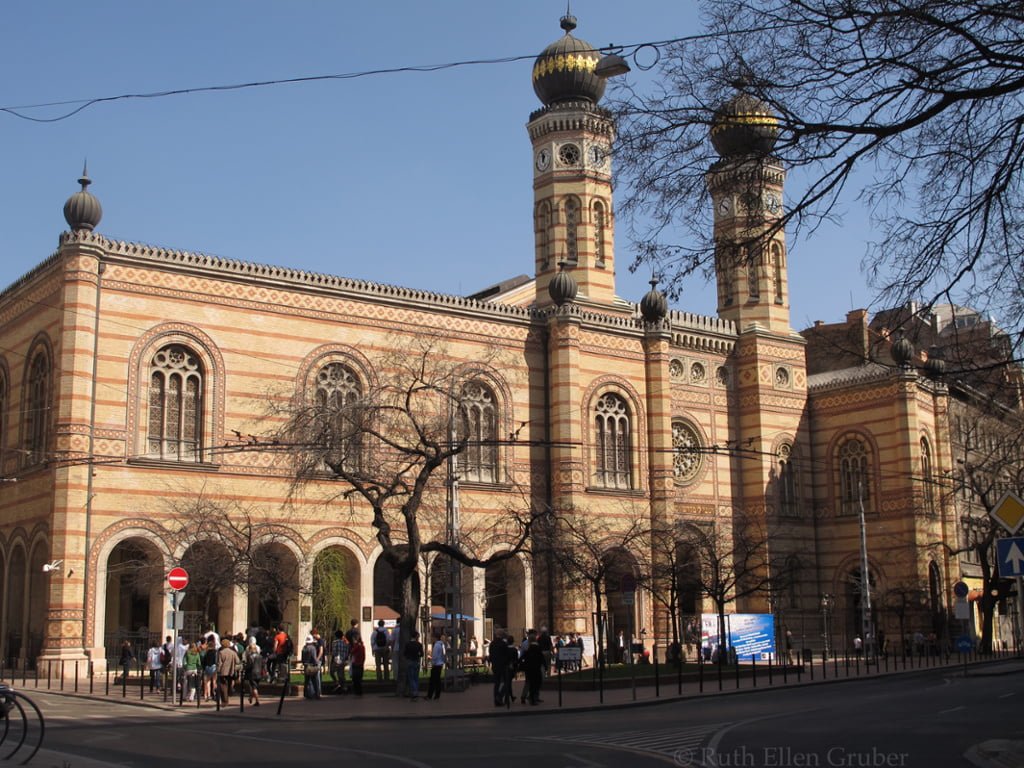
The twin-towered Dohany St Synagogue is a city landmark in downtown Budapest and a symbol of Hungarian Judaism, used for worship and also visited each year by scores of thousands of tourists. The elaborate, Moorish-style building was designed by the Viennese architect Ludwig von Forster and inaugurated in 1859.
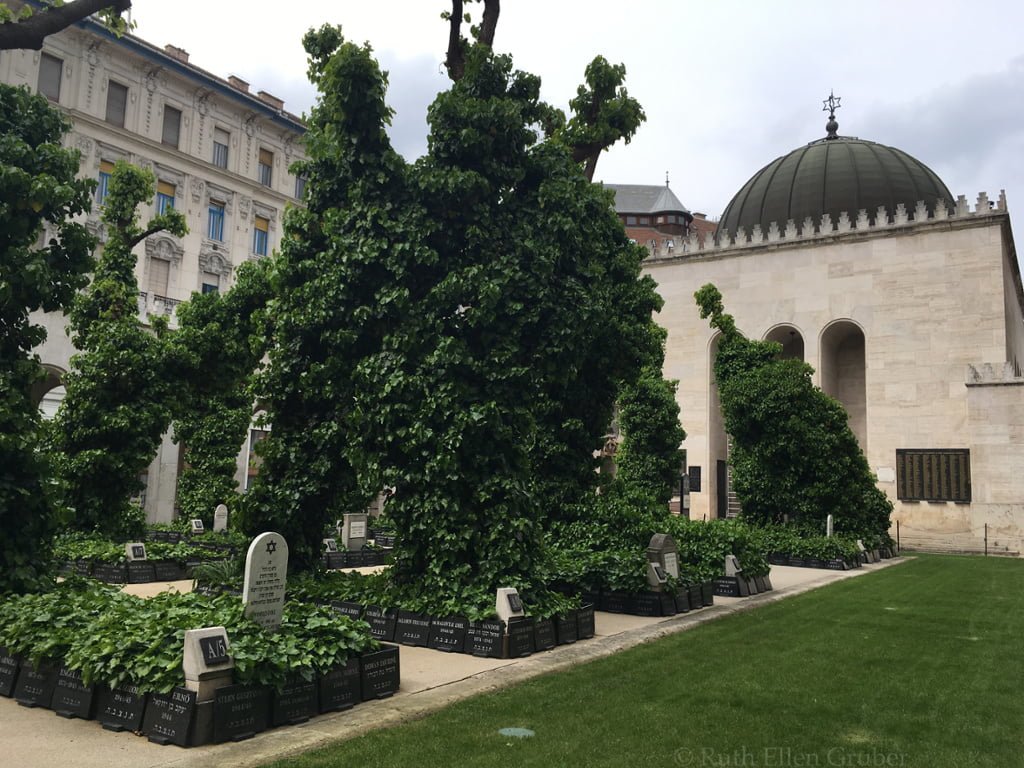
The complex around the synagogue has grown to include the Hungarian Jewish Museum, the Heroes Synagogue (built in 1931 to honor Jewish soldiers who fell in World War I), and a Holocaust memorial space including a monument and a cemetery with the mass graves of Jews who died in the World War II Jewish ghetto.
What did it look like over the decades?
We present here images of its history, via photographs in the Hungarian online Fortepan archive, a remarkable resource that contains almost 120,000 copyright-free photos, freely downloadable and shareable.
The Fortepan website was launched in 2010 by Akos Szepessy and Miklos Tamasi, who initially aimed to gather random photos of the streets of Budapest from the 20th century. Later, thanks to the donations and support from families, private collections, institutions, and professional and amateur photographers, the website expanded to become a fundamental historical resource.

The earliest photos date from the late 1800s and portray Hungarian everyday life over more than a century, depicting buildings, streets, festivals, war scenes, weddings, funerals, etc., not only in Budapest, but also in other cities within the territory of the so-called Greater Hungary, that is, the Hungarian Kingdom before WWI (including parts of today’s Serbia, Romania, Slovakia, Ukraine, Croatia, and Austria).
Fortepan has a search tool through which one can look for a wide range of material. By searching the words “Synagogue”, “Jewish Cemetery”, or simply “Jewish” in either Hungarian or English, it’s possible to find hundreds of Jewish heritage photos. Some of these places don’t exist anymore; others have changed over the decades. Others appear to have remained the same while their surroundings have changed. All in all, these photos bear witness to the history and stories of the country and its people.
The Dohany street synagogue remains the largest synagogue in Europe. The photos of it in the Fortepan archive date back nearly 150 years and show how the building itself has retained its original form, while its surroundings have undergone changes and development.
We have added some of our own photos for comparison.
This photo depicts the synagogue in 1890, decades before the complex itself was enlarged. The adjacent building on the left is where Theodore Herzl, founder of the Zionism, was born. The building was demolished in the early 1930s and in its place the structure now housing the Jewish Museum was built, in the same architectural style as the synagogue. At the same time, the Heroes temple and a courtyard garden were constructed.

Taken in 1945, these two photos show the former synagogue garden, which became the cemetery for the victims who died in the Budapest ghetto between 1944 and 1945. Today, the area is a memorial space.
In the first picture, you see the wall of the Dohany st synagogue on the right, while on the left is the Heroes’ temple.
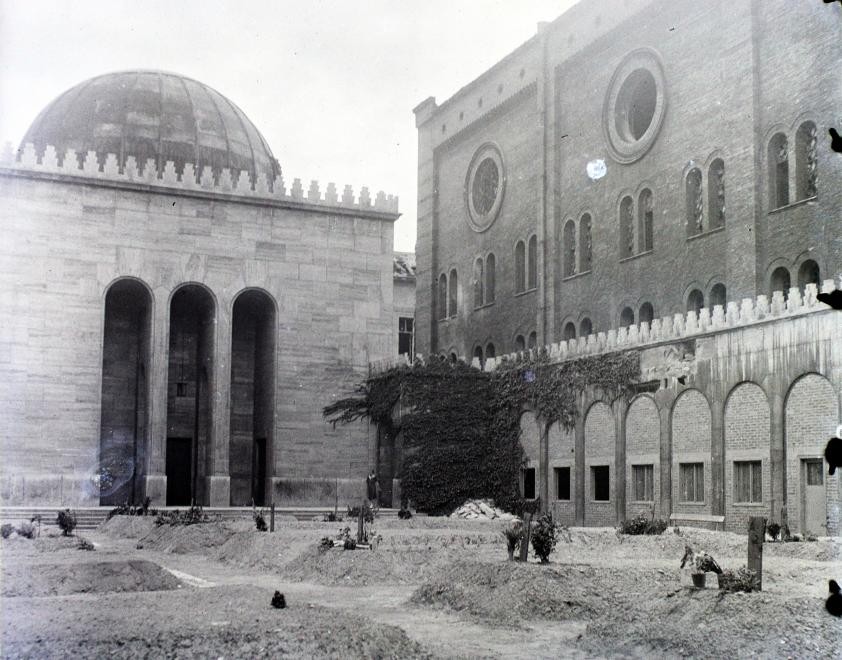
This photo shows the cemetery looking toward the wing housing the Jewish museum.

The cemetery today is a memorial space, — a Garden of Memory — with markers for the graves (and also a database of names). There is also a sculptural Holocaust memorial on the other side of the Heroes Temple.

Fortepan has many photos of Jewish weddings in the years following World War II. Here’s a wedding photo taken in front of the main entrance of the Dohany synagogue in 1947, two years after the end of WWII.

This photo was taken in 1956, during the Hungarian anti-Soviet Revolution, showing the synagogue in the background.

Here’s a photo from Simchas Torah in the Dohany St. synagogue in 1960, looking toward the entrance, showing a full congregation and the interior decor. (The women are upstairs in the gallery).

The is the same view today — showing some of the scores of thousands of tourists who visit the synagogue each year.

The Jewish Museum opened in a private apartment in 1916. Then it moved to the new wing of the Dohany st synagogue complex, built on the site where Theodore Herzl was born, in 1932 — and it occupies the same premises today. Here’s how the main room looked in 1960.

Here’s how the same room looked after a reorganization in the 1980s.
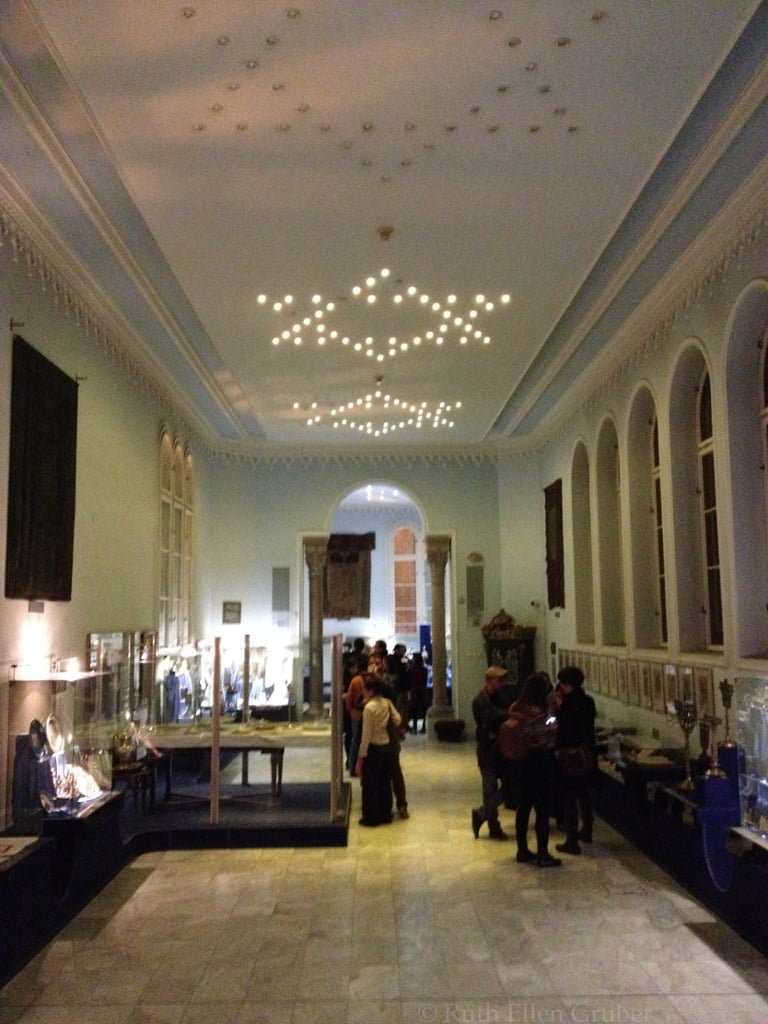
Here’s the same room, showing the museum today, following a revamp and renovation completed in 2017.

7 comments on “Hungary: Tracing the history of Budapest’s Dohany Street synagogue through the online photo archive Fortepan”
I was fortunate to visit in 2009, magnificent building. The wedding photo (looks like the 1920s) is marvelous. One could write a story about many of those standing there.
I so value these images and facts! We were there last year and simply adored it! Such a privilege! In the street alongside it is also an underground “museum” related to Holocaust years in the very place where German leaders interrogated and held Jewish citizens. Would love to revisit!! Many thanks!
It was wonderful to see the pictures, as my parents got married in this synagogue in April,1946.
I visited in 1987, and was most moved by seeing the old synagogue and seeing where my parents were married.
Wonderful pictures. A very, very good article. thank you for posting this.
An historic synagogue. A fine article. Great photos.
I visited the synagogue in 2018 and was overwhelmed at the many languages spoken inside the sanctuary. It was a solemn visit but also encouraging to see so many people who want to hear the history of the beauty and horror of the Holocaust.
Very extensive research of passing lives and historic building streets feelings of respect comes through in posted photographs.