
Visitors to Budapest interested in Jewish heritage rarely venture much beyond the so-called “Jewish triangle” — that part of the city’s inner Seventh District anchored by its three grand main synagogues, located on Dohány, Kazinczy and Rumbach streets. This was also the location of the Holocaust-era Jewish ghetto, and the Shoah is commemorated in the district by memorials.
Budapest, though, has a score of active synagogues scattered throughout the city and enjoys a vibrant and diverse Jewish life. In addition, there are a number of synagogue buildings that no longer serve as houses of worship.
In a series of three articles we will be posting over the coming weeks, JHE Contributor Michele Migliori explores the lesser-known synagogues in Budapest.
This first article takes a look at five former synagogues — synagogues that no longer serve their original purpose.
(NOTE: the Rumbach street synagogue, currently being developed as a Jewish museum and cultural/education center, fits in this category, but since it belongs to the mainstream Jewish tourist itinerary, we do not include it in this article.)
Discovering Budapest’s former synagogues
These five former synagogues, all located outside the inner city center, include several grand structures but are all well off the normal tourist trail.
Angyalföld (Dózsa György) synagogue

Located on Dózsa György ut, a busy traffic artery, the Angyalföld synagogue takes its name from the neighborhood in which it is located, in the north-central part of Budapest. Consecrated in 1908, the synagogue was designed by Lipót Baumhorn, the most prolific synagogue architect before WW2, who designed three other synagogues in the Hungarian capital. The imposing building with its triangular roofline suffered minor damage during the Second World War, and further deteriorated until its restoration in 1984, when it was bought by the Fencing club of the Honvéd, the Hungarian Army’s Sports Club, which still owns the property. However, the bas-reliefs of the Tables of the Law above the rose windows on three out of four sides of the building, together with the beautifully decorated interior of the immense dome that stretches above the fencing court, still recall its previous use as a synagogue. Moreover, a small synagogues still stands in the courtyard, where services are still held today
Watch a video about the synagogue (with English subtitles):
Kőbánya synagogue
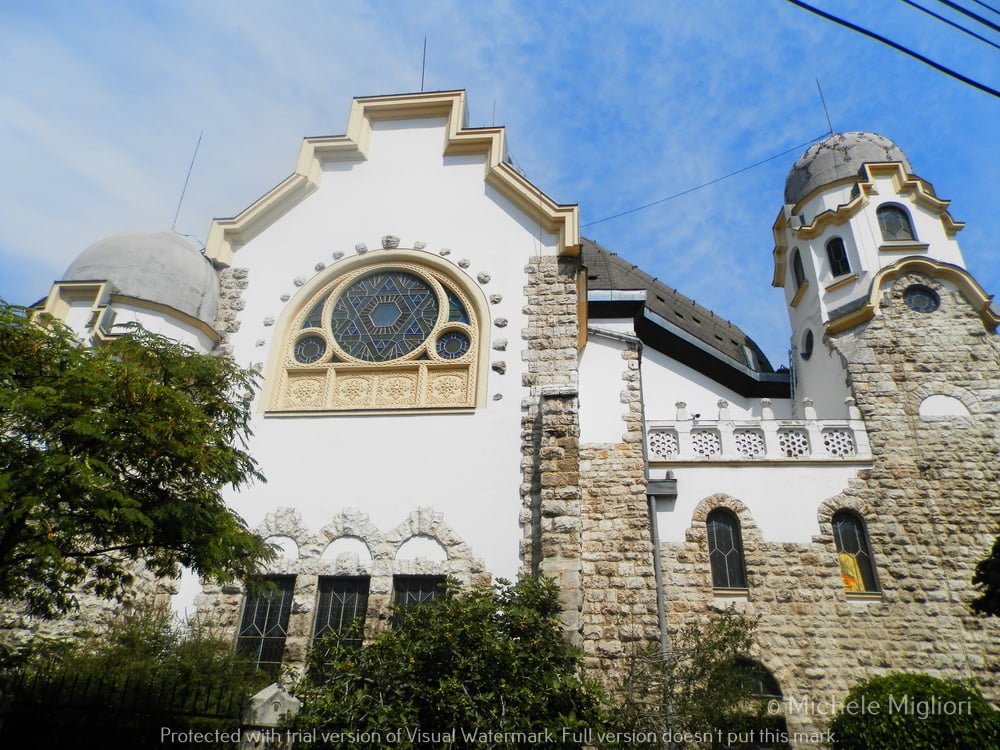
Located at Cserkesz street 7-9 in the X district, in the southeast outskirts of Budapest, the Kőbánya synagogue, with its low, wide dome and cupola-topped small towers, was designed by Richárd Schöntheil and inaugurated in 1911. It features typical patterns of the Hungarian Art Nouveau, with floral details in the dome, and distinctive exterior stone work. The synagogue belonged to the Neolog Jewish community until 1964, when it was sold, and then used as museum, then a theatre, and finally as a warehouse for the Hungarian National Television. It was declared as a protected building in 1974, but its conditions began to deteriorate until the Pentecostal Church bought it in 1989 and started a volunteer and donation-based renovation, which led to its re-inauguration as a Christian Church in 1991. From outside the building is still recognizable as a former synagogue, thanks to the star of David designed in the rose windows, while the interior also retains much of the original look, including the women’s gallery and the place where the Aron ha Kodesh was located.
Rákospalota synagogue

Built between 1926 and 1927 and designed by Mihály and Gábor Feith, the Rákospalota synagogue, at Régi Fóti utca 77, stands in the Rákospalota neighborhood in the north-eastern outskirts of the Hungarian capital. The big ocher building has a distinctive triangular facade marked by an arched portal, a row of thin arched windows, two low, cupola-topped square towers, and a central rose window with a prominent Star of David. It was sold by the Jewish Community in the 1960s and was used as a warehouse. Since the 1980s, it has been owned by the Széchenyi National Library.
Nagytétényi synagogue
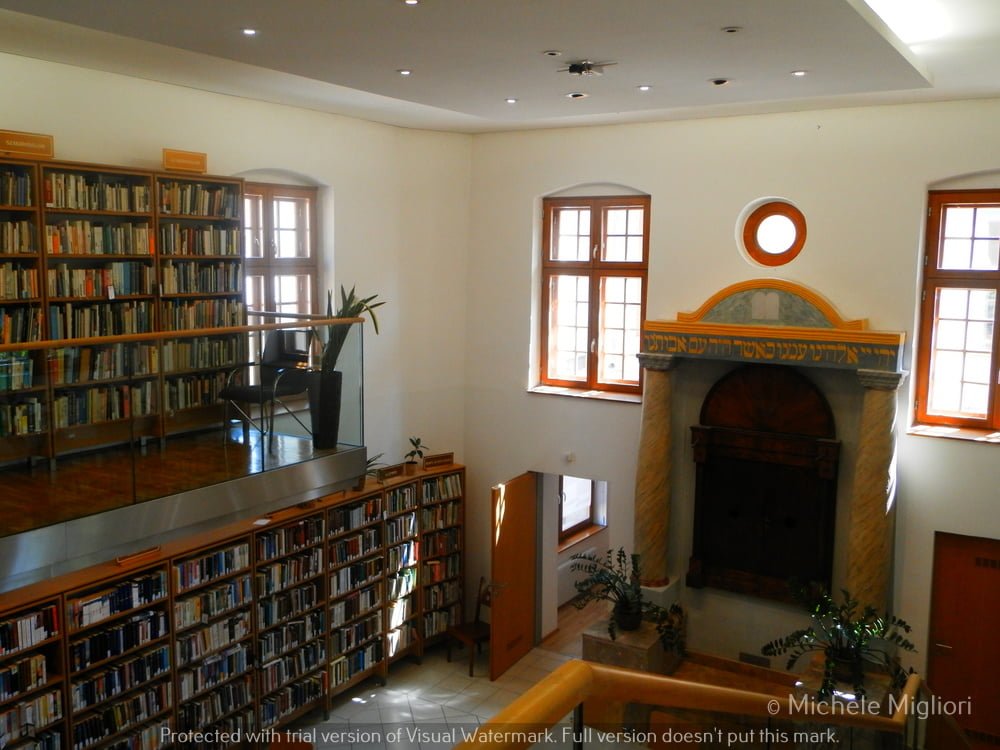
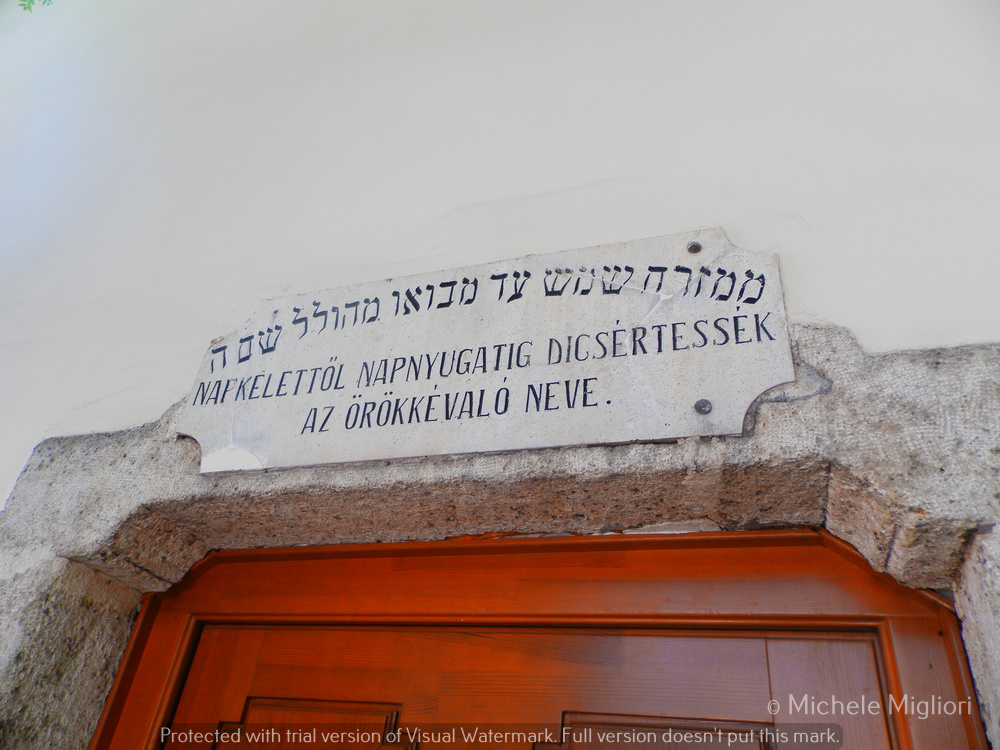
The synagogue is set back from the street at Nagytétény út 283 in the outlying Nagytétény neighborhood in southern Budapest, approximately 15 km away from the city center. Originally a village that was home to an active Orthodox Jewish community, the district was incorporated in the capital administrative area in the 1950s. After the Holocaust, only five Jewish families returned to their homes, and the small Baroque synagogue, built in the early 19th century, was abandoned and then used as warehouse and library stacks. In 2013, the synagogue was restored to serve as a public library, but it retains the original restored Aron ha Kodesh and the original Hebrew and Hungarian inscription above the main entrance. The inscription, from the Psalm 113.3, reads: “From East to West the name of the Lord is praised.”
Synagogue at Jávorka Ádám st. 15
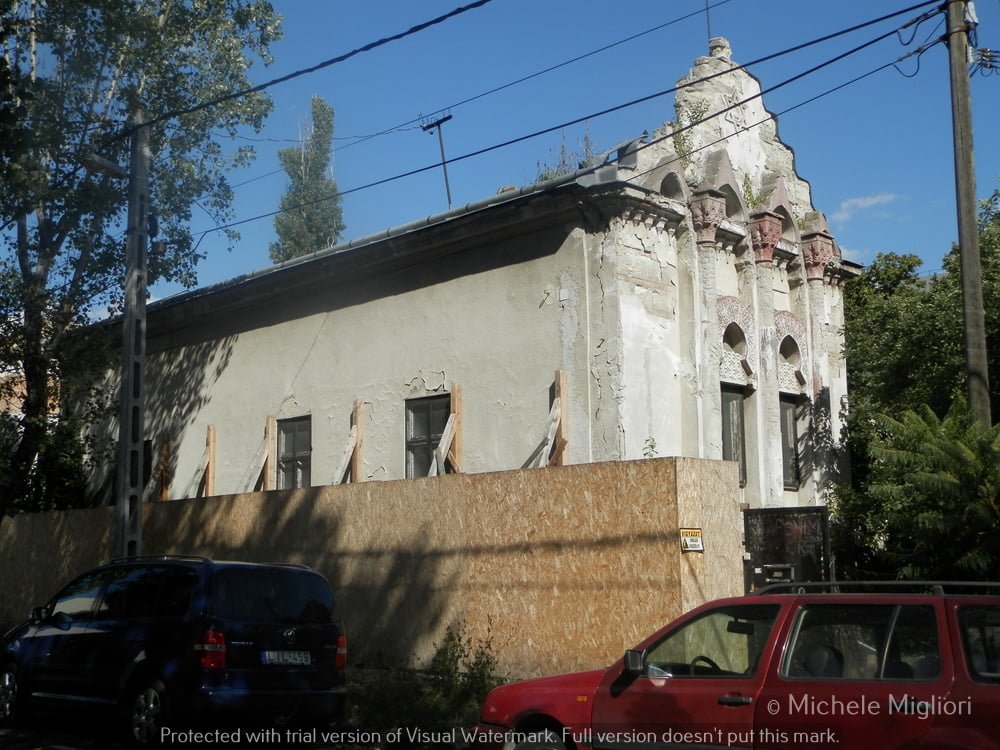
Standing on a quiet street in the neighborhood of Zugló, this is believed to be the only ruined synagogue building in Budapest. The original building was constructed in the 1870s as part of the holiday home of Lajos Csávolszky, a Hungarian journalist and member of Parliament, and it was bought by the Zugló Jewish Community in the 1910s, after Csávolszky’s death. The complex was heavily damaged during World War II, and then partially demolished, but it was used briefly for services after WW2. The synagogue later served as the headquarters of the Habonim Dvor Labor Zionist Youth movement until 2008. Today, the building is shored up by wooden beams, and the courtyard is used as a landfill. In 2015, the district’s mayor announced a working group to study upgrades for this and other local buildings, but the condition of the building has only deteriorated further since then. Click here to download an architectural description and history of the building (in Hungarian)
3 comments on “Hungary: Discovering Budapest’s lesser known synagogues. Part 1 — Synagogues that are no longer used as synagogues”
My grandfather Sandor Abend was a kantor in the synagogue until 1935. I have an old photo from when the synagogue was still there and I visited 5 years ago. Arena ut, Angyalföld (Dózsa György) synagogue
Thanks to you , it is possible to realize how many Jewish communities existed in Hungary. They were doing well , just from the looks , sizes and the beautiful architecture of the synagogues. The hungarians Jews contribuited to the country for many centuries , like any other hungarian citizen . But they were easily decimated , while everyone around them were silent … and in silence these worship buildings keep in their core the jewishness that is gone .
A very good articule of interest to know about the Jewish people, their temples like grant demostration of architecture, art, culture. Congratulations at the author of IT.