

An international team of Israeli, Lithuanian and American archaeologists who have been excavating for four years at the site of the destroyed Great Synagogue in Vilnius have announced extraordinary discoveries that reveal key elements of the building that for 300 years was the heart of Jewish Vilnius.

They include the front section of the Bimah, including the bases of two of its columns, and “a magnificent inscription that was originally set below the Hazzan’s (Cantor’s) reading table” and honors Vilnius Jews who went to live in Tiberius and Jerusalem in the 18th century.
A statement posted on the project’s Facebook page called the finds, made during three weeks of excavations this month, “our most important discoveries to date.” Excavation co-leader Dr. Jon Seligman, Director of the Excavations, Surveys and Research Department of the Israel Antiquities Authority, told JHE they were “spectacular.”
“The bases of the columns that have been unearthed are a huge discovery. We found one of the two holiest places in the building. In the past, these columns were 9 meters high. The unearthed space is special – on this platform the rabbi would stand and lead the service,” Seligman told the Vilnius city web site.
The most important find, the FB statement said, was “a large inscription, cut into red sandstone, with four lines of Hebrew text colored in gilded lettering. The inscription had been smashed with a hammer blow into multiple pieces.”
This stone had without question been one of the most important inscriptions in the synagogue and was placed in an auspicious place on the front of the Bimah. The plaque describes the donation of the Hazzan’s reading table to the Great Synagogue in 1796 by two brothers in honour of their father who had emigrated (Aliyah) to Tiberius in Eretz Israel and had later died in Jerusalem. These few sentences express the deep connection between the Litvak community and Israel that existed from the time of the Gaon of Vilna until today.

The Hebrew reads:
‘לפרט ‘תעלנו’ (שנת 1796) בשמחה לארצנו. נדבו ר’ אליעזר ור’ שמואל בני ר’ חיים שחי בטבריא תוב”ב וחי”ש תמת שרה אב”ר שבתי ד’ אדר, ולירושלים ‘מבשר’ (שנת 1782) אתן, וא”ר חיים ב”ר חיים מת שם ז’ ניסן, אתה ‘תקום’ (שנת 1796) תרחם ציון.’
The statement said:
the inscription contains multiple Biblical references, abbreviations, plays on words based on numerical inference and poetic styling.
A partial translation [by Vladimir Levin of the Center for Jewish Art and Rabbi Yeheil Poupko, as well as Seligman] captures some of the complexity:
In the year “Bring us with joy to our country” [a verse from Amidah prayer] [=1796]. [This Torah reading table] was donated by R. Eliezer and R. Shmuel, the sons of R. Chaim who lived in Tiberias, be it rebuilt and reestablished soon in our days. “And died Sarah” [Gen. 23:2] our mother, the daughter of R. Shabbtai, on the 4th of Adar “I gave to Jerusalem a messenger of good news” [Is. 41:27] [=1782] and our father R. Chaim son of R. Chaim died there on the 7th of Nissan “arise and have mercy on Zion” [Ps. 102:14] [=1786].

The Great Synagogue was built in the early 1600s in Renaissance-Baroque style. It became the center of Jewish life in Vilnius (Vilna), towering over the Shulhoyf, a teeming complex of alleyways and other Jewish community buildings and institutions including twelve synagogues, ritual baths, the community council, kosher meat stalls, the Strashun library, and other structures and institutions.
It was ransacked and torched by the Nazis in World War II, and the postwar Soviet regime torn down the ruins and in the 1950s built a school on the site.
The archaeologists, sponsored by a number of Israeli, Lithuanian, and U.S. institutions, have been excavating at the site each summer since 2016, after first preparing the way with geophysical scans. In 2017, major finds were the discovery of two ritual baths (mikvehs).
Last year, the excavations revealed the foundations of the Bimah that once anchored the synagogue, locating it directly under the school building. The Bimah was built in the 18th century following a destructive fire in 1748. Its construction was financed by a local benefactor, a writer and judge named Yehudah ben Eliezer, who was known by the acronym YESOD. The archaeologists have described the Bimah as having been “a two tier baroque structure built of four Corinthian and eight Tuscan columns, decorated with lions facing the Aron Kodesh.”
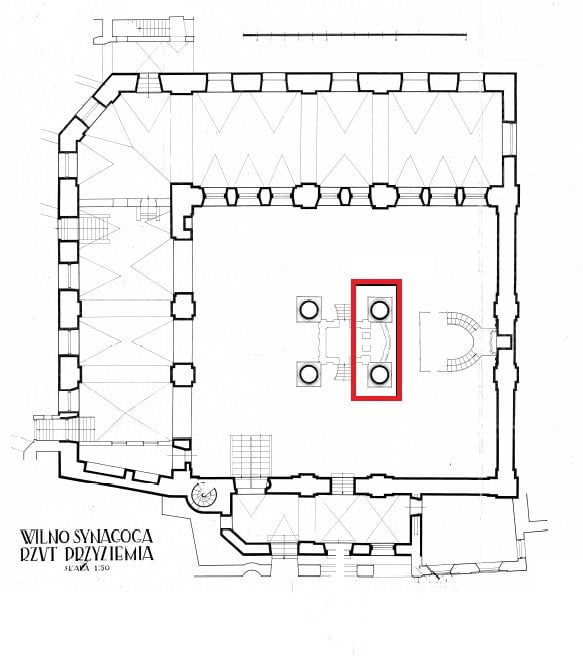
This year’s excavations, the Facebook statement said, uncovered the front section of the Bimah, “including two of the massive columns that once supported the roof of the Great Synagogue ” — and also a basement room beneath the Bimah, which contained coins and other material.
The Bimah had two sections, the central square section that would often host the synagogue choir, and the front porch, where the Hazzan would chant the weekly Parasha (Bible segment) to the congregation. The floor of the Bimah was decorated with coloured terrazzo with red and black patterns.
To our surprise, below the floor of the Bimah we found an underground cellar. The cellar’s contents were sifted and we found close to 200 coins dating from the 17th to early 20th centuries, buttons of Napoleon’s Grand Armée, seating plaques and many pieces of the smashed Bimah superstructure.
Fragments of the ceiling of the Bimah showed that it had been painted a deep, almost royal blue color.

Among the coins found was also a Five Reichspfennig Coin — a relic of the Nazi occupation. The Great Synagogue and shulhoyf were included in the so-called “small ghetto”, which existed for little more than one month in September-October 1941. Some 11,000 Jews were confined there; most were sent to their deaths at the Ponar extermination camp; 2,000 were moved to the “big ghetto” across the street.
Click to access the Facebook page for the project, with many earlier updates
Click to access the project’s web site with full reports on previous seasons of excavations
Click to see the article on the Vilnius city web site
See our post with video from 2017
3 comments on “Lithuania: Archaeologists announce sensational discoveries at site of destroyed Vilna Great Synagogue – including front section of the Bimah and important inscribed tablet honoring Vilna Jews who had moved to Eretz Israel in the 18th century”
This is AWESOME news. Thank you!
The three people mentioned in the inscription don’t appear to be rabbis. The Hebrew before their names is the letter Resh (r) followed by an apostrophe. This usually means Reb, which is roughly equivalent to Mister.
I’ve passed this on to the people who translated the inscription