

The small town of Venosa lies amid barren terrain in an out-of-the-way part of southern Italy, but it is the site of a rich trove of Jewish heritage sites — including catacombs — that shed important light on Jewish life in ancient Roman times and the early middle ages.
JHE director Ruth Ellen Gruber visited Venosa this month and toured the major sites, which are now being developed by the Foundation for Jewish Heritage in Italy, in collaboration with state, regional , and academic institutions, as part of a project called “Venosa: Jewish Capital of the South 2020.”
The sites in Venosa include the extensive Jewish catacombs dating from between the 4th and 6th centuries CE, and a huge, but never finished, church complex whose builders in the 11th-12th centuries used repurposed construction material including slabs from an apparently abandoned 9th century Jewish cemetery. In the town’s archaeology museum, located in the castle, there is also a permanent exhibit on ancient Roman-era Jewish inscriptions from Basilicata and Puglia.
Situated in the Basilicata region, around 170 km east of Naples, today’s Venosa was the ancient Roman city of Venusia, an important crossroads for trade and transport (and birthplace of the ancient Roman poet Horace). Archaeological evidence shows that it had a sizable Jewish population that was well integrated into local society.

The catacombs are Venosa’s most important and bestknown Jewish heritage site — and they are now the central focus of the longterm development project, one of whose aims is to fully document (using laser, digital, and other technology), conserve, and develop the site for visitors.
The Italian Ministry of Culture in June announced a grant of €2.5 million that will be directed mainly toward conservation.
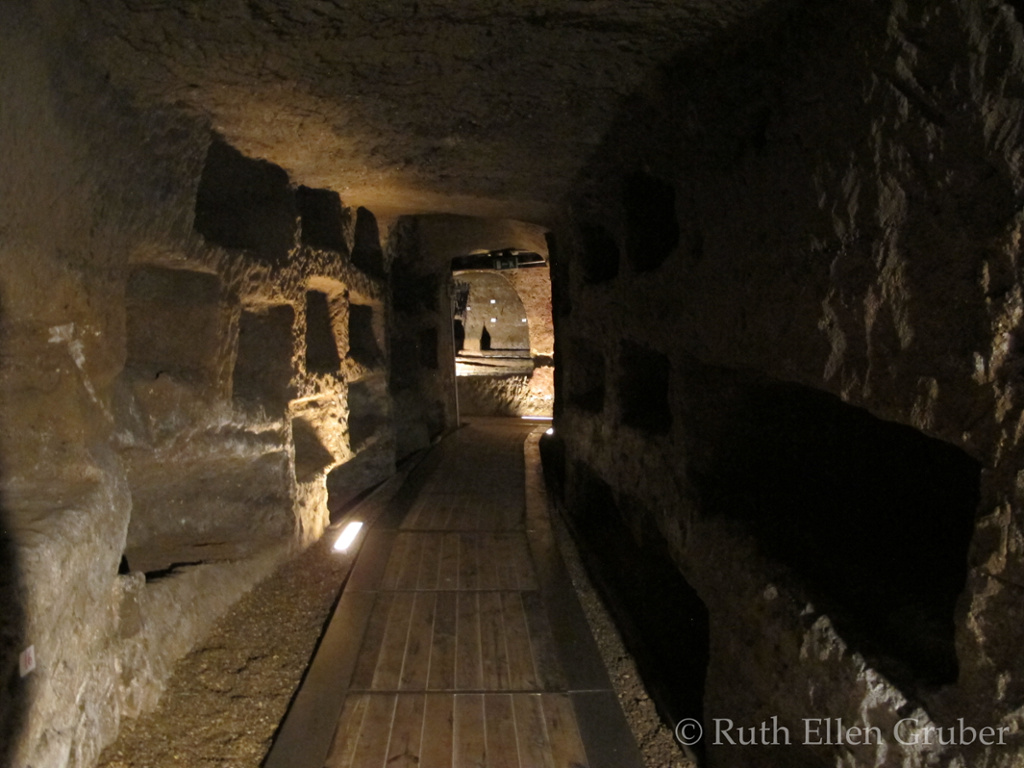
There are already information panels along a route that leads through a main part of the catacombs.
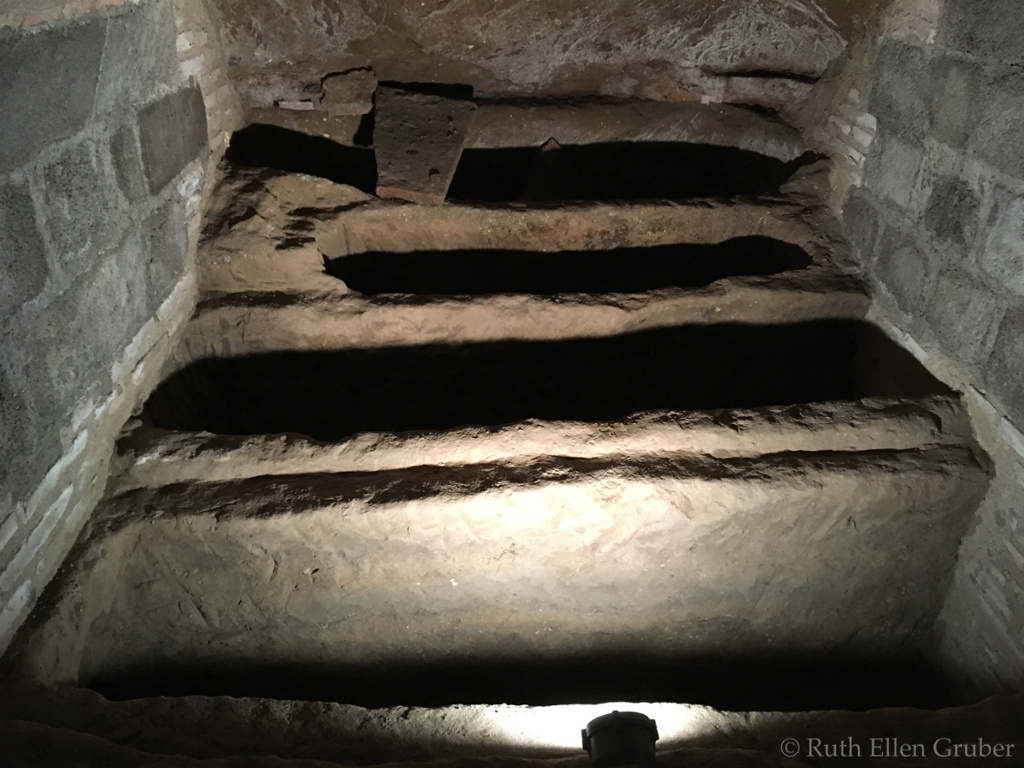
Lying carved into the soft volcanic tufa rock under Maddalena hill outside the city, the catacombs were discovered by chance in 1853.
They occupy an extensive network of passages, along three main corridors on more than one level, and feature several types of burials spaces. Some are:
loculus tombs arranged along the walls or set into the ground; other graves are organised in cubicles (chamber tombs containing multiple graves), and arcosolia (tombs placed in arched recesses).
Major archaeological excavations of the site took place in the 1970s and 1980s. They revealed that there were also Christian catacombs adjacent to the Jewish complex.
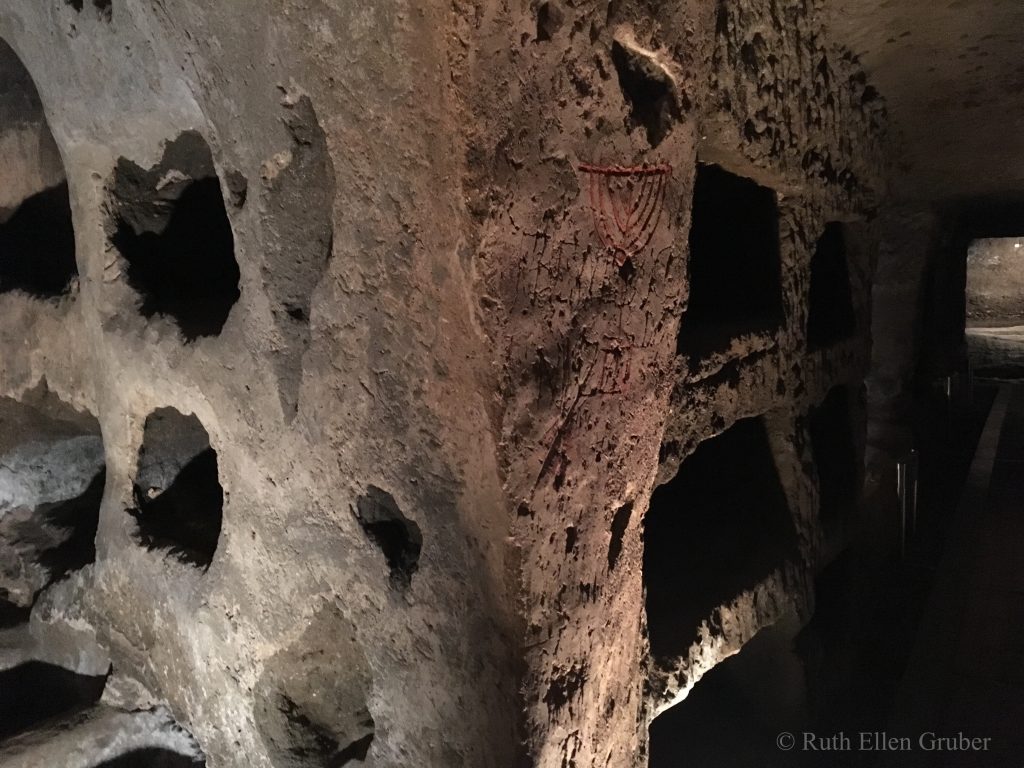
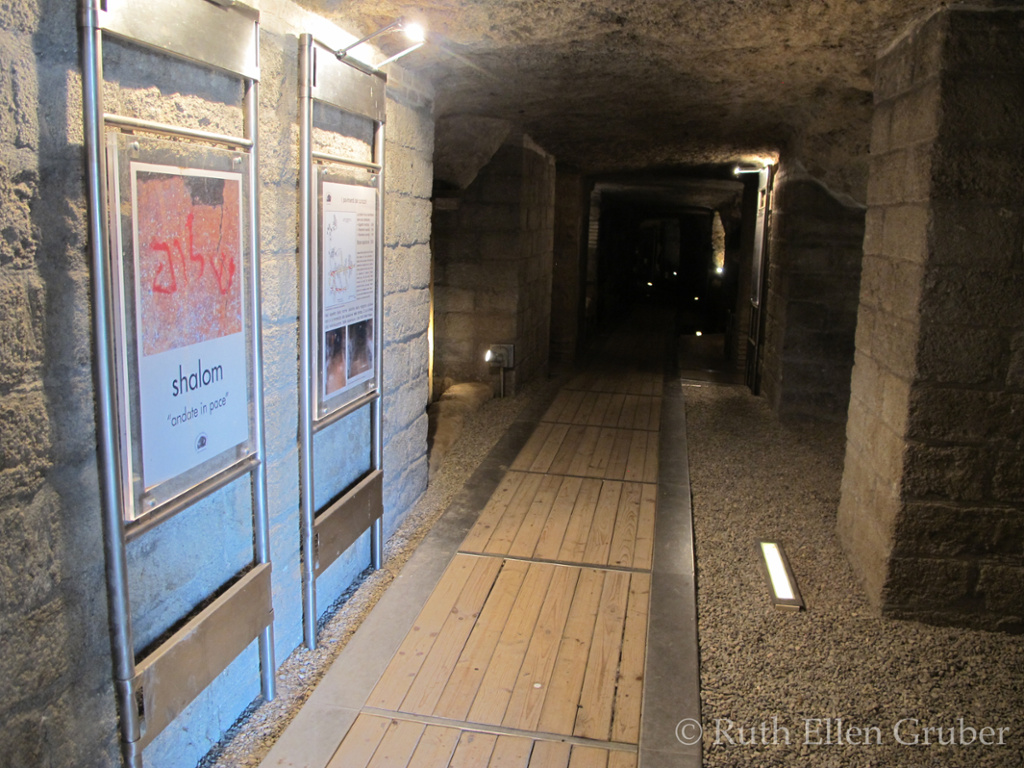
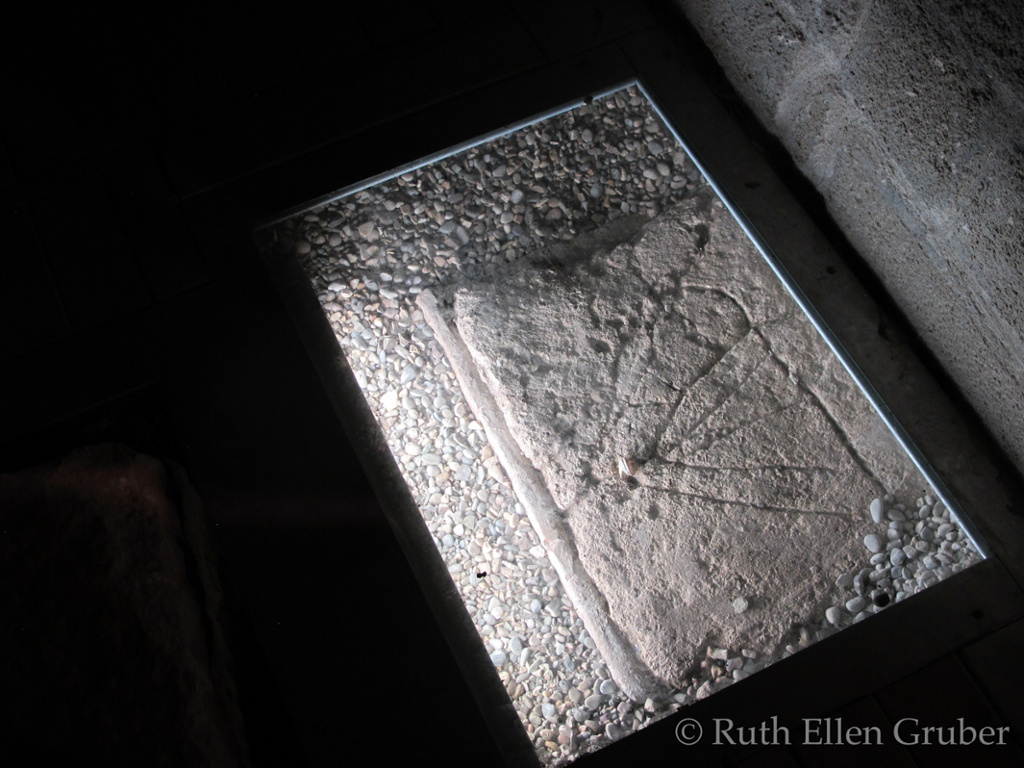
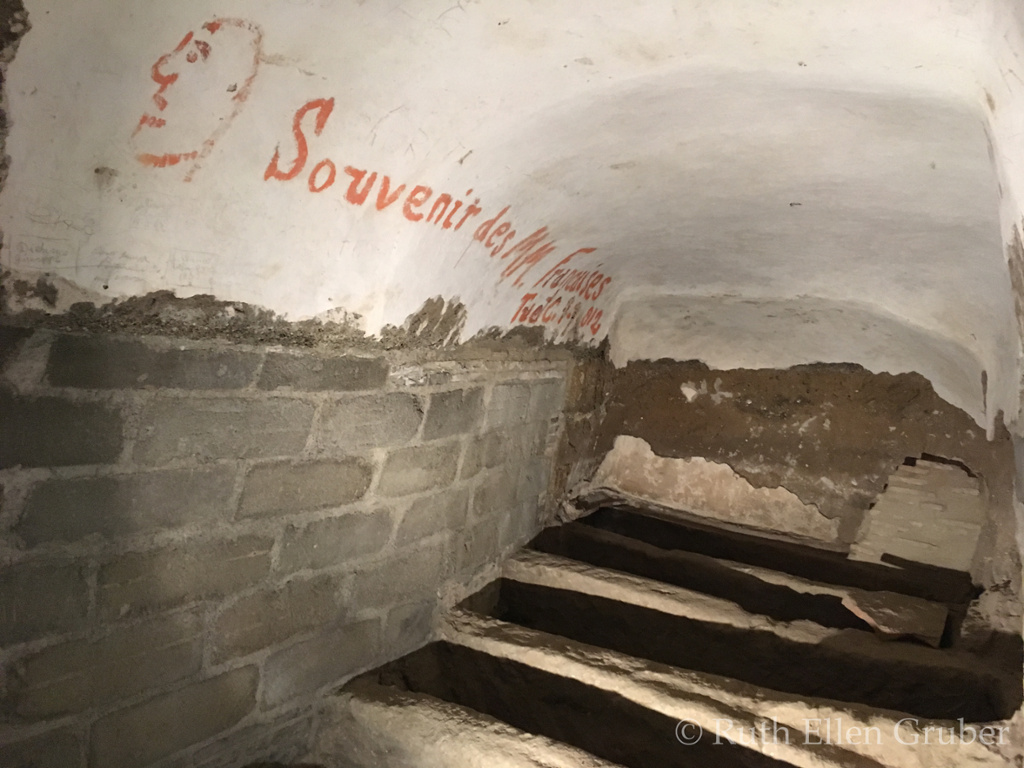
Excavations revealed around 75 inscriptions in the catacombs, written in Greek, Latin, and Hebrew, as well as depictions of Jewish symbols such as the Menorah, Lulav, Esrog, and Shofar.
The Naples-based scholar Giancarlo Lacerenza has just published an extensive new article on these inscriptions: “Painted Inscriptions and Graffiti in the Jewish Catacombs of Venosa: An Annotated Inventory.” (In Annali Sezione Orientale vol 79, 1-2 (2019) pp 275–305.)
Later Jewish inscriptions can also been seen at the vast Chiesa Incompiuta (Unfinished Church) complex, at the edge of the Venosa archaeological park.
The complex comprises two main buildings: the ancient church with guest quarters, in the early Christian building which was transformed and expanded mainly in the Lombard and Norman periods (10th-11th centuries); and the new church (11th – 12th century), which was never finished, hence its name “Incompiuta” (“Uncompleted”).

Repurposed stones were used in the construction of the Incompiuta.

These included stones with Latin inscriptions — and also around 25 stones bearing Hebrew inscriptions dating from the 9th century.
These are believed to have come from a Jewish cemetery that had been located near the Roman amphitheater nearby (which itself was also dismantled and used for construction). The exact location of that cemetery is unknown, as it was destroyed probably in the 10 or 11th century.
Exposed to the elements for more than 1,000 years, the inscriptions are not easy to read (or see).
The Dutch scholar Leonard Rutgers, who has studied them, has called them “the single most important collection of early medieval Jewish tombstones” in Europe.
What makes Venosa unique from the perspective of Jewish history, is that the history of the Jewish community there can be traced during one of the darkest periods in European and one of the most transformative periods in Jewish history. The early Middle Ages saw the rise of rabbinic Judaism, and the inscriptional evidence left behind by the Jewish community in Venosa is crucial in helping us to understand when and how this process took place. It is one of the paradoxes of history that the Jewish inscriptions from Venosa have survived at all: they did because they were reused by the builders of the church of the Holy Trinity. This building dates to the twelfth century and was never finished.

The third important focus of ancient Jewish heritage in Venosa is the exhibition of ancient Jewish inscriptions at the Archaeological Museum at the Venosa castle.
We wrote about this and a related exhibition when they opened in seval venues in 2014.

Called “Ketav, Sefer, Miktav: Jewish Written Culture in Basilicata and Puglia,” the exhibition was mounted in honor of the late scholar Cesare Colafemmina, who spent his professional career researching and writing about Jewish heritage in southern Italy — and who carried out major excavations in the Venosa Jewish catacombs.
It includes numerous examples of ancient inscriptions, as well a text panels.
A statement said when it opened that:
It is the first project concerning an interregional Exhibit between Puglia and Basilicata on the Jewish presence, a component which deeply contributed to the growth of the cultural identity of the territories considered in the context of the Mediterranean and in relation with the European area.
Read a New York Times article from 1981 about the excavations
Read our article about the ancient inscriptions exhibition
1 comment on “Italy: Venosa — a treasure trove of catacombs & other Jewish heritage dating back to ancient Roman times”
I am looking for the actual inscriptions on these 23 tombstone from Venosa. It is my understanding they have dual dating on them. One according to the Churban system. How many years from the destruction of the Temple and the other from creation. They were some of the earliets records of those using the second system.
I have documented 40 datable tombstones from Zoar Jordan. One using the Arabic calendar system.
Can you direct me to where I can get the inscriptions in English please.