

Berlin’s Weissensee Jewish cemetery, covering 42 hectares and with some 115,000 burials one of the largest in Europe, is something of a nature preserve, home to a remarkably vast variety of plant and animal life, a wide-ranging survey shows.
The survey was carried out by a team led by Ingo Kowarik, a professor of plant ecology at the Technical University of Berlin. Its results were published as “Biodiversity functions of urban cemeteries: Evidence from one of the largest Jewish cemeteries in Europe,” in the June issue of the journal Urban Forestry & Urban Greening.
As the world becomes more urbanized, urban cemeteries may become increasingly valuable for biodiversity conservation as cemeteries are ubiquitous elements of the green infrastructure in cities worldwide. By implementing a multi-taxon approach at different spatial extents, we analyzed habitat functions of a large urban cemetery in Berlin (Weißensee Jewish Cemetery) and explored related environmental variables. This cemetery is an outstanding cultural heritage site but it also stands for old urban cemeteries that have progressed to urban woodland, an ecosystem type that exists in many regional and religious contexts.
The researchers found that the cemetery, parts of it cleared and well maintained but much of it overgrown, is home to 604 species of flora and fauna normally found in deeply wooded areas.
According to a report on the survey in National Geographic, these included 44 avian species, including “some of conservation concern like the icterine warbler, the spotted flycatcher, and the green woodpecker,” as well as:
64 species of spiders, 39 species of ground beetles, five kinds of bats, and some highly endangered ferns. Lichen in particular has really taken hold in the cemetery—the researchers found 72 species of the slow-growing organisms on the numerous stone faces.
The findings suggest that urban gravesites may be even better refuges for wild creatures than parks, because cemeteries have fewer visitors and barking dogs, and they are often walled in and closed at night.
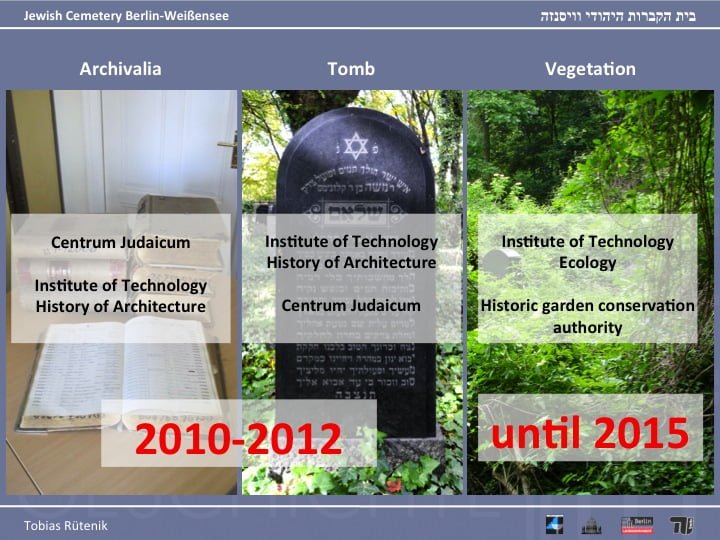
The survey of animal and plant life was published separately but linked to a much broader survey carried out in 2010-1012 that investigated every aspect of the cemetery and compiled a digitized database of its burials and inscriptions. Tobias Rütenik presented a report on this broader project at the 2013 conference in Krakow on Managing Jewish Immovable Heritage. It was published (and is available online) as 155.628 Berliners: The Weißensee Jewish Cemetery – Documentation of the Comprehensive Survey of the Burial Sites.
According to the abstract of the flora and fauna survey, the study results
support the use of differentiated management approaches to maintain habitat heterogeneity by allowing wilderness development in some parts of a cemetery while keeping others more open.
Since these aims can be combined with efforts to preserve outstanding grave architectures and allow access to visitors, our study indicates ways of reconciling conflicting aims of heritage preservation and biodiversity conservation, a promising perspective for biodiversity conservation in culturally shaped urban landscapes.
We conclude that cemeteries provide important cultural ecosystem services within the urban green infrastructure.
Read the National Geographic article
4 comments on “Fascinating! The wild wildlife in Berlin’s Weissensee Jewish cemetery”
I was unable to open the pdf: Download the PDF of the survey 155.628 Berliners: The Weißensee Jewish Cemetery – Documentation of the Comprehensive Survey of the Burial Sites
does anyone know how to read the article.
It opens fine for me in Firefox. Try again http://www.stadtentwicklung.berlin.de/denkmal/landesdenkmalamt/download/neuerscheinungen/band40_jued_friedhof_weissensee.pdf
very interesting history,thank you for sharing this.
Biodiversity ,fascinating : you may say a real Jewish Heritage to let grow and blossom : נח should be amused and proud.A continuity beyond praise.
A gut sjabbes!