
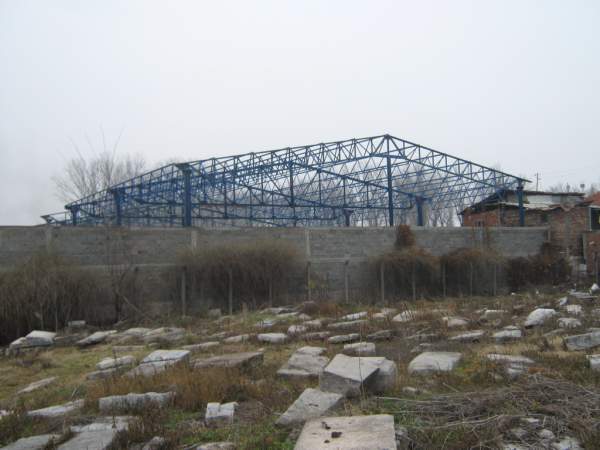
Legislation that would make the desecration of cemeteries – including Jewish cemeteries around the world – a violation of religious freedom has passed the U.S. House of Representatives and will now head to the Senate. The date of the Senate vote was not immediately known.
The bill, introduced in the House in February by Rep. Grace Meng of New York, was passed by voice vote on May 28. Meng said it had been suggested by some of her Jewish constituents who were concerned at threats to Jewish cemeteries in their ancestral homelands in Eastern and Central Europe, where few Jews now live and thousands of Jewish cemeteries lie neglected.
Two key threats, she said, were vandalism and developers building over cemeteries. Coincidentally, vandals struck the Jewish cemetery in Thessaloniki, Greece, on or about the same day, damaging about a dozen tombs.
According to a press release from Meng, “The Protect Cemeteries Act (H.R. 4028) would amend the International Religious Freedom Act of 1998 to include the vandalizing of cemeteries as one of many infringements on the right to freedom of religion.”
Under the1998 law, the U.S. can impose penalties on countries that obstruct religious freedom. These include slashing foreign aid, public condemnation, cancelling official visits and cultural or scientific exchanges, imposing trade sanctions and prohibiting import and exporting agreements, among others.
Meng stated:
This legislation would be a new and important tool in our fight against the desecration of cemeteries. It would combat religiously-motivated vandalism of cemeteries and also prevent developers from building over cemeteries, a new and emerging threat in places where there are no Jewish communities left to protect burial grounds. It is essential that we increase preservation, tolerance and respect for cemeteries across the globe, and this legislation would go a long way towards accomplishing that critical goal. I applaud my colleagues in the House for approving this important bipartisan legislation, and I now call on the Senate to do the same.
Here are some of Meng’s remarks delivered on the floor of the House during consideration of the bill:
There are two related problems we seek to address through this legislation. One is the religiously-motivated vandalism of cemeteries that occurs with alarming regularity. The second is the building and development over cemeteries in places where there are no communities remaining to protect and look out for the cemeteries. HR 4028 will give our diplomats a new tool they can use to protect our interests.
HR 4028 also empowers the Commissions on International Religious Freedom and on the Preservation of America’s Heritage Abroad. The latter Commission was established in the 1980’s through legislation introduced by the late Congressman Stephen Solarz. It works to identify and preserve cemeteries, memorials, and buildings in foreign countries that are associated with the cultural heritage of Americans, and it does much work in areas of the former Soviet Union, where Jewish communities were destroyed by the Holocaust and where power subsequently passed to atheistic, communist regimes.
It is essential that we act to protect religious freedom in these areas, where as we know political instability and anti-Semitism are widespread. The genocides of the 20th century destroyed communities and left their burial grounds uncared for and unpreserved.
The preservation of cemeteries often reflects the religious tolerance and freedom of the countries in which they are located. It is my hope that this resolution will help promote such preservation and greater tolerance, respect, and empathy around the world, as well as honest assessments of history. I urge my colleagues to support HR 4028 and I reserve the balance of my time.
Mr. Speaker, unfortunately anti-Semitism and religious intolerance remain all too prevalent in our world. We grapple with these issues in some form every day. This resolution will give American officials real tools with which to promote not only religious tolerance, but truth – truth in the form of preservation and recognition of the memories of those who came before us.
Read a Religion News Service article on the vote