
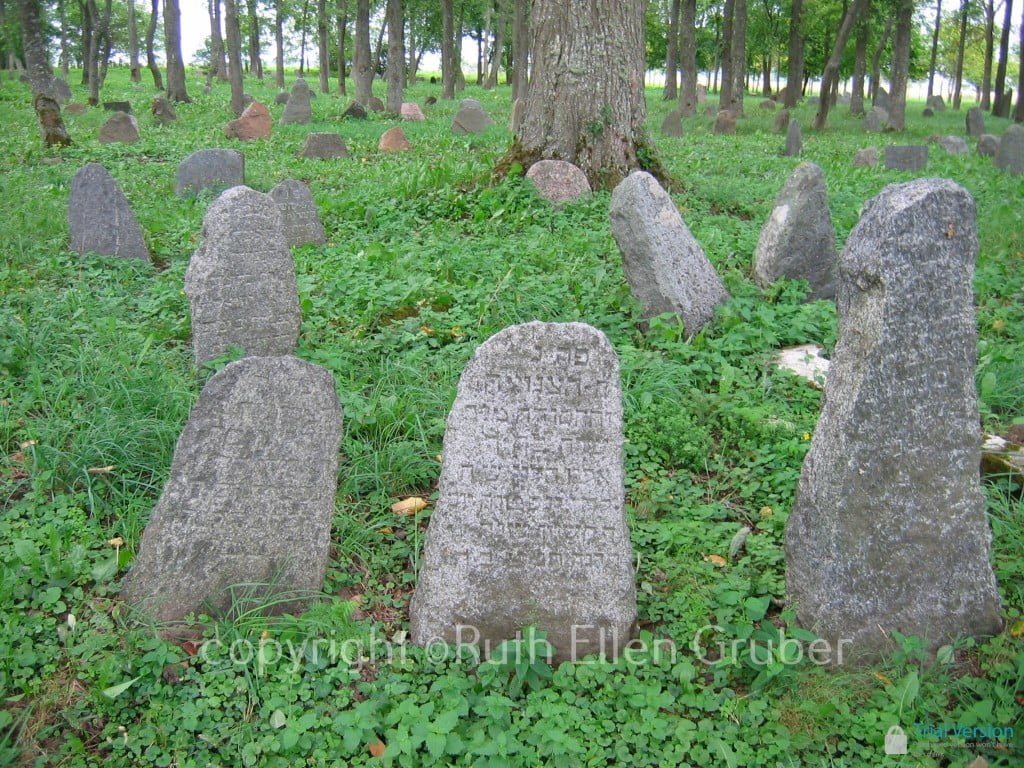
MACEVA, the Lithuanian Jewish cemetery project, has released its 2013 Activity Report on its efforts to digitally document and preserve Jewish cemeteries in Lithuania. It demonstrates progress — but also underscores the many challenges.
There are progress reports on digitization in five Jewish cemeteries — note, however, that not all the pictures from digitalized cemeteries have been uploaded online yet:
Gargždai Jewish cemetery – there are about 70 tombstones remaining, most are hardly legible. A large portion of cemetery was destroyed during the Soviet Era. The remaining territory is fenced and clean. Some parts of the previous cemetery territory are now part of residential plots.
Vainutas Jewish cemetery – nearly 30 tombstones remain.
Švenčionėliai Jewish cemetery – MACEVA and a few volunteers took pictures of every gravestone, we hope to translate all inscriptions and post it to our virtual cemetery database.
Pandėlys Jewish cemetery -Jewish cemetery of Pandelys was digitized and cleaned by local schoolchildren. Photos Eglė Butėnaitė.
Užpaliai Jewish cemetery – This cemetery has now been partially digitized ( thanks to Sandra Petrukonytė, Raimondas Rozluckis, Mantautas Šulskus, Marius Lukoševičius and Mantas Muckus for assisting in cleaning and taking pictures of tombstones). There are many tombstones remaining. A brief video of cemetery was taken in Autumn – view here.
In addition, the report updates the condition of 10 Jewish cemeteries that were visited by MACEVA personnel during the year — some are in good condition, others not.
Vilijampolė (Slobodka) Jewish cemetery in Kaunas – the cemetery exists, but is in terrible condition. Some parts of a fence remain visible. The northern part of the cemetery still has many old tombstones, they are located on a hill; forestation has made it difficult to see this surviving area. The cemetery was destroyed during the Soviet era.The cemetery of Vilijampole dates back to XVII-XVIII century – it is the oldest Jewish cemetery in Kaunas.
Vilijampolė Jewish cemetery II in Kaunas – cemetery exists, but there are no tombstones remaining only a memorial stone. This is also the Holocaust burial site in the area.
Žaliakalnis (Greenhill) Jewish cemetery in Kaunas – the area of the cemetery is in poor condition. Half of the cemetery was bulldozed, the rest of territory contains numerous fallen tombstones. The cemetery is the largest remaining Jewish cemetery in Lithuania.
Dotnuva Jewish cemetery – the area is well preserved. The territory is unfenced, but the cemetery is reasonably well preserved; all vegetation overgrowth has been removed, the area is regularly cleaned. It would appear that a local municipality attends to this matter. There are about 50 tombstones remaining.
Nemakščiai Jewish cemetery – the cemetery is fenced and preserved, some of the tombstones have fallen.
Jonava Jewish cemetery – the area of cemetery is well preserved by the local municipality.
Linkmenys Jewish cemetery – the cemetery is surrounded by an old stone fence. It is in a poor condition.Pumpėnai Jewish cemetery – the cemetery in Pumpėnai is near the main road to Panevėžys.
Pasvalys Jewish cemetery – although the cemetery in Pasvalys was destroyed during the Soviet period, some fragments of the ohel and gravestones can be found.
Valkininkai Jewish cemetery – the cemetery is the resting place for Jews from Valkininkai, Čižiūnai and Degsnė (a well-known Jewish farmers’ village).
The report also includes information regarding the progress on translating gravestone inscriptions; new photos shared and uploaded, and other activities.
Link to the 2013 MACEVA Activity Report
1 comment on “MACEVA Lithuanian Jewish cemetery project — 2013 activity report”
Hi
Is it possible to visit Valbaninkas Jesus cemetery?
My mom family came from this town.
We are going to Lituânia NeXT week and we would like to visit the town.
Thank you in advance