
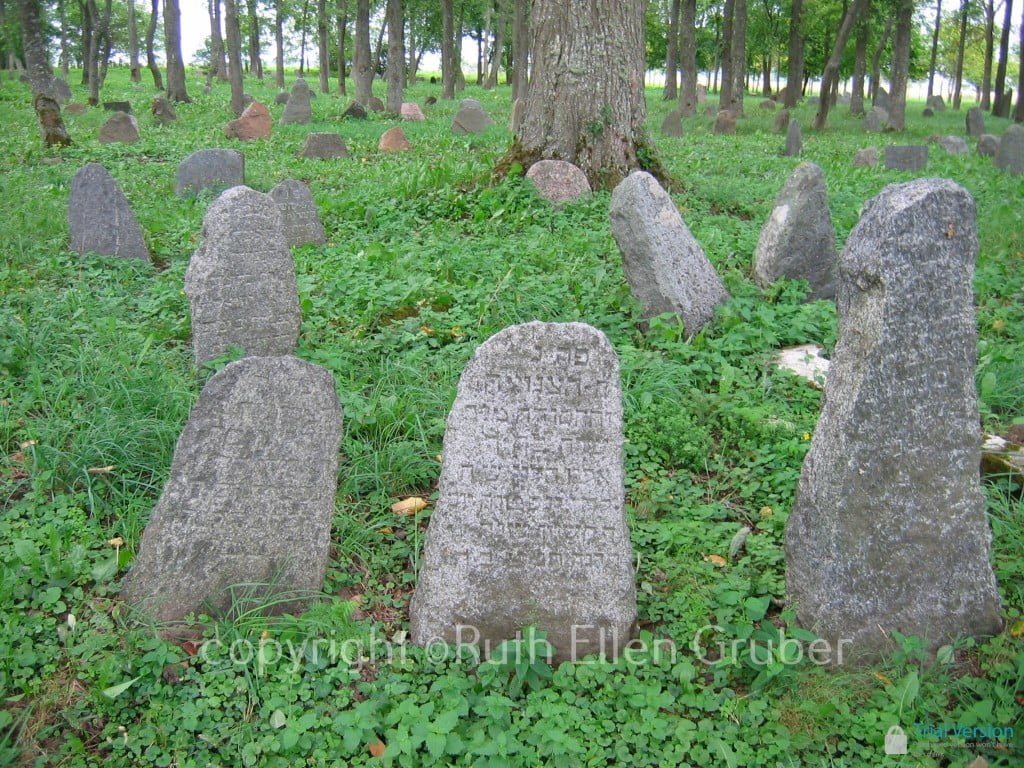
The English-language Lithuania Tribune runs a lengthy interview with Sergey Kanovich, one of the founders and directors of Maceva, a non-profit that organizes volunteers to document and maintain Jewish cemeteries in Lithuania.
Maceva’s project co-ordinator, Rūta Anulytė, gave a presentation about Maceva at the working seminar on managing Jewish immovable heritage that was held in Krakow in April. Videos of all presentations at that conference are online — Ruta’s can be viewed here.
Here is an excerpt of the interview with Sergey Kanovich:
TLT: Could you explain to our readers the process involved in selecting which cemeteries are to be restored and in turn preserved, and then how Maceva organises its volunteers to carry out the restoration process?
There were about 220 Jewish communities scattered across Lithuania before World War II, and most of them had cemeteries. The majority of them survived the WWII for the Nazis were mainly interested in killing people, whereas the Soviets applied many efforts to erase the memories of those killed: cemeteries were desecrated, tombstones were used as building material, and there was never any attempt to preserve them.
It would not be overstating the case to say that most of the approximately 170 remaining Jewish cemeteries in Lithuania are unfortunately in very bad shape. I would go so far as to say that their dismal condition in fact reflects the state of contemporary society’s knowledge of Jewish history – it therefore requires immediate rectification. There are few exceptions which might serve as an example, but they are the exception rather than the rule.
For instance the Radvilėnai cemetery in Kaunas, which contains almost 2,000 burial plots, is the largest of the remaining Jewish cemeteries in Lithuania. This cemetery is a State Protected Heritage site, but the preservation process is moving rather slowly and any progress that is made is only due to the intervention of the State Heritage Department. Authorities are not only lacking funds; they mainly lack understanding that this is an issue of common heritage and history, something which they should be proud of.
At the same time it must be said that we enjoy a lot of support from local teachers and museums in various provinces of Lithuania; all of our activity is performed by a number of dedicated volunteers who are acutely aware of the fact that saving and preserving Jewish cemeteries is saving the last living memory of the formerly significant Jewish presence in this country. It is thus remarkably sad that even cutting the grass and the overgrowth at such sites is regarded by some as a problem due to a lack of funds, when it is in fact largely a lack of compassion and comprehension of common history.
“Them” and “us” is something which is still deeply present when it comes to the attitudes of many towards the Jewish heritage in Lithuania, namely the cemeteries. And it hurts. We cannot continuously hear officials reminding us of 700 years of common history on one side and seeing this memory being constantly neglected on the other. We also cannot expect comprehension from younger generations of Lithuanians because they have been told and taught almost nothing about those 700 years, and history at school.
We always hear the names – Gary, Heifetz, Gaon of Vilna, etc. But what tools do we offer to the modern society to understand and comprehend that those and other famous people did not come out of empty vacuum: that there was in fact a vibrant Jewish life in the country, and that cemeteries are an integral part of the cycle of life and death? Jewish cemeteries in Lithuania are the last remaining witnesses of this former Jewish life in Lithuania.
As such, building awareness of this problem among authorities and within society is one of our major tasks. The cemetery, as my father rightly says, is more a house of the living than a house for the dead; it is a house for our memory and it is clear to see that this house is rather messy.