
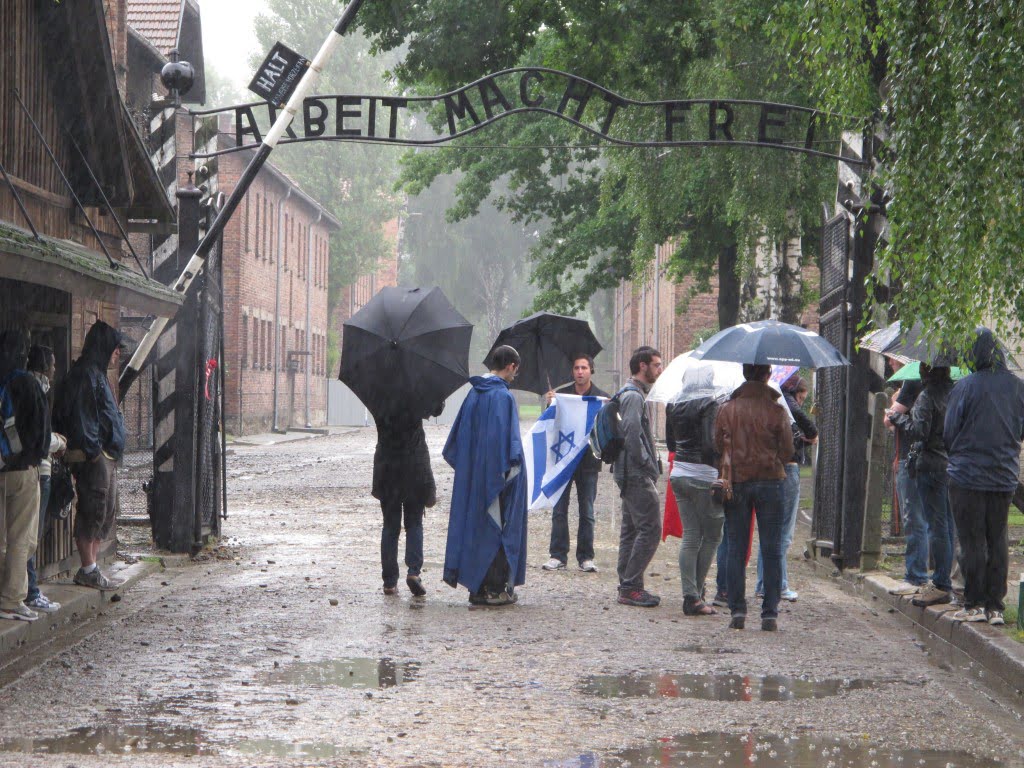
A new permanent exhibit about the Holocaust and Jews opened this week at Auschwitz. Called “Shoah” and located in the Block 27 barracks, it replaces the woefully outdated exhibit that had been installed there in 1967 — and which had been organized as a “national pavilion” along with similar exhibitions in other barracks buildings showing how a variety of countries and their citizens had suffered under the Nazis — there was little if any mention at the time that the overwhelming majority of these citizens were killed at Auschwitz because they were Jewish. A number of these “national pavilions” have undergone renovation and change since the fall of communism.
The ceremony June 13 was attended by Israeli Prime Minister Binyamin Netanyahu, Polish Minister of Culture and National Heritage Bogdan Zdrojewski and a host of other dignitaries and Holocaust survivors, including Israel Meir Lau, the former Chief Rabbi of Israel.
The new $8 million, multi-media exhibit was prepared by the Yad Vashem Institute for Holocaust Research in Israel and curated by its director, Avner Shalev.
Melissa Eddy in the New York Times writes:
The Israeli government asked Yad Vashem to create the exhibit, after Ariel Sharon, then the prime minister, returned from the camp in 2005 dismayed at the outdated, ill-kept display created in the 1960s to honor the Jewish dead.
Faced with the task of making it worth visitors’ effort to spend 30 more minutes with the display, after having already toured the sites and main museum at Auschwitz-Birkenau, Mr. Shalev huddled with researchers, teachers and survivors for several years to develop a mix of moving images, maps, audio clips of Hitler’s anti-Semitic rants and survivors’ videotaped testimony.
.
The Auschwitz web site describes the new exhibit as being divided into several galleries.
They are devoted to such things as Jewish life before the war, the ideology of the Nazis and the extermination of Jews within the Nazi-occupied Europe. One of the rooms was dedicated to the memory of children murdered during the Holocaust, and in it you can see the work of artist Michal Rovner, who used dozens of children’s drawings in his creation.
The exhibition concludes with a section devoted to memory, including room with a book of names, in which are gathered all the names of the victims of the Holocaust collected by the Yad Vashem Institute, as well as Reflection Centre, a special audio-visual room, where you can read the stories of many prominent figures from the world of science, culture and religion to the most important questions posed after the Holocaust.Museum Director, Dr. Piotr M.A. Cywinski, said that the new exhibition in block 27 from the beginning had been prepared with a view to the future main exhibition of the Auschwitz Memorial.“The goal of the Museum and Yad Vashem was to create a space of understanding that will make the most formed part of the whole meaning of the Memorial. In this way, generations of visitors will be able to fully comprehend the vastness of the destruction that took place in the centre of the dominated by the Nazi Germany Europe,” he said.
According to the curator of the exhibition, Avner Shalev, director of the Yad Vashem Institute, the new exhibition shows the basic dimensions of the Holocaust in a unique way and places the individual and his experience in the centre. “Chapter by chapter, we show the most important topics related to the Holocaust, which is not necessarily a historical narrative, but rather a presentation of the very deep ethical and cultural dimensions of the memory of the Holocaust. To the visitor, this experience is to be a deep, meaningful and complete reflection on our fundamental morals as a people and members of today’s global civilization,” said Avner Shalev.