

A major restoration and enhancement project is planned for the Jewish cemetery in Pisa. It is to include opening the Porta di Leone gate in the high wall that separates the cemetery from the adjacent Piazza dei Miracoli — where the famous medieval Cathedral, Leaning Tower, and Baptistry are located — and to create a visitors’ center and exhibition.

Representatives of the Union of Italian Jewish Communities and Italy’s Culture Ministry on Sunday signed a memorandum of understanding for what the culture ministry said was a €3.5 million euro project.
Initiation funding for the project will come thanks to a donation from the Russian-American Jewish billionaire Alex Knaster, who owns the Pisa soccer team.
The UCEI called the project “An intervention designed to restore visibility, dignity and public function to a place that is an integral part of the history of Pisa and Italian Judaism.”
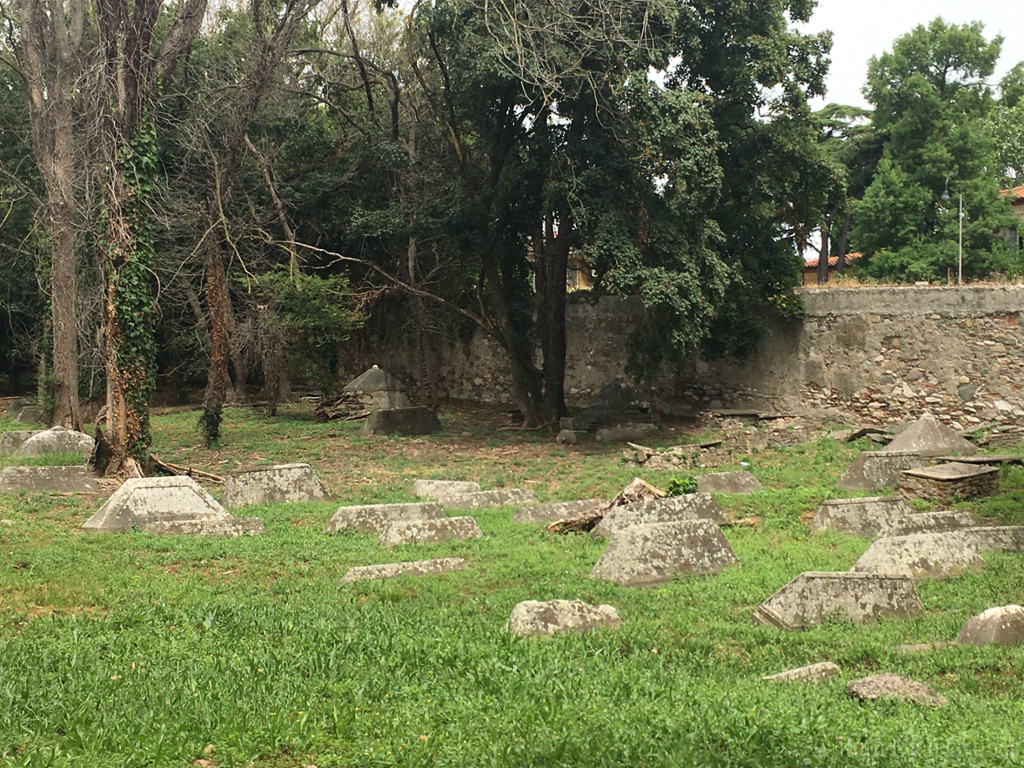
The Jewish cemetery in Pisa was founded in 1674 and includes various styles of grave markers, mostly in the horizontal or sarcophagal Sephardic style. Three earlier Jewish cemeteries no longer exist, though traces of the oldest,dating back to the 13th century, can still be found.
The cemetery lies just outside what was the old city wall. The Porta del Leone (Gate of the Lion) was historically the main entrance to the cathedral square, but it was closed in the 16th century. A new city gate was constructed, and the area outside the Porta del Leone was allocated to the Jewish community for the cemetery.
Though located right next to the Piazza dei Miracoli and open to visitors on a regular basis, the cemetery is little known to the hordes of tourists who visit Pisa each year.
“Three or four million people walk past it each year and don’t know it exists,” Pisa Jewish community president Andrea Gottfried said during the ceremony signing the memorandum.
The project will be carried out in three stages and is expected to be finished in 2028, the UCEI said in a report.
The first stage will be the restoration of around 100 gravestones, some sunken into the earth.

Stage two will be the reopening of the Porta del Leone, which will connect the Jewish cemetery directly with the Piazza dei Miracoli. Gottfried called it the most important part of this project. “Reopening it is not just an act of urbanism,” he said. “It is a political gesture in the highest sense of the term. It means recreating a bridge with the city, with the curia, with the millions of visitors who pass in front of it every year without knowing what is behind that wall.”
The third stage of the project will be the creation of a visitors and information center in what is now the cemetery caretaker’s building.
In his 1933 book A World Passed By (described as the first Jewish guide book to Europe and North Africa), the writer Marvin Lowenthal made that point — using the Jewish cemetery in Pisa as an example of how Jewish heritage sites were often overlooked and ignored. He wrote:
The synagogues, as in Segovia, Cordova, or Lemberg, often stand within a stone’s throw (and many were the stones thrown) of a famed cathedral. The cemeteries, as in Pisa, often lie literally and figuratively in the shadow of a renowned historic pile. The ghettos … wait around the corner from a tourist postcard shop.
But the average traveller knows nothing of their existence
Yet, like the cathedrals and castles of Christian Europe and the Moslem antiquities of Spain and North Africa, the Jewish monuments embody and perpetuate one of the oldest cultural forces of the Western World. They, too, are a part of Europe’s past and the heritage of our common civilization.
Read the UCEI report of the signing
Read the Culture Ministry report about the signing
Click here to watch Andrea Gottfried discuss the project at the signing