

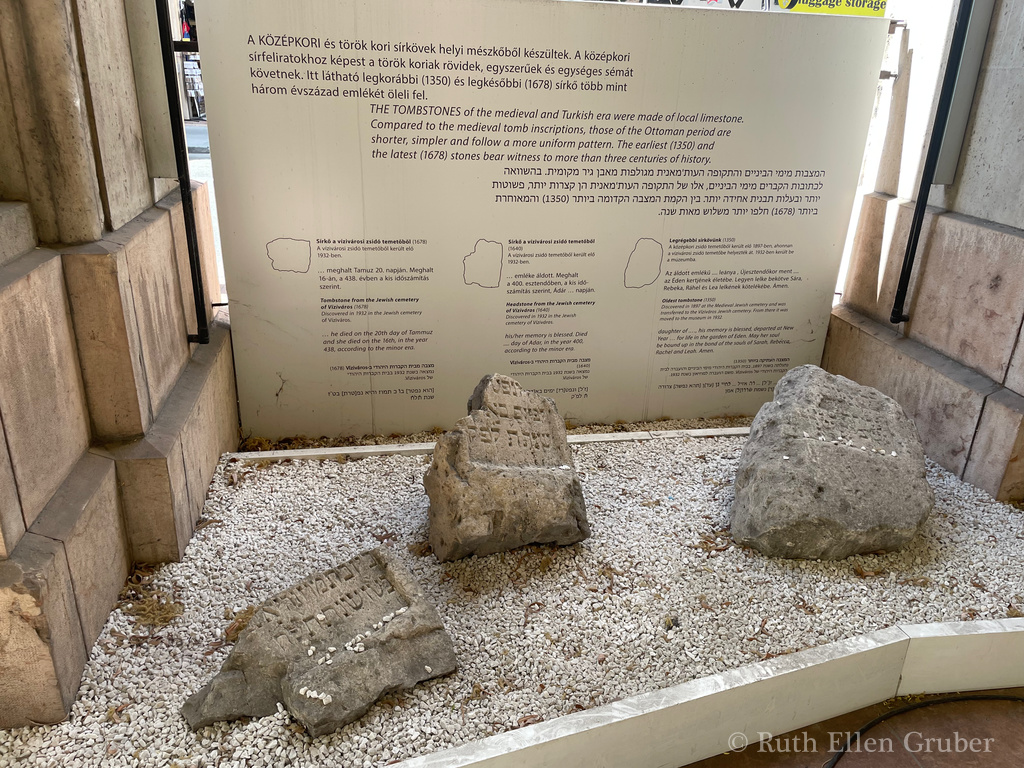
In addition to its “inside” exhibits, the Jewish Museum in Budapest has mounted an exhibition of centuries-old Jewish gravestones that date from the middle ages and the period of Ottoman rule in the Buda district, near the castle (1541-1686). It also includes later stones found in the northern Obuda district, where Jews lived after being persecuted and expelled from Buda when the Habsburgs and Christian Holy League recaptured Buda 1686.
Many of the stones and fragments, from long-destroyed Jewish cemeteries, were used as building material and were discovered during urban renewal and other construction projects.
The earliest gravestone from Buda dates from 1350 and the latest from 1678.
The exhibition is mounted under the arcaded porch of the museum and Dohany St. synagogue complex. The informative exhibition signage provides translations, maps, and other information about each stone. There is also a detailed web site with photographs, translations of epitaphs, and other material (in Hungarian and English).

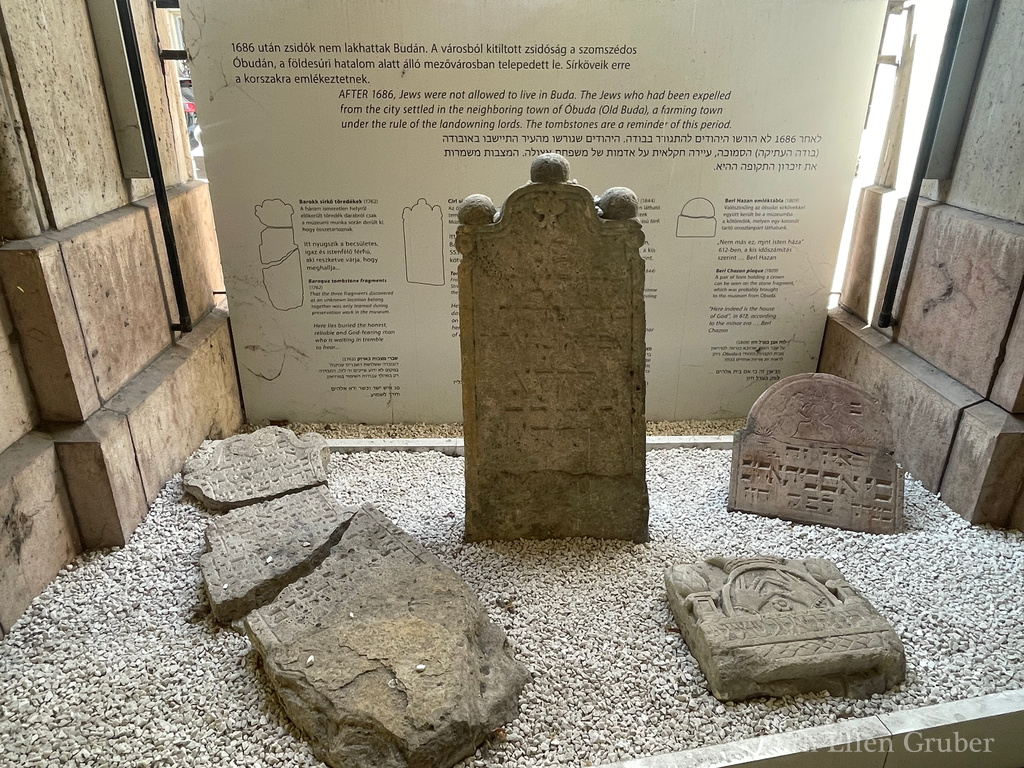
The exhibition includes an example of how the side of an ancient Roma sarcophagus, which was found in Obuda, repurposed as a Jewish gravestone. The sarcophagus bears the names and memories of the four children of Petronius Censerinus and his wife Aurelia Maximia. The other side was used to make the gravestone of the Jewish merchants Koppel Deutsch, who died in 1765.


The video below is in Hungarian, but it also shows visually how the exhibition was mounted. Speaking are the director of the Jewish museum and the exhibition designer.
Click here to access the web site of the exhibition