

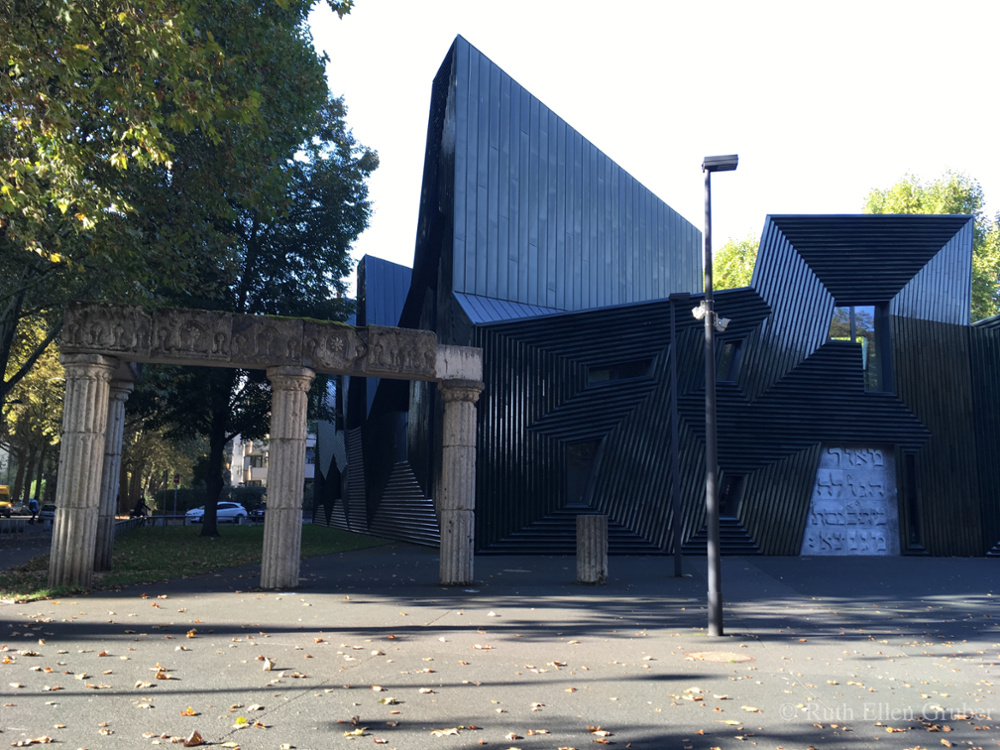
Salvaged fragments of the imposing marble portal from the destroyed Old Synagogue in Livorno are planned to be restored and reassembled in front of the city’s modern New Synagogue in a project led by the Foundation for Jewish Cultural Heritage in Italy (FBCEI) and the local Jewish community.
Built in the late 17th/early 18th century and expanded further in the 18th century, the Old Synagogue was damaged during an Allied bombing raid in World War II. Its ruins were demolished after the war to make way for the construction there of the New Synagogue, which was inaugurated in 1962.

The remnants of the synagogue portal were conserved in the garden of what today is the Yeshiva Marini Jewish Museum, where, according to FBCEI vice president Renzo Funaro, who coordinates the Livorno project, they were rediscovered “under a heap of brambles” in 2022. These included columns, capitals, and the architrave.

According to Funaro’s preliminary project, which was made public in late February, the salvaged marble elements will be restored and mounted within a tubular metal framework structure that will rest on a reinforced concrete slab supported by micro pylons and clad with corten steel panels. The whole structure, he said, will measure more than six meters high and five meters wide.
The portal originally bore the Hebrew inscription from Genesis 28:17: “This is none other than the house of God, and this is the gate of heaven.” This inscription will be recreated using corten-type metal letters.
The estimated cost of the entire project is approximately €360,000, Funaro told JHE. “The Livorno and Pisa Heritage Authority has already approved the preliminary project and forwarded it to the Ministry of Culture to assess the possibility of funding it,” he said. “Moreover, the project is also currently under review by the joint commission between the Italian State and the UCEI.”

“It is an ambitious project,” Livorno Jewish community president Vittorio Mosseri said at the public presentation of the project. “In addition to bringing a piece of the Temple before our eyes, it will also serve as a way to remember the value of the contribution made by Livornese Jews to the city over more than four centuries of presence.” The Mayor of Livorno has also reviewed the project alongside the relevant municipal department.
A portal or other rescued fragments from destroyed synagogues have similarly been used elsewhere, for example in Germany at the Jewish community center on the site of the destroyed Fasanenstrasse synagogue in Berlin, and outside the modern synagogue in Mainz.
Designed by the Roman architect Angelo Di Castro, Livorno’s New Synagogue, which stands on the site of the old synagogue, is made of reinforced concrete and features vertical exterior and interior ribs and two rows of hexagonal windows. Internally, the sanctuary centers around an elaborate carved wooden Ark originally from Pesaro, dating from 1708 and created by the expert artistic woodworker, Angelo Scoccianti.
The Livorno Jewish Museum is housed in a former oratory, or prayer room, in an 18th-century villa once owned by the Marini merchant family. Acquired by the Jewish Community in 1867, the building served as a center for charitable confraternities. After World War II, it served as the city’s only synagogue until the inauguration of the New Synagogue in 1962. The museum retains its synagogue layout and includes a historic ark from a side section of the destroyed Old Synagogue as well as valuable ceremonial art.
Livorno is also home to two Jewish cemeteries. The Monumental Jewish Cemetery, used between 1840 and 1900, is the fourth burial site for the city’s Jewish community. In 1939, older burial grounds were expropriated, and many tombstones were later relocated. The newer cemetery, which has been used since 1901, was designed by architect Adriano Alberto Padova. The graves are simple and aligned, though some older tombs stand out with grand and solemn designs, such as the Chayes family mausoleum, an eclectic structure with Byzantine influences.
Read a lengthy blog post by Samuel Gruber about both synagogues
MM/REG