

The long-derelict synagogue in Budyně nad Ohří, around 50 km north of Prague, near the Terezin Memorial, has been painstakingly restored and will open soon as a cultural and religious center. The facade shines in the original cream and blue, and the interior has a fully reconstructed ark and other fittings.
Recognised as a cultural monument by the Czech Ministry of Culture, the synagogue was originally built as a wooden structure in the early 18th century and was rebuilt in brick in the early 19th century, in late classicist style with a late rococo facade. It was used for services until the community was annihilated in the Holocaust. After the war it was used as a warehouse and fell into disrepair.
The restoration, begun in 2019, was carried out by the city, which owns the building, with major co-financing from a grant of more than €852,000 from the EEA/Norway funds — around 90 percent of the total cost.
“The aim of the project is to revitalize the monument as a whole and return it to its appearance and function for religious and cultural purposes,” the project description states, with target groups local residents, tourists, and the general Jewish community.
No Jews live in the town, but the aim, it said, will be to organise “regular services and related spiritual events” with outreach “through cooperation with the Federation of Jewish Communities in Prague and the synagogue’s website.”

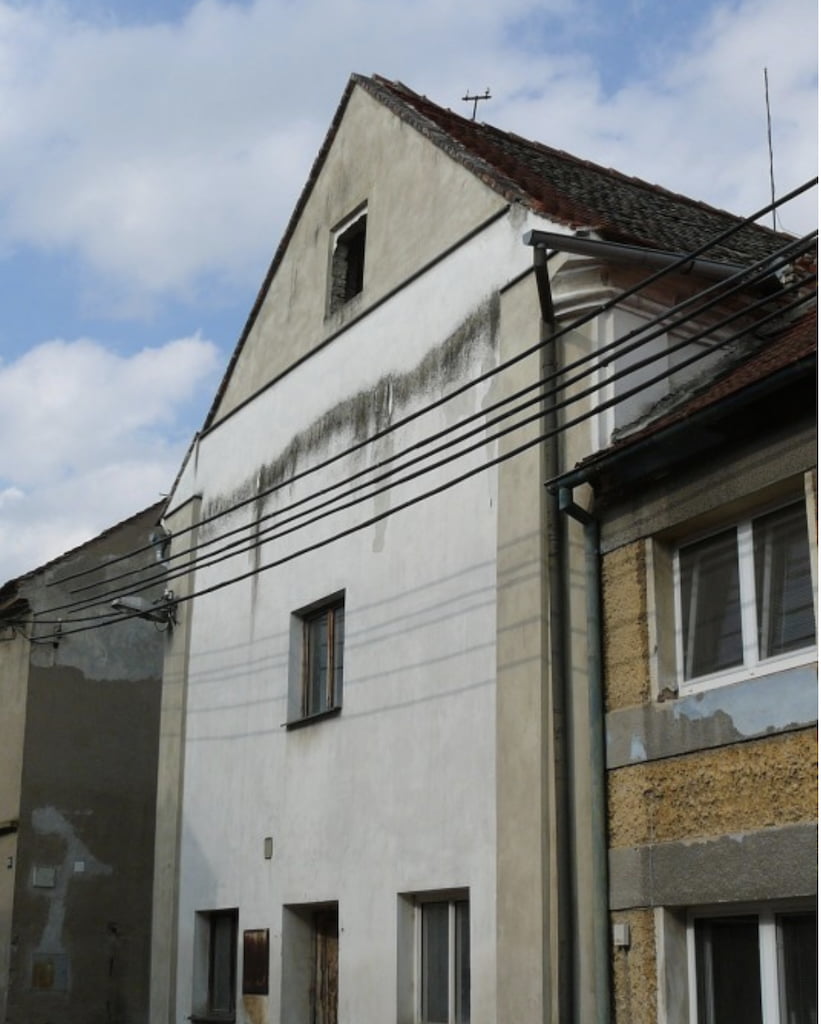
No work on the building had taken place since the end of WW2, and before the restoration began it was described as being in danger of collapse, with severe structural problems such as “alarming” cracks, “deformation of the ceiling and walls and buckling of the perimeter wall,” and damp damage, although some traces of the original wall painting could still be seen. Click to see a photo gallery of its condition in 2018.
Restoration work included the structural securing of the building, the total restoration of the facade, windows, and doors, and replacement of the roof and stairs. In the interior, the women’s gallery and other elements were reconstructed, including the Ark, flooring, and other furnishings.
Experts used historic photographs and paintings to recreate both the exterior and interior.
Budyně is located near Terezin, the site of the main Holocaust ghetto/concentration/labor camp and Holocaust memorial in the Czech Republic, and the intention is that, in cooperation with the Terezin Memorial, the synagogue will become a site linked to Jewish heritage and history that can be visited along with visits to the memorial.
“The project envisages that after the complete reconstruction, the synagogue will serve religious and cultural purposes,” the project description says.
“Tourist tours, exhibitions, concerts and the like will be organized here,” it said. “Local museums, galleries, the Memorial Institute, the Terezín Memorial and other organizations and communities that cooperate with the city of Budyně nad Ohří will collaborate on these activities.
It said that:

The city’s intention is to build a permanent exhibition in the building about the life of the Jewish community before the Second World War with the cooperation of the Terezín Memorial and the Terezín Ghetto Museum, or the Federation of Jewish Communities in Prague. At the same time, the exhibition would be fully digitized and placed in an interactive form on the website of the synagogue project. With the Terezín monument, which is visited by approximately 300,000 people per year, the city has already discussed future cooperation in the use of the synagogue. Possible cooperation options are tours of the Budyně nad Ohří synagogue and the Terezín Memorial.
A Jewish presence in Budyně nad Ohří dates back to the 16th century, but it was never large. According to information on the city’s web site, in 1638 the Jewish community numbered 11 families, in 1724 there were 22 families (104 people), in 1783 there were 34 families, in 1880 there were 113 people and in 1930 (according to the census) 39 people.
The town today (which boasts a castle) has a population of only around 2,200. A walled Jewish cemetery dating back to around 1785, with around 200 graves and a ceremonial hall, is located outside of the village in the middle of fields.
Web site of the synagogue and restoration project, with photo galleries documenting the process
The City web page with details of the restoration plan, etc
See a video and photogallery about the restoration in local media
