

Happy centennial to the Páva street synagogue in Budapest — designed by Lipot Baumhorn, dedicated on January 6, 1924, and today incorporated into the city’s Holocaust Memorial Center. (A Jewish congregation also shares the synagogue complex.)
A series of lectures on the history of the building and the Jewish community is being held this week (January 22-24) to mark the anniversary.
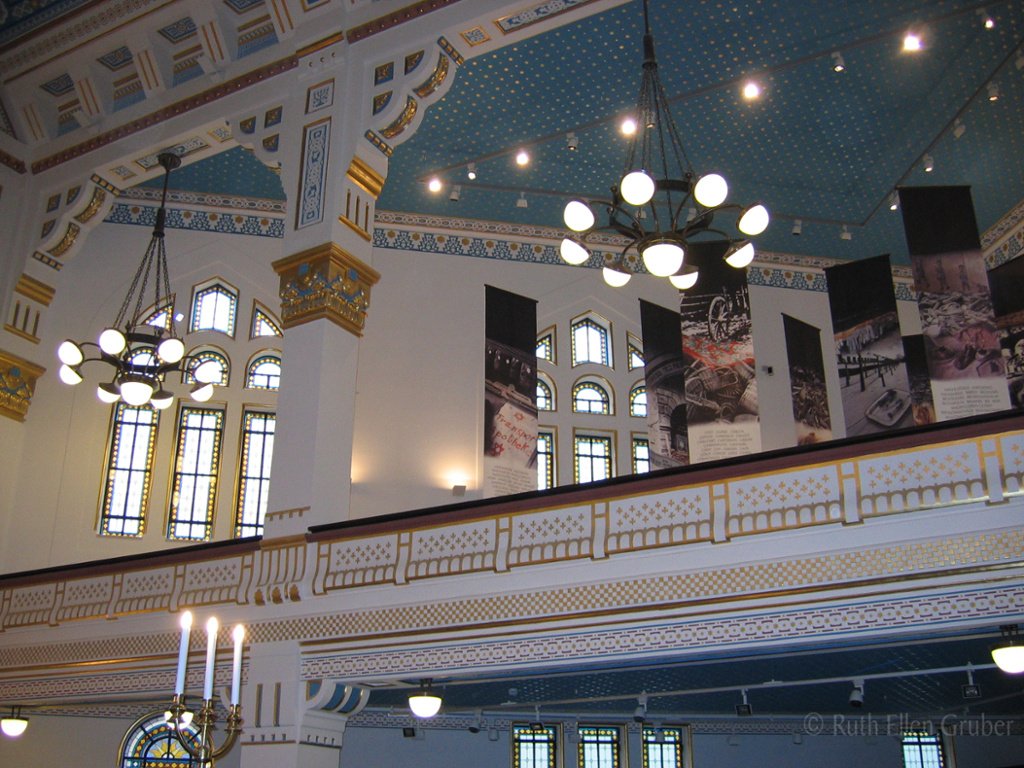
This is how the magazine Egyenlőség (Equality) described the interior of the synagogue in an article in 1926:
“In addition to the rich and yet decently applied gilding, the rich architectural painting is made in the three traditional Jewish colors: blue, white, and yellow. The style of the painting is [novel]: curtain drapery often used in medieval painting is used here in the apse of the sanctuary to a beautiful effect with the motifs of the walls; on the parapet of the women’s gallery, the divided fields are scattered with Maccabean lilies and the blue pillars flanking the sanctuary apse represent the two pillars of Solomon’s temple […]. On the huge archway of the sanctuary shines the great motto of Jewish ethics: “Love your neighbor as yourself” with Hebrew and Hungarian text. All the motifs of the painting were designed and drawn by the architect Lipót Baumhorn, even in the smallest details.”
The lily motif was also used in the decoration of the facade — you can see this clearly in this close-up.

The synagogue was used for services until 1944; it was used as an internment camp in 1944-45.

After the war, it hosted occasional religious services and was used by some Jewish organisations, but the condition of the building deteriorated over the years.
Mazsihisz, the Neolog Jewish umbrella organization, offered the synagogue to the Holocaust Memorial Center, then under development, in 1999. Restoration began in 2003, and the Center was opened in 2004 – it celebrates its 20th anniversary in April.
According to the Center, restoration was based on photos from the 1930s and included the reconstruction of “800 square meters of decorative painting, 760 meters of metallic gold paint and 800 meters of plaster stucco.” The walls were reinforced and modern insulation was installed.
The sanctuary is used mainly for cultural events. The Páva st congregation shares the complex, mainly using the small “winter shul” for regular services.
Schedule of anniversary lectures
Holocaust Memorial Center web site
FB page of the Páva st congregation