

(JHE) — A new smartphone and tablet app teaches Holocaust history in Venice by using Augmented Reality to tell the stories of the people commemorated by Stolpersteine – Stumbling Stones – memorials and at other memorial sites around the city.
Called “Remembering the City: Stumbling Stones, Memory Sites and Augmented Reality,” the app is a project of a public history initiative developed by the Venice Ca’ Foscari University, in collaboration with the city’s Jewish Community and funded by the Veneto Region. It was presented to the public on January 31.
Information about the sites can be accessed via the project’s dedicated app, which can be downloaded from the website — so far it is available only for the Android platform, but an IOS version is planned.

Through the app, users can “scan” the site in question on their devices and obtain multimedia information related to the people mentioned on the Stumbling Stone or plaque. This includes audio, images, text, and maps.
The scientific leader of the project is Prof. Fabio Pittarello, while the software developer is Dr.Tommaso Pellegrini, and the digital humanities experts were Dr. Alessandra Volo and Dr. Alessandro Carrieri, all from the Ca’ Foscari University.
“We designed the interface of the app looking for a balance between emotional involvement and textual deepening, to make sure that the arrival of users at the Stumbling Stones is not a point of arrival, but a point of departure,” Pittarello told JHE.
Though the project currently focuses on Venice, he said, it has a “European dimension, with the technical potential of mapping the Stumbling Stones of our continent.”
Stolpersteine are commemorative brass cobblestones placed by the German artist Gunter Demnig as a memorial art project in front of the houses of people who were deported. More than 75,000 have so far been installed all over Europe.
The first Stumbling Stones in Venice were placed in 2014, and since then new stones are placed each year around January 27, International Holocaust Remembrance Day.
Stumbling Stones usually report the name, date of birth, and other information related to the deported person, including, if known, the place and date of death.
“What the Stumbling Stones lack is the chance to discover something about the life of the person being commemorated,” the Remembering the City website says.
This new project, it says, “aims to bring the Stumbling Stones of Venice to life thanks to the use of augmented reality (AR) as a new narrative level. They are part of the narrative landscape of memory, where the public has the opportunity to get directly in touch with the history of these places.”
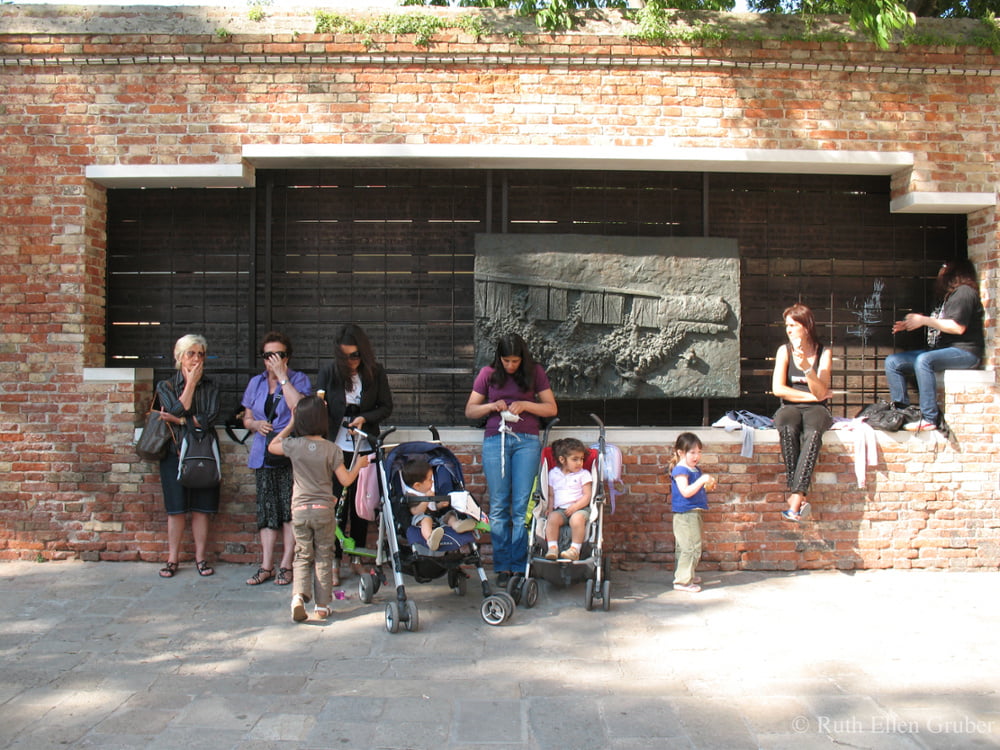
In total, the project features 24 Stumbling Stones and six other places of memory.
These include sites where Italian partisans were executed by the Nazis and Fascists, and places where Jews and others were arrested, detained, and deported, between 1943-44. Most of these sites feature a commemorative plaque.
A map with the sites is available on the project’s website.
“The fundamental idea behind this project is to explore the urban memory of cities and their formation through the use of augmented reality (AR) as a visualization tool, in order to develop digital historical narratives,” the website says.
“The aim”, it says, “is to increase the cognitive and emotional involvement of users, to promote a better understanding of the history of Nazi-fascist persecution and deportation.”
Access the Venice project web site