

(JHE) — A full-scale replica of one of the hundreds of East European wooden synagogues destroyed during WW2 has been installed at Poland’s largest open-air ethnographic museum, or skansen. The replica of the synagogue of Połaniec now forms part of a Galician Market Square, which is part of the Folk Architecture Museum in Sanok, in the far southeast corner of Poland.

It is one of three such replicas (or partial replicas) in Poland, along with the replica of the wooden synagogue from Wolpa, in Biłgoraj, and the replica of the painted ceiling of the synagogue of Gwozdziec, now a centrepiece installation of the POLIN museum in Warsaw.
We wrote about the Polaniec synagogue reconstruction project in 2014, when it was about to get started. And already in 2011, the director of the Sanok museum described plans to build the synagogue replica to JHE’s Ruth Ellen Gruber.
Ruth visited the site again in early September of this year. Work on the structure is now complete — with finishing touches still under way outside the building. It will be officially inaugurated during a conference October 7-8 on Judaica in Open-Air Museums.
In addition to the structure itself, the synagogue includes replicas of the ark and bimah, as well as fragments suggesting what the paintings that once decorated the interior would have looked like, based on drawings made in 1933.

Ruth was taken around the building by Artur Górecki, a guide at the museum, who explained how it was built using only traditional hand-construction tools and methods.
In a lengthy article from August 2016, the photographer and writer Jason Francisco described the process.
I could clearly see the process of the reconstruction, specifically the ethnologic fidelity of the construction, being undertaken by hand using only traditional tools and techniques. Even the wooden nails and the scaffolding (with its oblique Star of David references) were impressive to me.
The synagogue will house an exhibition including the museum’s small but valuable collection of Judaica, photographs, paintings and other material that to date has been displayed in one of the buildings.
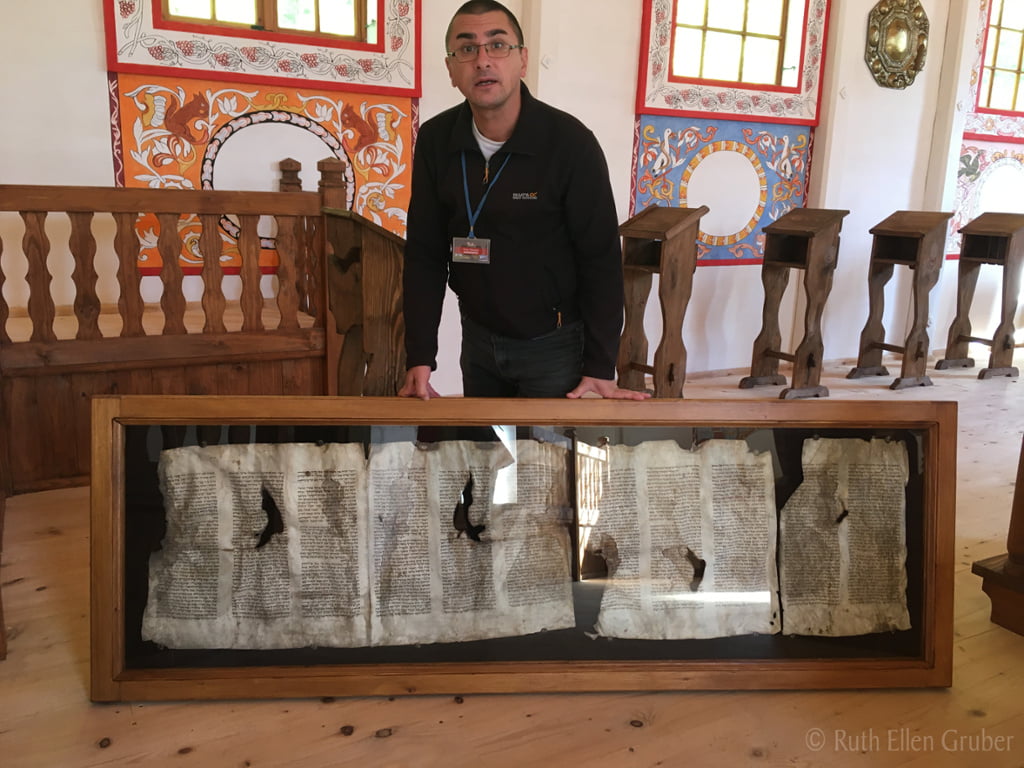
Also exhibited will be fragments of a Torah scroll from Połaniec that survived the destruction. In his article from 2016, Jason Francisco wrote about how the ruined scroll was preserved by local people, but also questioned what might have been their motivations and reflects on the ambiguities and complexities of difficult history.
…this is Poland, a place where historical understanding is less about evidence than it is about attitude––learning how to dwell in ambiguity and in contradiction, to think with the heart, to feel with the brain. In Poland, history occupies the space in-between, the conceptual space between a wooden synagogue displaced in its own re-creation, and the relic of its destruction whose strange and triumphant appearance resolves nothing about how to live with genocide.
The Połaniec synagogue was build in the mid-18th century. Ample documentation made in the 1930s of its structure and decorative wall paintings survives.
The exhibit in the replica includes some of the photographs and drawings used in the construction and decoration process.

Informational signage at the rear of the synagogue also reproduces the material and provides a brief history of the building.

The replica synagogue stands at one end of the museum’s Galician Market Square, opened in 2008, which consists of replicas or reconstructed buildings from various villages in the region, arranged around a square to approximate the look of a typical town from the mid-19th century in the Podkarpackie Province.

In addition to the synagogue, it includes two houses lived in by Jewish families, each bearing a mezuzah on its doorpost and furnished in period style. They also include Shabbat table installations.

Read our story about the project from 2014
3 comments on “Poland Update: Full-scale replica of the destroyed Połaniec wooden synagogue is installed at the open air ethnographic museum in Sanok”
The family of my great grandfather Shmuel David Lan lived in Sanok. Thank you for this glimpse into a vanished past.
My grandfather lived in Polaniec before the war. This article and Mr. Francisco’s essay were very interesting to find on Google as I am trying to piece together what life may have been like for him. Thank you for posting it.
Hi Erik
My dad was from Polaniec as well.
Find the book ( on Amazon ) “They called me Mayer July”
It’s a wonderful accounting of life in Poland before the War.