

Work on the second stage of the Space of Synagogues memorial site in Lviv is about to get under way, with archaeological excavations due to begin at the site of the Great City Synagogue, one of three synagogues in the city’s downtown Jewish quarter that were destroyed by the Nazis in WW2.
On its web site, the Lviv City Council said work should begin in early June and be carried out for two months; a report on results is due in October. It said the aim would be to uncover and explore the foundations of the Great City Synagogue, which was built around 1800 to replace an earlier, much smaller synagogue that had become so dilapidated that that Austrian authorities who then ruled the city ordered it to be dismantled.

The site of the synagogue is paved over and in the summer is usually occupied by restaurant tables.
The City’s announcement said the works are financed by the city in cooperation with the EU-funded ReHERIT project: “Joint Responsibility for a Common Heritage”. The partners of this project are the Lviv City Council, the city council of Uman, the Center for Urban History and the Laboratory of Urban Space.
It said the archaeological works will cost 495 thousand UAH (€16,400).
The Space of Synagogues project is believed to mark the first time in Ukraine that a memorial commemorating Jews was initiated by city authorities, and it represents a public recognition of Jewish history as local history.
In JHE Have Your Say op-ed, the photographer and writer Jason Francisco wrote:
the breadth of the coalition responsible for the project marks a key turn. That coalition includes the Executive Committee of the L’viv City Council, the city’s Office of Historical Environment Preservation, the Center for Urban History of East Central Europe, the German GIZ (Deutsche Gesellschaft für Internationale Zusammenarbeit), plus L’viv’s Chesed Arieh Jewish charity fund, the US-based Gesher Galicia genealogy association, and the Israel-based Association of Commemoration of Lwów Jewish Heritage and Sites.
The first completed part — one of three planned sites commemorating Jewish history and heritage in L’viv — was dedicated in September 2016.
This includes the conserved ruins of the 16th century Golden Rose synagogue, and also the footprint of the adjacent Beis Midrash, destroyed during the Holocaust, and — between them — an installation called the Perpetuation Memorial formed from 39 vertical stone slabs bearing 10 photographs and 21 text quotations from Jews who lived in Lviv before, during, and after the Shoah.
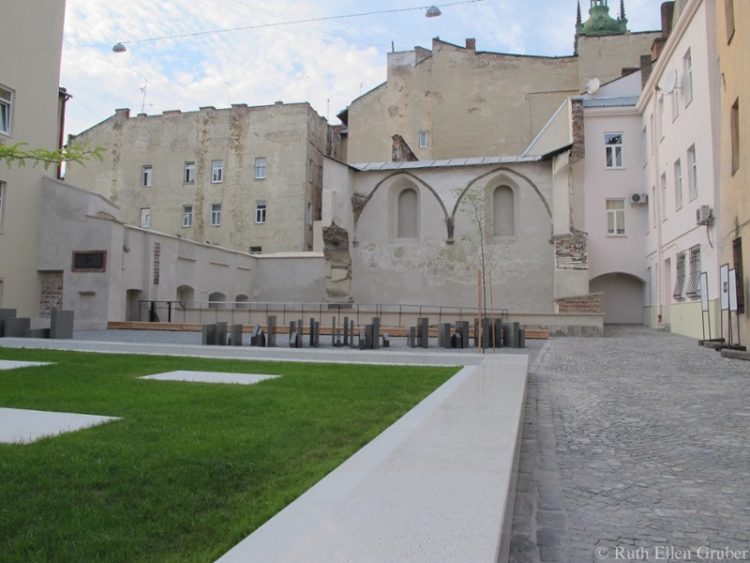
The Beis Midrash site lies between the ruins of the Golden Rose and the site of the Great City Synagogue.
In 2010 the L’viv City Council, in partnership with the L’viv Center for Urban History and the German Society for International Cooperation, launched an unprecedented design competition to mark three sites of Jewish history in the city — the Space of Synagogues area, a remnant of the Old Jewish Cemetery (the only part of the cemetery that has not been built over), and the site of the Janowska concentration camp .
The official brief was “to respond to the growing awareness of L’viv’s multi-ethnic past by contributing to the rediscovery of the city’s Jewish history and heritage through creating public spaces dedicated to the city’s historic Jewish community.” The winning designs for all three sites were chosen by an international jury in December 2010; Jewish Heritage Europe director Ruth Ellen Gruber was on the jury.
The idea for the competition grew out of a conference on Jewish cultural heritage, held in Lviv in October 2008, at which Gruber gave the keynote address.

Click to see the announcement on the Lviv City Council web site, plus video (in Ukrainian)