

By now, it is fairly common — at least in Poland, but also elsewhere — to use the recovered fragments of gravestones from destroyed Jewish cemeteries to create Holocaust memorials. (We wrote about the recovery of gravestones and fragments in 2016.)
The latest such lapidarium, an installation called “Pavement of Memory” created by the artist Janusz Marciniak, was inaugurated in recent weeks at the site of the destroyed Jewish cemetery in Poznan.
The memorial places on a wall in a corner of the site 30 pieces of matzevot that were used as paving stones in the city’s streets for several decades, along with three commemorative plaques with text in Polish, Hebrew and English.
The plaques read:
“There was a time when matzevot were used for pavement; a time when the memory of the people buried under the matzevot was most literally broken, trampled upon, and maimed. Some remnants have survived and today this memory is connected with the gratitude to those who contributed to its rescue. ‘A man shall be satisfied with good by the fruit of his mouth, and the doings of a man’s hands shall be rendered unto him’ (Prov. 12:14).”
Marciniak, who is not Jewish and who is now a professor at the University of Arts in Poznan, has focused his art work on the Jewish heritage end memory in Poznan for many years.
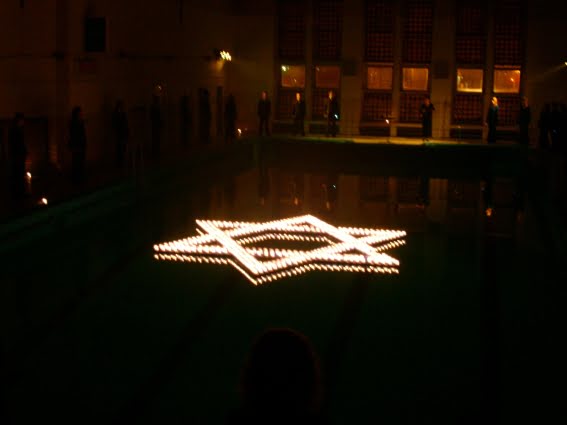 One of his early such works was called “Atlantis” — a performance and installation in 2004 inside the former synagogue in Poznan, which the Nazis had turned into a swimming pool — and it was still being used as such: 600 burning memorial candles shaped into a huge Star of David were set floating on the surface of water, while 100 memorial candles lit the entrance leading to the interior and 200 torches with blue light were distributed to the audience. (See a January 2004 article by JHE Coordinator Ruth Ellen Gruber about this installation.)
As a child, Marciniak lived in the building that stands next to the site of the Poznan Jewish cemetery: His backyard was literally in its grounds, although he did not know it. As he writes on his web site:
Until recently, [a] lilac tree was the only trace of the destroyed Jewish cemetery located there. When I was a child playing in the sandpit I saw human bones there. Since 2003, I have been painting my backyard as the “invisible” cemetery. In 2008, the cemetery was partially reconstructed. We managed to save it, but the backyard no longer exists. Thus my paintings have become also a visual remembrance of the backyard.
The inauguration of Marciniak’s monument prompted a reflection about such memorials by Marysia Galbraith on her blog, Uncovering Jewish Heritage:
The extraordinary thing is that when public spaces are designated as repositories of Jewish memory and culture, objects return to them. As cemeteries are cleaned up, fenced, and marked, tombstones come back. In some cases, it’s as if people have known for a long time about these objects. They felt they were out of place and it has sat uneasily on their minds. They are relieved to finally know where these objects should go. In others, as with this road project, people are surprised to find these fragments, but they feel a sense of obligation to honor the memory of the past. To put things back into place.
Read Marysia Galbraith’s full post
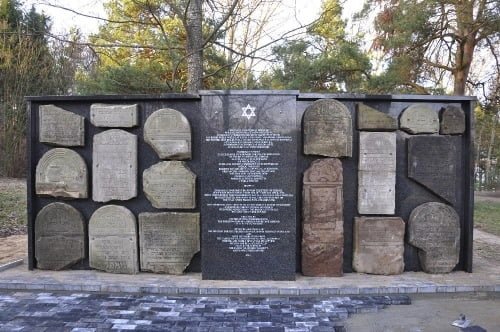
Here are photos of some other memorials constructed from returned fragments of gravestones:




3 comments on “Poland: New lapidarium memorial in Poznan; a reflection on the return of broken gravestones”
Thanks for writing about this important work, and for mentioning my blog post. Another lapidarium in Wronki, Poland stands as a monument to the town’s prewar Jewish population. Hundreds of tombstone fragments were recovered during roadwork in a nearby village; they had been used to make a curb. This project shows what can be done when a community works together to recover Jewish heritage.
I wrote about the lapidarium in Wronki here: https://uncoveringjewishheritage.com/2015/04/14/lapidarium-in-wronki/
In Wiener-Neustadt, Austria on a part of the remained old wall of the town ( to-day placed in the city-park) you have for more than about 150 years ago constructed such a so-called lapidiarum maden from a dozen of old matzevot of the 13-15 centuries.
Is there a link or photograph you can share?