
News has come of the death of Yaffa Eliach, 79, the scholar who — as the New York Times put it
survived the Nazi massacres of Jews in her Lithuanian town, and went on to document their daily life in a kaleidoscopic book and a haunting, three-story canyon of photographs at the United States Holocaust Memorial Museum in Washington
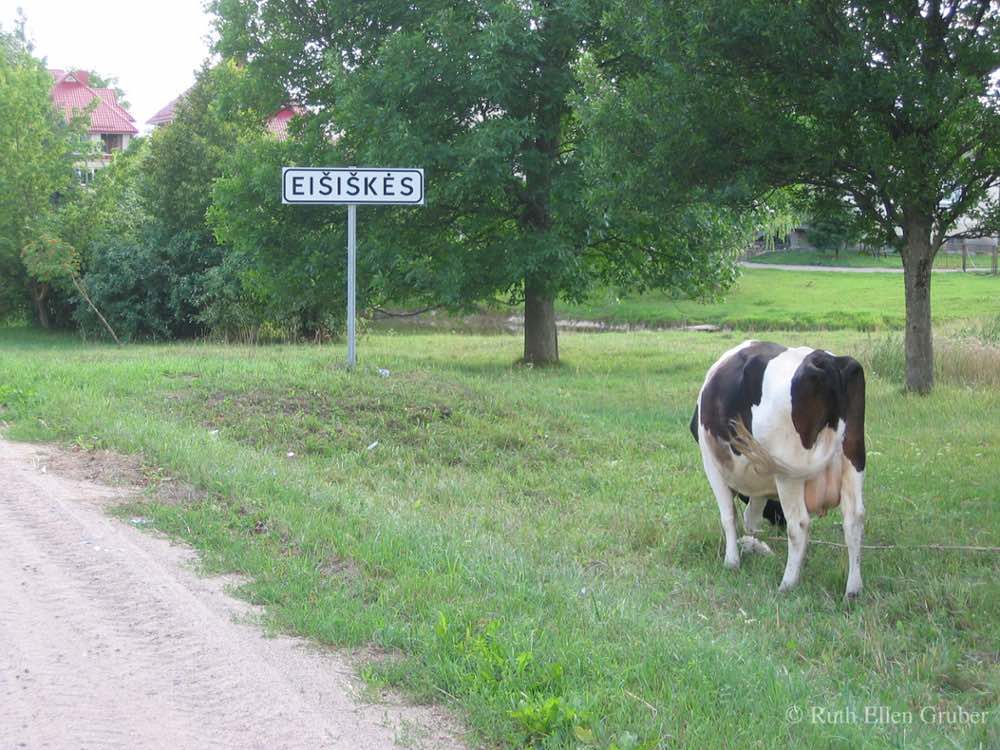
Eliach was born in Eišiškės, known in Yiddish as Eishyshok — a small town about 70 km south of Vilnius, not much larger than a village. Millions of people have come to know the one-time shtetl through Eliach’s project — the extraordinary Tower of Faces (or Tower of Life) exhibition at the Holocaust Memorial Museum, which powerfully evokes the life — and lives — of the 3,500 Jews who lived there before the Holocaust.
Eliach was one of only 29 who survived the Shoah. The Times writes:
Her father, Moshe, a leather tannery owner, escaped a German roundup in September 1941 by jumping out a synagogue window. He took his wife, Zipporah; Yaffa; an older brother, Yitzhak; and a baby brother, Hayyim, into hiding. In two days, almost all the town’s Jews were shot to death in front of open pits.
In a secret loft in the ghetto of Radun, Yaffa’s baby brother was suffocated by other refugees who had clamped a hand over his face so that his cries would not betray them. In a pit under a pigsty on a farm owned by Christians, her mother gave birth to another boy, also named Hayyim. There Yaffa studied Hebrew, Yiddish and Polish, using the pit’s clay walls as a blackboard.
In the Tower of Faces, some 1,600 photographs of pre-war Eishyshok Jews are displayed in a space that soars upward three stories. Eliach’s book, There Was Once a World: A 900-Year Chronicle of the Shtetl of Eishyshok, details the history and Jewish life of the town in intimate detail.

When JHE coordinator Ruth Ellen Gruber visited Eisiskes some years ago, she found many wooden houses, reminiscent of the pre-war shtetl, but little other sense of the Jewish history of the town. She wrote in her book Jewish Heritage Travel:
It felt, in fact, empty; the Jewish soul was now in Washington, DC. The main square had been destroyed and rebuilt; side streets were lined by neat wooden houses and log cabins, some of them painted bright colors. Tall crosses and other personal shrines stood in some front gardens.
The only testimony she could find were small memorials at the sites of the the mass executions of the local Jews — one where the men were killed and the other where the women and children were massacred.

The inscription, in Yiddish, Lithuanian and English, reads that in this place, on September 25 and 26, 1941, “the Nazi assassins and their local collaborationists murdered ferociously” about 2500 Jewish women and children.

Click to read the obituary in the New York Times