

Of all the iconography found in Jewish gravestone art and in painted wooden synagogues, the one that to us (and by to “us” we mean to “me” — JHE Coordinator Ruth Ellen Gruber) is perhaps the most fascinating, not to mention the most enigmatic, is the motif of the Three Hares — that is, three hares chasing each other in a circle, and joined by their ears. It is an optical illusion — though each hare clearly has the requisite two ears, there are only three ears in total, not six.
The design is by no means just a Jewish motif — the Three Hares (and related images) are found across the world, from China, to Pakistan and the Himalayas, to Germany, France and remote corners of England and Wales. It is found in Buddhist, Islamic, and Christian culture as well as Jewish. Documented examples date back to Medieval times and even much earlier; they decorate Christian cathedrals, manuscripts, Buddhist cave temples, plates, ceramic tiles, ceilings, stained glass windows, ironwork, and more….even, in one German town, a manhole cover.
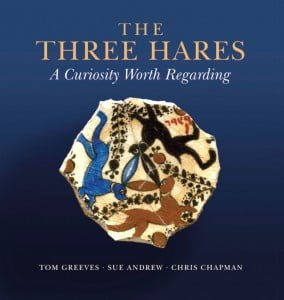 A recently published and richly illustrated, limited edition book now traces the history of the motif and tells the story — The Three Hares: A Curiosity Worth Regarding, by archaeologist Tom Greeves, art historian Sue Andrew and photographer Chris Chapman.
In the book, the three, who are based in Devon, England, trace their fascination with the image and their research trips to document it in Europe and Asia, as well as the various possible meanings inherent in the design.
“Our constantly expanding journey embraces Judaic, Buddhist and Islamic hares from western Europe to China, or vice versa, touching Himalayan Ladakh and the Swat valley in Pakistan,” Greeves writes in an introduction. “We believe that the Mongol Empire and precious silk played a crucial part in transmission of the motif over vast distances in medieval times, traveling on the many strands of the Silk Road.”
Greeves concludes that while the meaning has varied across religions and cultures, the ubiquity of the hares symbol attests to its importance. Modern observers are free to create their own interpretations, he says. He also hopes sharing knowledge of beautiful things that connected civilisations across religion and time may help unite disparate peoples in a fractured age.
The authors are clear their book is not the final say on the mysterious symbol. But readers left frustrated by this should remember that animals in an eternal circle never stop.
The chapter on the Three Hares in Jewish tradition is one of the briefest in the book. Indeed, the Jewish examples of the Three Hares are quite few compared with other cultures. And compared to other traditional Jewish motifs — candlesticks (on women’s graves); lions, books, blessing hands, Zodiac signs, etc — the Three Hares image is fairly uncommon, at least in what Jewish heritage sites remain today.

It has been found carved on fewer than a dozen early 19th century gravestones, located only in three towns in the Podolia region of Ukraine (Sataniv, Gorodok, and Smotrich), and it could be found in the 18th century wall paintings that are known to have decorated several now-destroyed wooden synagogues in Germany and eastern Europe.
These include the synagogue that stood in Gwozdziec (now Ukraine) — the roof and painted ceiling of this synagogue has been reproduced and installed at the POLIN Museum of the History of Polish Jews. And also the replica of the ceiling of the wooden synagogue at Chodorow, now in the Museum of the Diaspora in Tel Aviv.

For the Jewish chapter of the book, the authors rely heavily on the work of Boris Khaimovich, from the Center for Jewish Art at Hebrew University, one of the most important and insightful researchers into Jewish gravestone epitaphs and iconography.
Khaimovich has written extensively about the Three Hares in Jewish symbolism, for example, in his PhD dissertation and in a 2011 article in East European Jewish Affairs. He has linked various examples of it to a particular month, to the name of the deceased, to a visual metaphor of the bond of eternal life, to “universal ethical concepts” — or simply decoration.
On some monuments the motif of the “three hares” paradoxically replaces the “three overlapping fish” which are depicted as the zodiacal sign of the month Nisan. On the tombstones the image hints at the name of the deceased. But its central place in the composition of murals is evidence that this motif has an important universal meaning. This analysis of the motif shows that it became an integral part of an artistic tradition and that its semantics were determined within a well-defined geographical and chronological framework

In the second part of this video, starting at around 8:36, you can watch Khaimovich outline a theory about the appearance of the “Three Hares” motif in Jewish cemetery art, specifically in the case of the three gravestones with the carving found in Sataniv. He says the image seems to be related to the names of the deceased, which are connected the three patriarchs, and evoke the chain of life,
Read a review of the book on Hyperallergenic
Read a review of the book in The New Scientist