

On the first day, you will take for yourselves a fruit of a beautiful tree, palm branches, twigs of a braided tree and brook willows, and you will rejoice before the lord your God for seven days.
-Leviticus 23:40
The Jewish holiday of Sukkoth, the “festival of booths,” starts tonight and lasts a week. It is both a harvest festival and a commemoration of the years Jews spent wandering in the desert in Biblical times. Jews traditionally build temporary sukkahs, or sheds that recall the wandering period. These are often decorated with fruits and vegetables celebrating the harvest.

Also at Sukkoth, Jews ritually bind together four species of plants — an etrog, or citron (a citrus fruit similar to a big lemon); a lulav, or palm branch; two willow branches (aravot) and three myrtle branches. The lulav and etrog are so identified with Jewish practice that they have been powerful symbols of Judaism for centuries — as can be seen above, in the fresco of Jewish symbols from the Jewish catacombs in Venosa, Italy, which include a menorah, a shofar, and the lulav and etrog.
In pre-Holocaust times was not uncommon for Jewish homes to sometimes include a sukkah — or room that could be opened up and used as a sukkah. Several examples have survived.

One is the house in the village of Schwabach, Germany where a new branch of the Jewish Museum of Franconia opened last year. It includes a sukkah, believed to have been installed by the then-owner of the house, Moses Löw Koppel, in about 1795, which features a coffered ceiling that can be opened and is decorated with unique wall paintings from the late Baroque period.
Fortunately, this example has been saved….another example is this sukkah portruding from a tenement in Będzin, Poland. (Jewish heritage in Będzin, including the Jewish cemetery and several synagogues/prayer houses, is slowly being conserved thanks to the efforts of the Brama Cukerman Foundation). This photograph of the sukkah in Będzin dates from 2009 — but from what we understand it still was there in 2014.

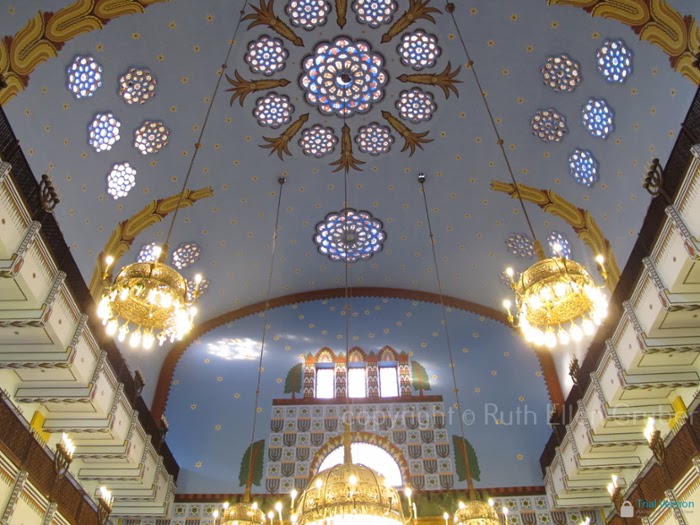
To celebrate the holiday, we post here some pictures of fruit, palm fronds, willows and other motifs associated with Sukkoth that are used — independently — as decorative elements in Jewish heritage sites — and that our readers can — figuratively — use to decorate their own Sukkahs.


2 comments on “Sukkoth greetings!”
Many thanks for the concise story about Sukkot’s meaning and significance!…and the illustration by
photographs.
Thanks for the great article.