

The restoration at the Old Synagogue of Carpi, in the Italian region of Emilia-Romagna, has been completed, and the sanctuary – seriously damaged in 2012 earthquakes — will soon be reopened to the public as a permanent exhibition center focused on local Jewish history and culture.
Dating from 1722, the Old Synagogue is one of two former synagogues located in a building owned by the city in Carpi’s historic ghetto. The neoclassic New Synagogue, dating from the 19th century, was also damaged in the quakes, but it was repaired and reopened in 2015.
Both are administered by the Fossoli Foundation, which has its headquarters in the building and also manages the site of the WW2 Fossoli concentration camp, just outside Carpi, and a Museum Monument to the Deported.
No date has yet been set for the reopening, as the Foundation is waiting to sign a new Memorandum of Understanding with the city regarding its administration of the two synagogues.
In the Old Synagogue, “we aim to create an exhibition space dedicated to the Jewish presence in Carpi, also using digital equipment, and open it to schools, and local and international tourists,” Marzia Luppi, director of the Fondazione Fossoli, told JHE.
She said accessibility remained to be resolved, since the space can be accessed only by a narrow staircase or via the women’s balcony of the 19th-century synagogue, which is located on a lower floor of the same building.
The municipality of Carpi announced the completion of the restoration of the Old Synagogue in early February, following around 18 months of work. It said the cost amounted to €400,000, funded by the city through municipal insurance funds.

“The city gains back a little-known treasure, which will integrate with the nineteenth-century synagogue,” Paolo Malvezzi, the city’s heritage councillor, said in the announcement.
Two major earthquakes struck northern Italy at the end of May 2012, killing at least 24 people, leaving thousands homeless, and causing widespread damage to art and architectural heritage. In addition to the Carpi synagogues and Jewish cemetery, synagogue buildings in Ferrara, Modena, Mantova, Sabbioneta, Soragna, and Sermide, and Jewish cemeteries in Ferrara, Cento, Lugo, and Finale Emilia also suffered damage.
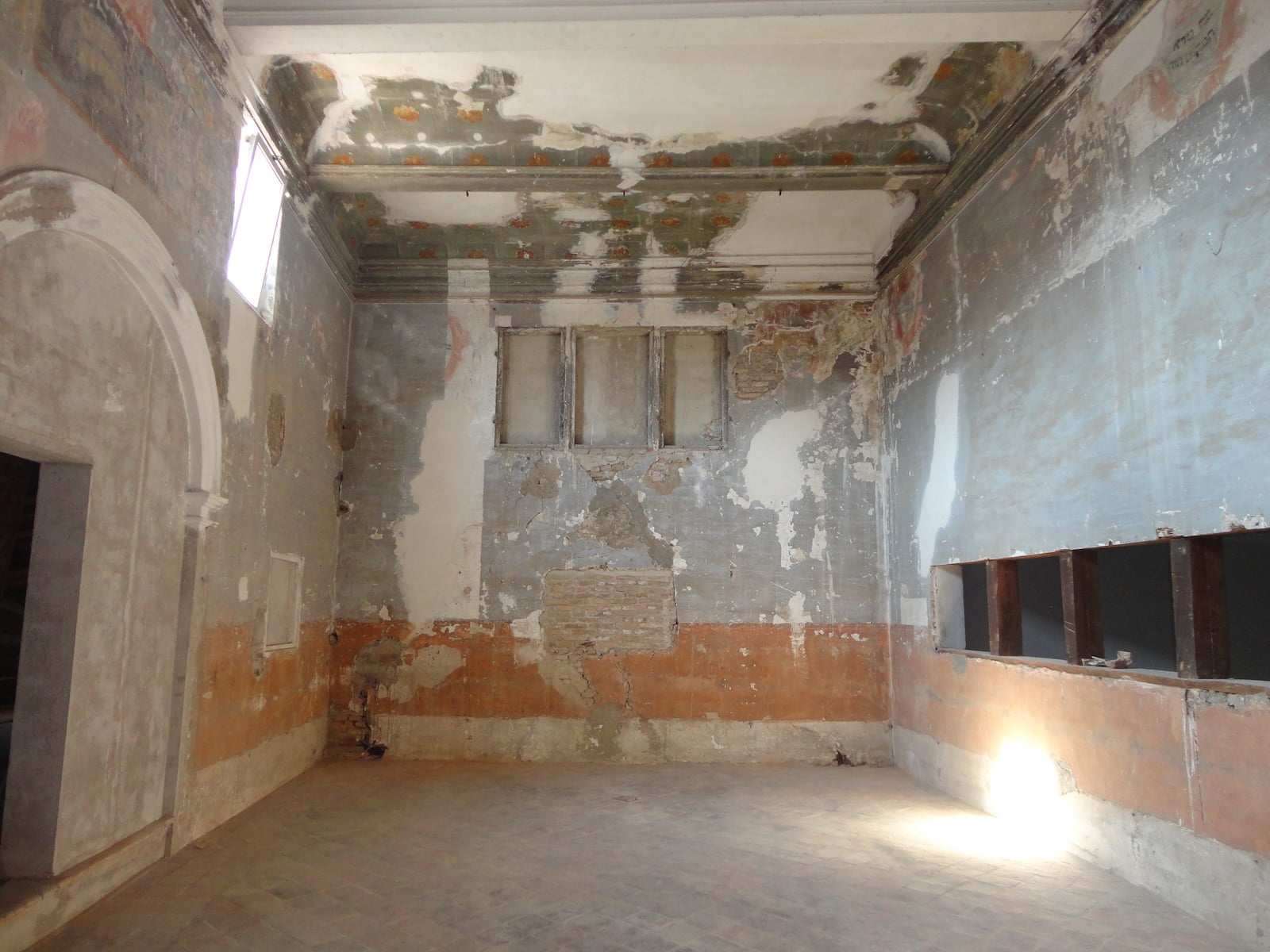
Caterina Manfredi, director of the restoration, told JHE that the earthquake had caused damage to the Old Synagogue’s walls and a partial collapse of the vaults.
“In the first phase of the work, we focused on the structural consolidation of the internal staircase and hall, as well as the facade facing the street and the internal courtyard. In the second and last phase, we concluded work at the women’s section and on the wooden roof and ribbed vault of the sanctuary,” she said. “In the vestibule, the ablution basin for rituals was also restored.”
She said that during the restoration, Hebrew inscriptions were revealed on the upper part of the sanctuary walls after the removal of layers of paint and restoration of the walls.
The building where the synagogues are located, known as the Portico del Grano, historically had been the property of a wealthy Jewish family, the Beneroi. In addition to the two synagogues it housed a Jewish school and the family’s apartments.
The former 19th-century synagogue is used today as a cultural venue. Designed by a young engineer from Carpi, Achille Sammarini, it was inaugurated in 1861. It remained active for almost 50 years, but the Jewish community dwindled and eventually dissolved; the last service – a wedding — was celebrated in 1907. The synagogue’s religious fittings and furnishings were removed taken to Modena, and in 1921 the building was sold to a private family, which converted the sanctuary into a reception hall.

Eventually the city took over ownership of the building, and the Fondazione Fossoli has used it as its headquarters since 2009, with the nineteenth-century synagogue used for concerts, exhibitions, and other events.
The Old Synagogue, located in a raised attic of the building, was preserved largely intact, though in poor condition. A rare example of an eighteenth-century synagogue in Emilia Romagna, it was built in 1722, designed by the architect Giacomo Lucenti and accessed by a staircase. The hall is mainly bare, with traces of paintings at the top of its walls and on the ceiling.
Carpi’s Jewish cemetery was in use from 1825 with the last burial in 1922. According to Marzia Luppi of the Fondazione Fossoli, the site, which is property of the Jewish Community of Modena, is still inaccessible because of the damage provoked by the 2012 earthquakes.
Click here to watch a TV report on the restoration
See an article about the Jewish community and history of the synagogues