

The year 2022 marks the 10th anniversary of Jewish Heritage Europe, and we will be celebrating it throughout the year with special content.
The theme of JHE’s 10th birthday celebrations is the “Anniversary of Anniversaries” — that is, using JHE’s own anniversary to feature other significant or symbolic anniversaries related to Jewish heritage that also take place this year.
Here’s the second article in the series, highlighting the 400th anniversary of the establishment of the Ghetto in Pitigliano, in southern Tuscany, Italy. In this article, we retrace the history of the imposition of the Ghetto in the town, and we note the important Jewish heritage sites that still stand there.
In the first article of the series, we highlighted the 150th anniversary of the dedication of one of Budapest’s stunning synagogues: the Rumbach street synagogue. (Click here to read that story)

Pitigliano is a stunningly beautiful hill town perched on a neck of rust-colored tufa rock in southern Tuscany, 150 km north of Rome and 200 km south of Florence. Long known as “La Piccola Gerusalemme” — the “Little Jerusalem” — for its vibrant Jewish past, Pitigliano today has no Jewish community, aside from individuals. Nonetheless, local Jewish heritage sites bear witness to its rich Jewish history and are among the town’s main tourist landmarks.
This year, 2022, marks the 400th anniversary of the institution of the town’s Ghetto.

A Jewish presence in Pitigliano was already documented in the 14th century, but an established community was only formed two centuries later after waves of Jewish refugees from the Papal States found a new home in what was then an independent earldom governed by the noble Orsini family.
In 1555 Pope Paul IV issued the papal bull Cum nimis absurdum, which instituted closed ghettos in Rome and other cities in the Papal States and imposed other restrictions, including ordering Jews to wear a yellow hat or other distinguishing marks. After 1569, the ghettos in Rome and Ancona were the only places in the Papal States where Jews were allowed to live. The ghetto mandates in the Papal States soon spread to other parts of the Italian peninsula.
Jews fleeing north found refuge in Pitigliano (and two other nearby “refuge towns,” Sorano and Sovana), which were located just over the border from the Papal States. The Pitigliano community was soon bolstered by Jews fleeing expulsions from other cities, such as Florence, where Jews were expelled by the Medici family in 1595. Pitigliano’s elegant synagogue was built three years later, at the very edge of the tufa cliff.

Conditions for Jews changed radically for the worse in 1608 when Pitigliano became part of the Grand Duchy of Tuscany, ruled by the Medici.
The law establishing the Pitigliano ghetto was issued on October 20, 1622. Jews were confined to a small area of narrow lanes, arches, and steep stairways known as the Palazzetto, located around the synagogue at the edge of town along the cliff, between today’s via Zuccarelli, vicolo Marghera, and vicolo Goito.
Jews had to wear a distinguishing red hat or badge. They could have shops and carry out economic activities elsewhere in the town but had to return to the ghetto before a nightly curfew. Jews were allowed to own property and could even buy houses outside the ghetto — but only if access to them was from within the ghetto.
Things improved after rulers from the House of Hapsburg-Lorraine took power in Tuscany in 1737. The open-minded Grand Duke Pietro Leopoldo (Peter Leopold — who went to reign briefly as Holy Roman Emperor Leopold II) visited the Pitigliano synagogue in 1773 – he described it as “all gilded stucco and of fine design.
Inscriptions in the synagogue memorialize this visit and the visits of two later Grand Dukes in 1823 and 1829.

Under Hapsburg-Lorraine rule, the ghetto wasn’t officially eliminated, but restrictions gradually eased, and the Jewish population grew steadily, with 222 members making up more than seven percent of the local population by 1784. Two years later, a local Jew, Angelo Febo, even became a member of the Pitigliano city council.
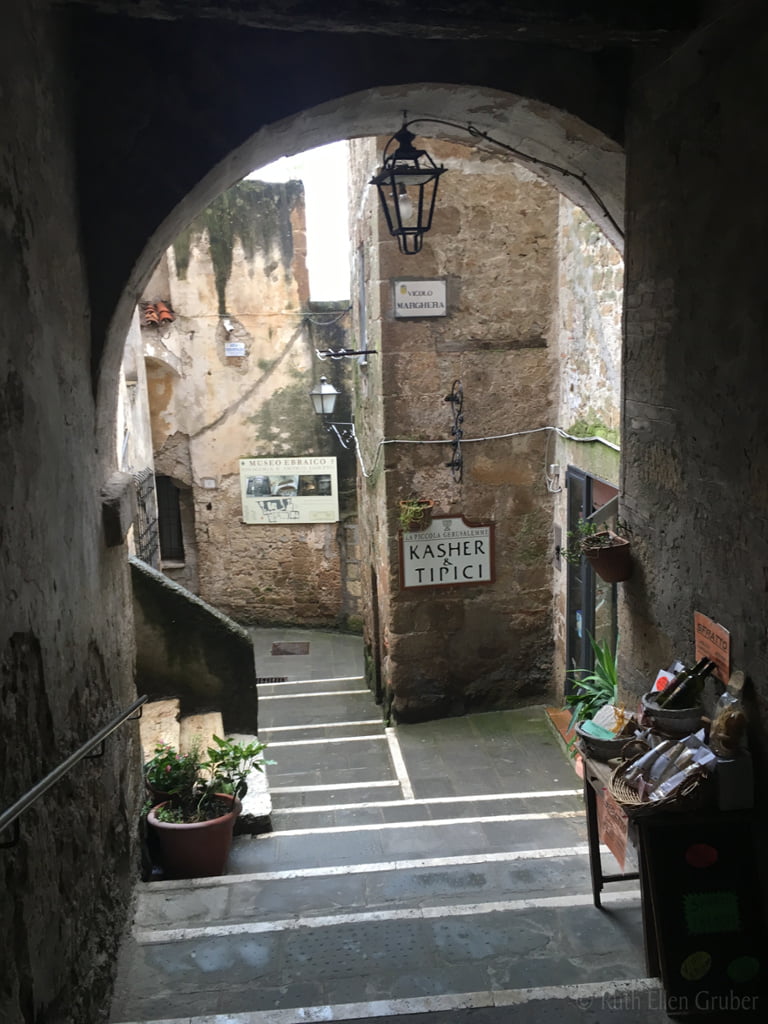
The gates of the ghetto were briefly demolished in 1799, when Napoleonic troops occupied Pitigliano and the rest of the Grand Duchy of Tuscany. But Jews did not permanently gain full civic and political rights until the unification of Italy during the Risorgimento liberation struggle, and the ghetto was not officially abolished until 1859.
Nonetheless, Jews in Pitigliano thrived in the 19th century — the “Golden Age” of the “Little Jerusalem.” By 1841, almost 11.5% of the entire population of Pitigliano was Jewish (359 Jews out of 3125 inhabitants): no other city or town in Italy has ever reached this percentage in modern history.
The Jewish population reached its peak in 1858, with 424 Jews.
But after emancipation, the community dwindled sharply, as many Jews moved away to cities, and only around 70 Jews lived in Pitigliano on the eve of World War II. Most survived, hidden by local farmers. But most moved away.
After the Holocaust, around 30 Jews lived in Pitigliano, but almost all eventually left.
The Jewish heritage sites in the one-time ghetto, however, now form a complex that is one of the Pitigliano’s “must see” attractions.
Anchored by the synagogue, originally built in 1598, the complex is managed by an association called “La Piccola Gerusalemme.”
It includes a small museum as well as underground chambers carved into the tufa rock beneath the synagogue that once served the Jewish community — these include a mikvah, a matzo bakery, a room to dye textiles, a winery, and a kosher butchery.

“The temple was open every day for three services,” Pitigliano native Edda Servi Machlin recalled in her 1981 book The Classic Cuisine of the Italian Jews. “As one entered the beautiful Sanctuary done in a superb blend of Renaissance and Baroque styles, one would see on the right wall an impressive mural tablet, written in block Hebrew letters on an embossed stucco relief ornately framed in gold leaf, which read … ‘If I should forget you, oh Jerusalem, may my right arm wither.’ And every man, woman, and child tried to live up to this pledge.”

Abandoned after World War II, the synagogue collapsed almost totally in the 1960s and for decades remained a pile of rubble, with only a wall and part of the entrance standing. It was rededicated with a gala ceremony in March 1995 following a total reconstruction, financed by the Pitigliano municipality and the European Union, that took nearly ten years to complete.

The Jewish cemetery, with around 280 graves, lies on a cypress-shaded terrace on a steep slope below the town. It was established in the 16th century, but grave markers legible today date mainly from the 19th and 20th centuries.

Older graves are simple, while starting from the second half of the 19th century, monumental gravestones and notable sculptural representations started to be added in the cemetery. Moreover, as the Foundation for Jewish Heritage in Italy notes, “of particular interest are the burial niches dug into the side of the tufa rock.”
Edda Servi Machlin’s book is much more than a cook book. She provides detailed memories of life in pre-WW2 Pitigliano – as well as traditional customs and recipes.
An iconic Jewish recipe from the time of the Pitigliano ghetto is the so-called “sfratto” — a sweet made of honey and nuts and shaped like a stick. Sfratto literally means “eviction,” and both the name and the shape recall the stick used by landlords and local authorities to evict Jews from their homes.
Still, as Servi Machlin notes, it “looks unappealing but tastes delicious.”

Click here to read our obituary of Servi Machlin in 2019
To Learn More…
Click to see the Foundation for Italian Jewish Cultural Heritage’s information on the Ghetto, on the Synagogue, and on the Jewish cemetery
Piccola Gerusalemme Association web site
And here are some books where you can find out more (in English and Italian) about the history of the Ghetto of Pitigliano, and its Jewish Heritage Sites:
Servi Machlin, E. (1992). The Classic Cuisine of the Italian Jews. Giro Press.
Pivirotto, R., Sideri, M. (1997). L’ebreo errante: guida ai luoghi ebraici tra arte e storia nella Maremma collinare. Edizioni Brest-Service
Roumani, J. (2020) Jews in Southern Tuscany during the Holocaust: Ambiguous Refuge. Rowman & Littlefield.
Salvadori, R. G. (1991). La Comunità Ebraica di Pitigliano. Dal XVI al XX Secolo. Editrice La Giuntina
2 comments on “Anniversary of Anniversaries: 400 years since the imposition of the Ghetto in Pitigliano, the “Little Jerusalem” of southern Tuscany, Italy”
We visited this site during 2003/4 many times with friends.
Probably the best memory of all the Jewish historical sites.
Stories of local cooperation between Al 3 religions were related to us by many current residents.
Italy has so much Jewish history and current vibrant Jewish life
My paternal grandfather, Gustavo Calo’, was the last Rabbi of Pitigliano.
Daniela Calo’