

(JHE) — A new core exhibit has opened at the Jewish Museum in Worms, Germany, telling the history of the so-called “ShUM cities” — Speyer, Worms, and Mainz, all near each other on the Rhine river — that combined to form a major Jewish center in the middle ages. Their rabbis were a central authority in Jewish religious, liturgical and legal issues, whose teachings remain influential today.
Called ShUM on the Rhine – From the Middle Ages to Modernity, the exhibit will be on display for the coming five years in the Jewish Museum in the Rashi House, a building constructed in the early 1980s on the site of the medieval Jewish community house that was demolished in 1971. It fully replaces the previous, more limited core exhibit which had been on display for many years.
(ShUM is an acronym of the first letters of the medieval Hebrew names of the three cities: Shin (Sh) = Shpira = Speyer; Vav (represented as U) = Warmaisa = Worms; and Mem (M) = Magenza = Mainz.)

Rashi House stands next to the Worms synagogue, which was built in the middle ages (with a women’s synagogue added to the structure in 1212/13), destroyed in WW2, and totally rebuilt from rubble after the war.
Adjacent to the synagogue there is a centuries-old mikveh.
Worms is also home to the oldest Jewish cemetery in Europe in situ — the “Holy Sands,” whose oldest gravestones date from the 11th century.
In Mainz (which has a modern synagogue that is marking its 10th anniversary this year), Jewish gravestones dating back to the 11th century are arranged in a memorial cemetery.

The new core exhibit provides an introduction to the Jewish history and heritage sites in Worms and the other ShUM cities, with historical background as well as material about their status today.
It uses photos, archival documents, maps, ritual and historic objects, and other material, including contemporary art, to tell the stories. Videos, interviews, and personal stories are featured. There are several audio stations and installations that provide access to music, songs, prayers and other audio material.
There are several thematic sections.
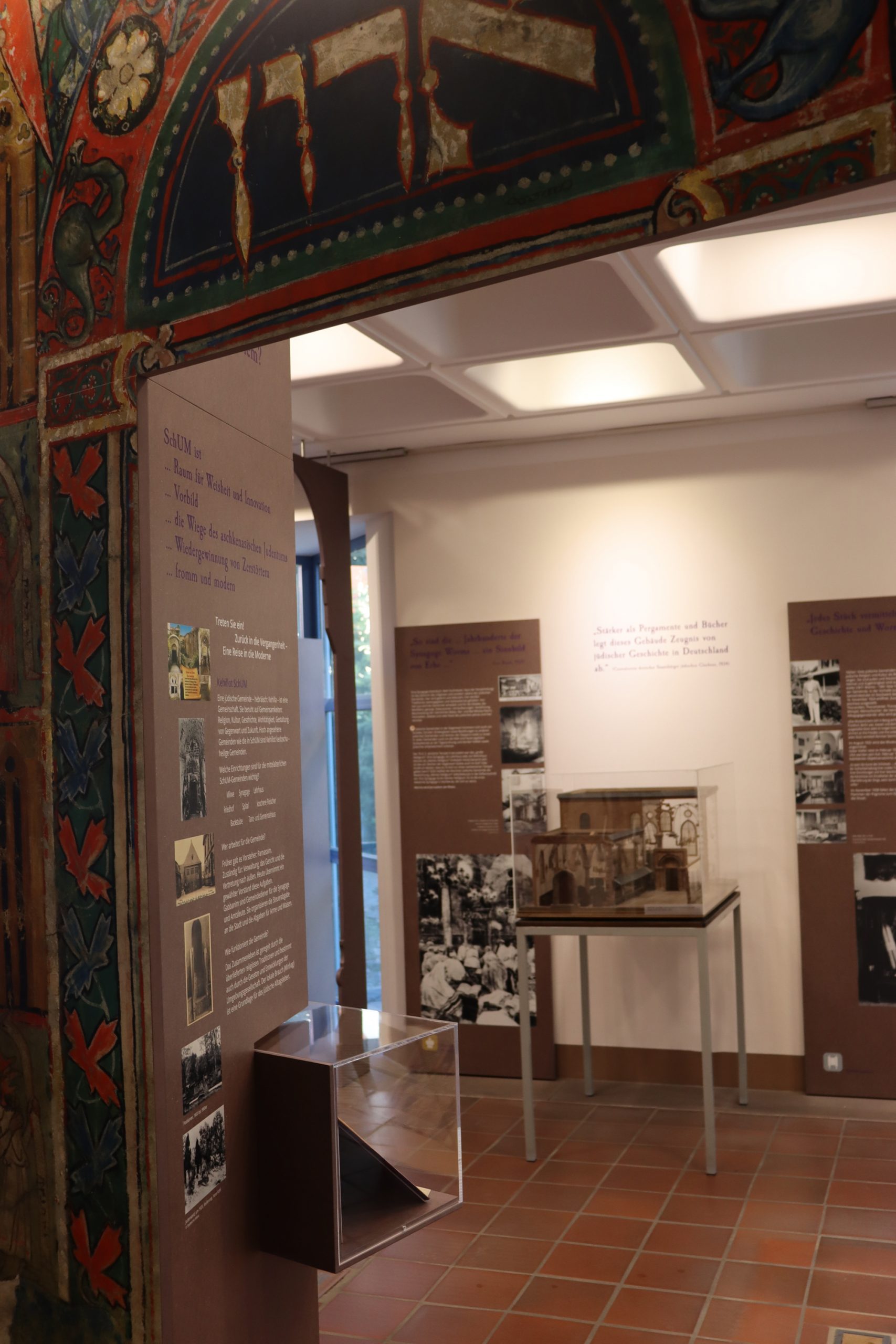
Among them is one on women and their stories. In this section an audio station features a modern song about the mikveh as well as performances from several women cantors.
Given the centuries-old mikvehs in Worms and in Speyer, and the ShUM cities’ position on the Rhine, there is also a focus on water — both as a ritual purifier, as in the mikvehs, as well as water as a vector of trade and exchange.
One section deals with the history of the Worms synagogue — including its destruction and post-WW2 reconstruction, as well as its role today as both a heritage site and a house of worship for the local Jewish community.
The exhibit was produced by the City of Worms with the Worms Jewish Museum in cooperation with the State of Rhineland-Palatinate with the General Directorate for Cultural Heritage Rhineland-Palatinate (GDKE) with the participation of the ShUM-Cities Speyer, Worms, Mainz e.V., an organization whose goal is to have the ShUM cities recognized by UNESCO as a world heritage site. An application for listing the ShUM Sites of Speyer, Worms and Mainz as UNESCO World Heritage was presented to UNESCO by the State of Rhineland-Palatinate in January 2020.
ShUM Cities web site, with videos, smartphone app and other material
Read the 2016 Have Your Say essay by Susanne Urban, director of the ShUM Cities Association