

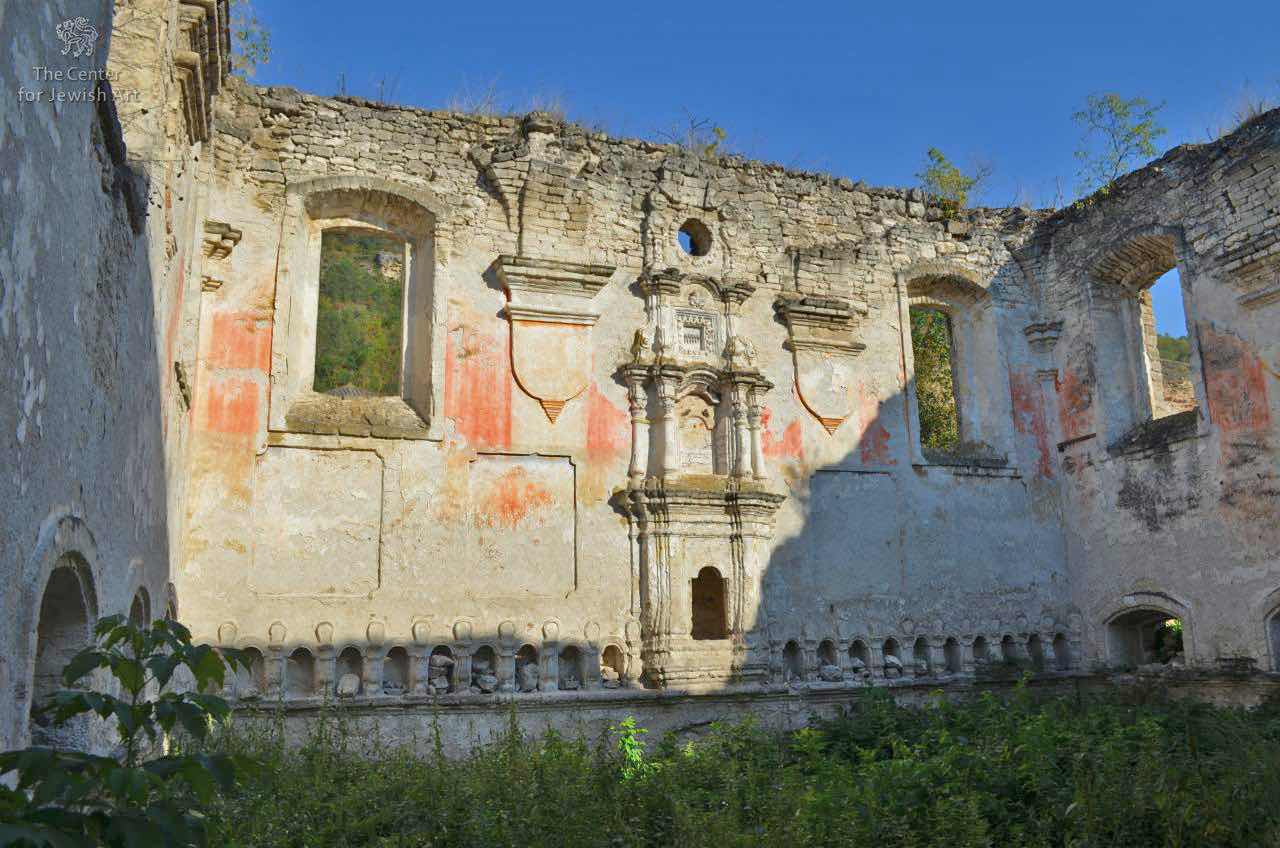
The Great Synagogue of Raşcov (Rashcov), dating from the mid-18th century, is one of the most picturesque and impressive synagogue ruins in eastern Europe.
Situated on the left bank of the Dniester River, the town of Raşcov is currently part of the unrecognized Pridnestrovian Republic (Transnistria), which split from Moldova in 1990–92. However, historically Raşcov belonged to Podolia (now a part of Ukraine) and its Jewry was integral part of Podolian one.
A ruined and overgrown Jewish cemetery with about 5,000 gravestones from the 18th to the 20th centuries is located outside Raşcov, while another, sprawling Jewish cemetery is dramatically situated across the river in Vadul-Raşcov, in Moldova proper.
There has been talk in the past about the possibility of restoring at least part of the Raşcov synagogue. In recent months, new hopes have emerged, through a project called “Raşcov Rebirth,” established in Israel in 2016, which wants to develop the synagogue, and the Jewish cemetery, as part of a tourist and pilgrimage route.
The scholars Sergey R. Kravtsov and Vladimir Levin of the Center for Jewish Art at Hebrew University in Jerusalem, tell JHE that “The establishment of a secure lookout point at the edge of the western wall of the synagogue — with spectacular views of the building, the shulhoyf and the Dniester valley — may attract tourists and cause the local authorities to pay more attention to the upkeep of this outstanding monument.”
The Center for Jewish Art, they write in the article we publish below, “is ready to provide advice in the field of art history” for the project. But they underscore that Raşcov Rebirth (or any other restoration/preservation project for the site) in addition to funding “needs the support of conservation professionals, to ensure that the preservation would not cause any damage.”
In their article, Kravtsov and Levin discuss the history, architecture and potential of the Raşcov synagogue.
They note that the town was an important place in the history of Hasidism: the author of the first hasidic book Toldot Yaakov Yosef, R. Yaakov Yosef of Polonne (d. 1783), was the rabbi of the town in 1748–52. He was succeeded there by his son, R. Avraham Shimshon, who moved to the Land of Israel c. 1759. Another hasidic personality, R. Shabbetai of Rashkov (1657–1745), served as a scribe of the Besht and authored one of the first Hasidic prayer books. His descendants formed the Raşcov hasidic dynasty.
Will the Raşcov Synagogue be Conserved?
By Sergey R. Kravtsov and Vladimir Levin
The Great Synagogue of Raşcov – a notable monument of regional baroque architecture – was constructed presumably in 1749, during the rabbinical tenure of R. Yaakov Yosef. We may only suggest that some features of the Great Synagogue in Raşcov, like the central cupola, the vaults’ brackets, and the oval windows where “imported” by R. Yaakov Yosef from his previous seat in the Great Synagogue of Sharhorod.
The synagogue was ruined in 1930s, during an anti-religious campaign in the USSR. Since then only its roofless, unprotected walls remain, while some elements of its historical shape and decoration may be virtually reconstructed from the old photographs, drawings, and the memories of the prewar gabai’s son, the artist Mikhail Voronsky (1914–2014). His memories were recorded in word and drawing by himself and by another Raşcov personality, the Israeli architect Moris Kleinerman, who recently produced a meticulous graphical reconstruction of the synagogue in its better days.

The synagogue was a monumental masonry edifice under a saddle roof, shielded by a shaped gable on its main, western front (the gable is not preserved).
According to Voronsky’s testimony, the main interior space of the synagogue was a lofty prayer hall with four pillars (also not extant) supporting eight perimeter bays of groined vaults; the central bay above the bimah was spanned by a cupola hidden in the roof space. The synagogue was decorated with interior paintings, representations of the Signs of Zodiac, real and fantastic birds and animals, and panels inscribed with prayers; the hall was lit by stained glass windows. In addition to the main hall, there were a western vestibule with a minute “winter synagogue” on the north, a council room on the south, and a women’s area on the upper floor. A staircase inside the western wall lead from the council room to the attic.
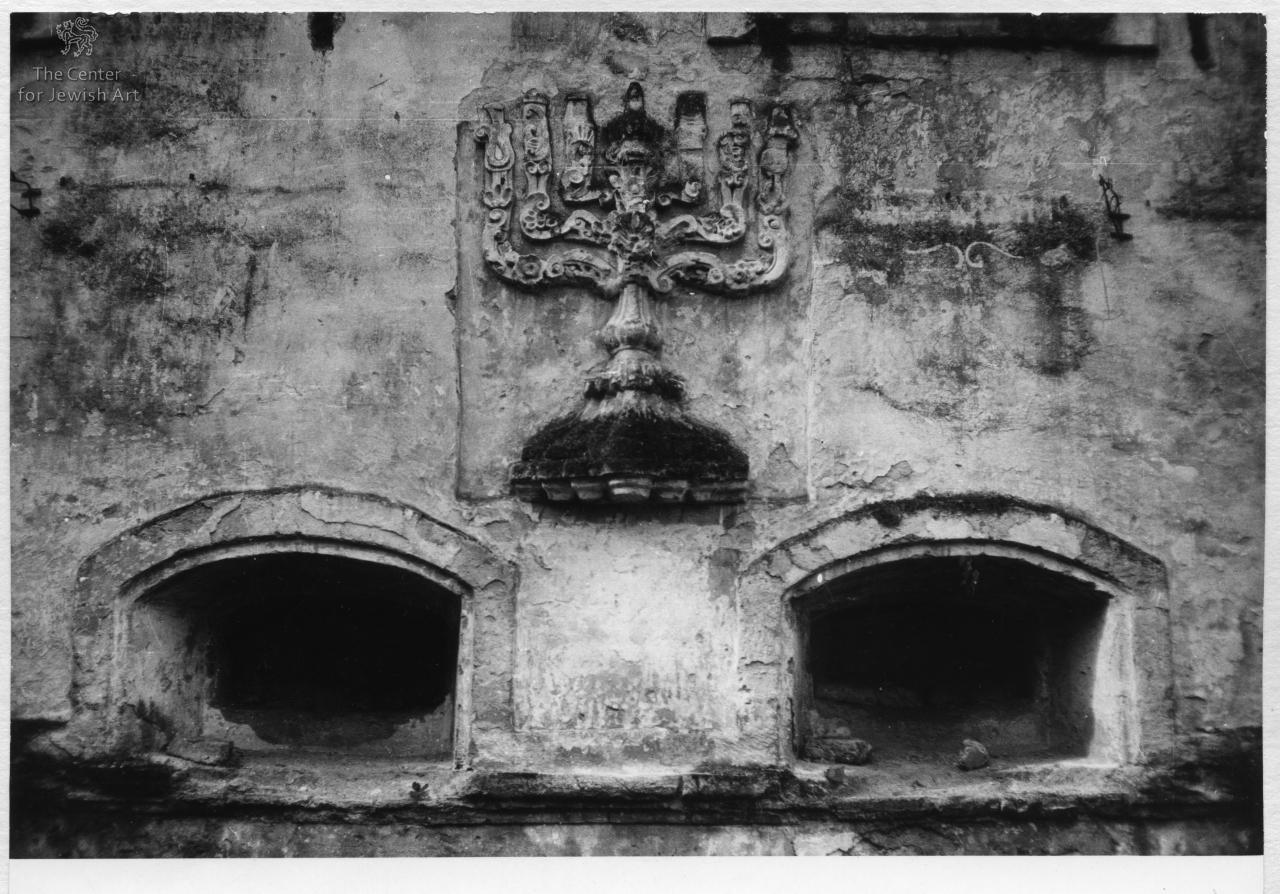
What makes this synagogue outstanding is its decoration with carved stone panels on exterior and interior. The carved central cartouche of the western elevation, the window hoods, the main Torah ark and that of the “winter synagogue,” the niche for ner tamid and small niches in the eastern wall are masterful examples of local baroque. Especially interesting was a now-lost carved bas-relief seven-branched Menorah attached to the southern wall of the prayer hall: it echoed the ancient Menorah, likewise located on the southern side of the Tabernacle and the Temple of Jerusalem.
Another important feature is that the entire synagogue compound – the shulhoyf – is preserved. It still includes three smaller synagogues (two of them blocked together) and a well, while the Talmud-Torah school, the rabbi’s house, and the communal bathhouse with a mikveh are no longer existent.

The Great Synagogue of Raşcov has attracted the attention of researchers. It was thoroughly documented on behalf of the Center for Jewish Art in 1993 and its photo was published on the cover of the survey Jewish Heritage Sites and Monuments in Moldova by Samuel D. Gruber, published in 2010.
However, the synagogue remains a vulnerable ruin. Its defenselessness invites further losses. This, the carved Menorah was torn out from the synagogue’s wall by some “collector;” the Torah ark of the “winter synagogue” suffered a similar fate. Their visual records, however, are preserved in the archives of the Center for Jewish Art. The natural elements also contribute to the further deterioration of the walls.
The initiative group “Rascov Rebirth” was established in Israel in 2016 in order to preserve this unique synagogue. The leader of the group, Iosif Dudelzon, is seeking funds now to undertake conservation work in order to prevent the deterioration of the ruin.
The establishment of a secure lookout point at the edge of the western wall of the synagogue — with spectacular view of the building, the shulhoyf and the Dniester valley — may attract tourists and cause the local authorities to pay more attention to the upkeep of this outstanding monument.
While the Center for Jewish Art is ready to provide advise in the field of art history, the group needs financial assistance and the support of conservation professionals, to ensure that the preservation would not cause any damage.
Click to access the Rascov Rebirth web site
Click to access Center for Jewish Art 1993 Documentation of the Rascov synagogue
Click to see JewishGen report by Yoram Kagan on the Jewish cemetery in Rascov
2 comments on “Will (or can) the great synagogue in Raşcov be conserved?”
My grandparents were killed by Hitler
David Berezansky
My father shmuel was born in Rashkov in 1910
How can I find the grave of my grandparents in Rashkov ?
https://www.facebook.com/toldotrashkov