

Here is a second installment of field notes from the on-site research that is being carried out for the international “Shtetl Routes” project, a tourism itinerary through a score or more of towns in the Poland-Belarus-Ukraine border region that is under development with a more than €400,000 grant from the European Union’s Cross-border Cooperation Programme Poland-Belarus-Ukraine 2007-2013.
Click here for the first installment.
Formally called Shtetl routes: Vestiges of Jewish cultural heritage in transborder tourism, the project involves both on-site and archival research in all three countries; the development of three tourist trails; an internet portal that will describe towns and feature images, anecdotes and history; a guidebook to Jewish heritage in the region; guided tours and the training of tour guides; and the preparation of 3-d virtual models of 15 shtetls, five in each country.
See our January 2013 report on the launch of the project.
FIELD NOTES #2
The following is a report by Józef Markiewicz that focuses on Jewish heritage in small towns in the Podlasie region, Poland. It reflects the on-site research carried out by the “Grodzka Gate – NN Theatre” Centre of Lublin, Poland, in May-July 2014
The research covered five small towns in Poland’s eastern Podlaskie Voivodeship, which borders on Belarus and Lithuania: Knyszyn, Krynki, Orla, Siemiatycze, and Tykocin. All five have a rich Jewish history as well as several heritage sites related to their Jewish past. The main goals were to describe material remains of Jewish culture; to initiate cooperation with local authorities, cultural institutions and activists; and to estimate the importance of intangible and tangible evidences of Jewish culture for contemporary and future economic as well social development of the local communities. Photographs, audio and video recordings (and also personal notes) resulting from the research forms a base for further analysis.
The core of the material that was collected includes interviews with local residents (witnesses of the “Jewish past”) as well as with activists involved in a wide spectrum of initiatives connected with local history and cultural heritage. Markiewicz used two sets of questions prepared by the “Grodzka Gate – NN Theatre” Centre complemented by his own questions and remarks. Often he let the discussion flow into different directions, not necessary “covered” by prepared questionnaires, but meaningful for narration or investigation subject.
In this report he does not discuss the heritage sites per se, but the issues around incorporating Jewish heritage and local heritage in general into a viable tourism product.
Jewish heritage in small towns of Podlasie region, Poland
By Józef Markiewicz
Without a doubt there is special value in development of cultural tourism in Poldasie. First of all Podlaskie Voivodeship is labeled as touristic region, and this is constantly stressed in all official PR, promotional campaigns, and strategies of economic development. Tourism should compensate for the lack of industry and generate economical growth in the region. Still, Podlasie is often described as “Poland B”, that is, one of the poorest provinces of the country. Indeed Podlasie has unique resources such as history, untouched nature and preserved cultural landscape. The Voivodeship logo, a bison formed from colorful pixels, conveys that idea in a clear way. It also refers also to the region’s historical and cultural border location — and multiculturalism. For more than 10 years the official policy of the region has been based on promoting multiculturalism and ethnic diversity, something that often contrasts with media reports about acts of intolerance or anti-Semitism. Nonetheless, Podlasie as a touristic product still is a “magical” place (one popular internet portal about the region is called “Magic Podlasie”) built on the image of intriguing periphery.
The small towns that I visited tend to play an important role in Podlasie’s touristic industry. This is because small towns combine values of life that are close both to nature and to the “melting pot” of different cultural groups, which fits perfectly into the official vision of the Voivodeship. Sometimes multiculturalism is only something from the past. In Tykocin and Knyszyn, for example, we can find only the traces of groups other then Poles who once lived there: Jews, Germans, Russians etc. It is different in towns close to the Polish-Belarussian or Polish-Lithuanian border, which are still inhabited by Poles, Belarusians, Tatars, Ukrainians or Roma.

Still, Jews (along with local Germans) mainly constitute a lost urban element and character of those places. This idea came through in several conversations with my interlocutors; in fact it demonstrates the potential of Jewish history as a component of the reconstruction of “urban history” in general, as a means of highlighting not just the ethnic, but also the economic or even industrial development of small towns. For example Krynki was an important center of the tanning industry, run mainly by Jewish entrepreneurs. Also Siemiatycze and Orla were not simply commercial centers, but were also full of tile workshops. An examination and reevocation of local urban history seems to be not only a necessary context for presenting Jewish history, but also an important stage in creating a new narrative or story for each town.
Often, in the rush of discussion, my interviewees and I spoke about the need to reconstruct a detailed image of the local town square as it was in the interwar period, with a precise description of lots, and the owners of buildings and institutions. Indeed, the deputy mayor of Knyszyn actually did this himself, on the basis of his own research and collection of documents. The process of reconstructing the image of the town, starting from the central square, in fact remains a key strategy in the architectural revitalization of towns in general.
It’s important to say that in each town I visited I had no major problems in finding activists or local historians dealing with Jewish heritage. However, representatives of the local communities are not the only actors involved in preserving or promoting Jewish heritage. In fact every town I visited cooperates with organizations from “outside”– Jewish institutions in Poland, including the Foundation for Preservation of Jewish Heritage in Poland FODZ), the Shalom Foundation, Museum of the History of Polish Jews, and the Jewish Historical Institute (ZIH).
In that sense, Jewish heritage has a “vibrant” nature: it constantly initiates relations with outsiders (and also, very often with Jews who are visiting land of their ancestors). For example, I was able to take part in an official meeting between the mayor of Siemiatycze and son of the town’s biggest tile factory, who had managed to escape from the World War II Siemiatycze ghetto and emigrate to the United States. Likewise, in Knyszyn the deputy mayor collects memoirs form Jews visiting the town of their ancestors — indeed, in that case the Jewish community abroad is a source of knowledge about local history. In some towns, such as Orla, there was a systematic documentation of testimonies, through audio and video recordings, of the oldest local inhabitants about life of the pre-war Jewish community.
Our research in these small Poldasie towns revealed that local society in these places has also gathered a lot of documents and knowledge about the Jewish past of its towns. A main problem is the lack of coherent presentation of this material or simply lack of access to those collections. Some of this information can be found on local websites, though it is not always easily accessible by normal tourists. Some of it, however, is still found only “in the heads” of local historians or tourist guides.
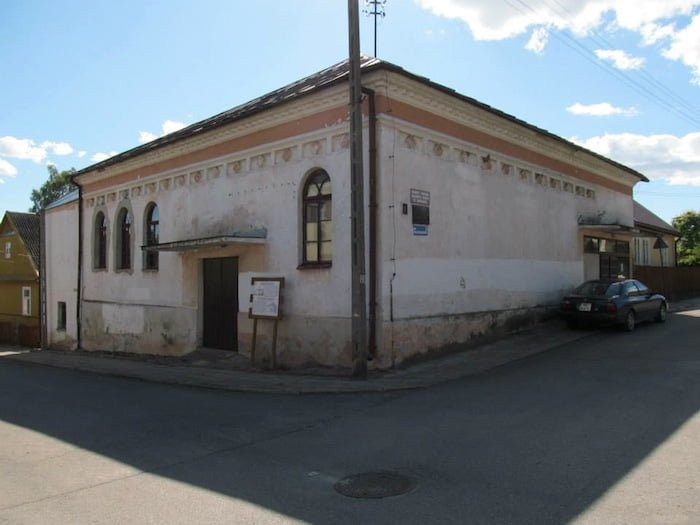
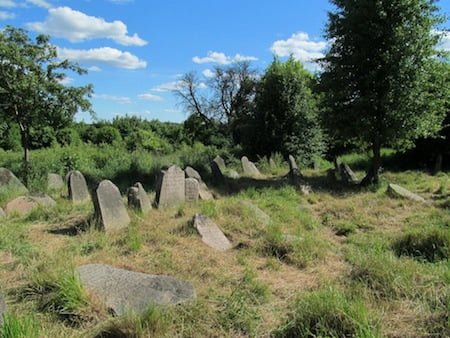
And unfortunately it is not everywhere that local authorities recognize the importance and potential of Jewish heritage — or even local history in general. Krynki, a town on the border with Belarus, has a very rich local history and extremely interesting Jewish sites — two preserved synagogue buildings, the ruins of one synagogue, and one of the biggest Jewish cemeteries in Podlasie, plus a fairly well preserved town center. In Krynki, however, the local authorities do not appear to see any future in touristic development!
On the other hand, we can observe a quite different problem in Tykocin. Tykocin is the oldest town in Podlasie, known because of its monumental Great Synagogue, built in the 17th century and rebuilt in the 1970s as a Jewish museum. Thanks in part of Jewish tour groups, the town has become to some extent a center of mass touristic business, but it still lacks a well thought-out or presented cultural tourism policy or program. This is may also be because of a low evaluation of local heritage in general.
8 comments on “Shtetl Routes project Field Notes #2 — Podlasie region, Poland”
Looking for surname information from 1840 to 1900 for Siemiatycze, I think was Grodno Gubernia then? Anyone have any ideas? I am looking for names Moshenz or Morss or Mors or Shmais or Shmeiz..
My family comes from Krynki. Would info on the Bachrach, Ptnitski and Rosebloom families. I know they were in the tannery trade.
Hi Richard, maybe you’d like to join the Krynki virtual Verein on Facebook? You can find it here https://www.facebook.com/groups/krynkivv
My maternal grandparents came from Knyszyn Poland to Chicago in the early 1900’s: Max Siegel (originally: Cygan) and Riva (Dora? Rivka?) Siegel (nee Lazowska/i). The Lazowski family is in the business index of the 1920’s (30’s?) — they had something to do with horse equipment. Riva’s father was named Shimon and was a sort of wholesaler. They were well to do. I am interested in finding out more about the family.
Thank you,
Sheila Steinberg Price.
Knyszyn, Poland CYGAN LAZOWSKI. Piaski (Puisk) Poland, STEINBERG APPEL, APEL, APPELBAUM.
Tykocin is where my paternal maternal family is from. Names include HOFMAN, GOFMAN, KRAWCEWICZ or SILVERSTEIN
I am interested in any information available from Tykocin. My Grandfather, Sam Cohen, whose real name was Tychochinski came from there. His Sister Gertie also came to the UK. I understand they left siblings behind. How can I trace them?
Information from Revision Lists.
Information from records of birth /marriages/deaths (where legally permissible-over 100 years old)
My paternal grandparents lived in Tykocin, Poland. Louis Appel arrived in New York in 1895 and Celia Appel arrived in 1901 with three children. I have, absolutely, no information about them except that their marriage took place 20 years before somewhere in Poland, probably, Tykocin. The names of the three children are listed on the Dec. 22, 1901 manifest of the S.S. Phoenicia are: Berl, Freide, Chaie (?), and the mother’s name is Sime (?) Appel.She was born in
1857 (?) and Louis was born in 1854 (?). I would appreciate any information you can provide. Thanks so much.