


Ida Shenderovich is an educator and manager of social and charity projects at the Jewish Community of Mogilev, Belarus. She writes that the preservation of the heritage and collective memory of the Jewish community is one of the most important fields of her professional activity — as well as her favorite. In her Have Your Say personal essay, she writes that the Jewish cemetery in Mogilev — and its fate — are of particular concern.
Saving the Mogilev Jewish Cemetery; Saving History, Saving Memory
By Ida Shenderovich
Once prominent in the cityscape, the “Jewish spaces” of Mogilev are now barely discernible.
The former synagogues and Jewish houses of Torah study, the schools, apartment houses, mansions, and hotels, now belong to the state or private owners. Only one building, the Traders’ Synagogue, is marked by a plaque with an inscription mentioning the original use of the building, but this place has also been detached from the contemporary life of the Jewish community.
The only space that still maintains its clear Jewish identification is the Jewish cemetery. Although damaged or ruined in its many parts, this is also the only accessible Jewish space in the city.
I am truly delighted that many people share my vision of the Jewish cemetery in Mogilev as the locus of Jewish memory and common local history.
The Jewish community of Mogilev, Mogilev-born Jews around the world, and the devotees of the local multinational heritage are joining their efforts in the preservation of the cemetery and its tombstones. Sponsors and volunteers of various ages, different sociological strata and from many countries consolidate an international community that enjoy a closer acquaintance with each other’s culture and a deeper knowledge of family genealogies. The project also fosters local, national, and international tourism, and our work attracts the attention of the custodians of local history. We gladly advise those who establish or manage similar projects far beyond our city.

The cemetery, the only surviving Jewish cemetery in Mogilev, was first marked on a city map in 1808, but obviously it was founded even earlier.
Up until the late 1970s, the cemetery was maintained by a custodian employed by the municipal Public Utility Services. He was an observant Jew who maintained the venue for Jewish burials. Shortly after his death, other citizens began to be buried there as well. In course of time, the cemetery was neglected, and many gravestones were despoiled or demolished.
New graves, primarily Christian, soon began to fill the territory. As there was not enough space for new burial places, the old Jewish gravestones were destroyed bit by bit. Selling ransacked burial places for new burials and reselling granite Jewish gravestones on which were earlier engraved epitaphs in Hebrew became a specific «cemetery business» for a couple of decades. In 1990s, when the local Jewish community significantly decreased, the cemetery fell into disrepair.
In 2000, U.S. Jews with Mogilev origins initiated a reconstruction of the cemetery. David Shemano and his nephew Raphael Reichenberg, who found their ancestors’ graves at the cemetery, and Mark Jitler funded a concrete fence, an iron gate with Jewish symbols, and guard booths, which were installed by the Jewish Community. The maintenance of the auxiliary buildings at the cemetery was handed on to the Municipal Public Services Office.

Since 2000, we – a group of volunteers – began to care about the cemetery.
First we gathered bones, which had been thrown out of old graves and were literally lying on the ground. We buried the remains of about a dozen people in four special sacks and installed a monument on their grave. Such mass graves had appeared here in the 1950s when Mogilev Jews reburied the remains of their relatives who had been killed during Holocaust and buried right in the streets of the city.
In 2002, the Mogilev City Executive Committee divided the cemetery into two parts – the old and the new — and forbade burials at the old one to protect the ancient Jewish graves from vandalism. It helped to minimize the destruction of the oldest part of the cemetery. However, back then the cemetery was given a status of «Public», which legalized non-Jewish burials. Numerous requests for providing a separate place for burials according to the Jewish tradition were repeatedly neglected by the municipal authorities.
More than 600 gravestones dating from the mid-19th– to the beginning of 20th century can be seen at the oldest part of the cemetery.
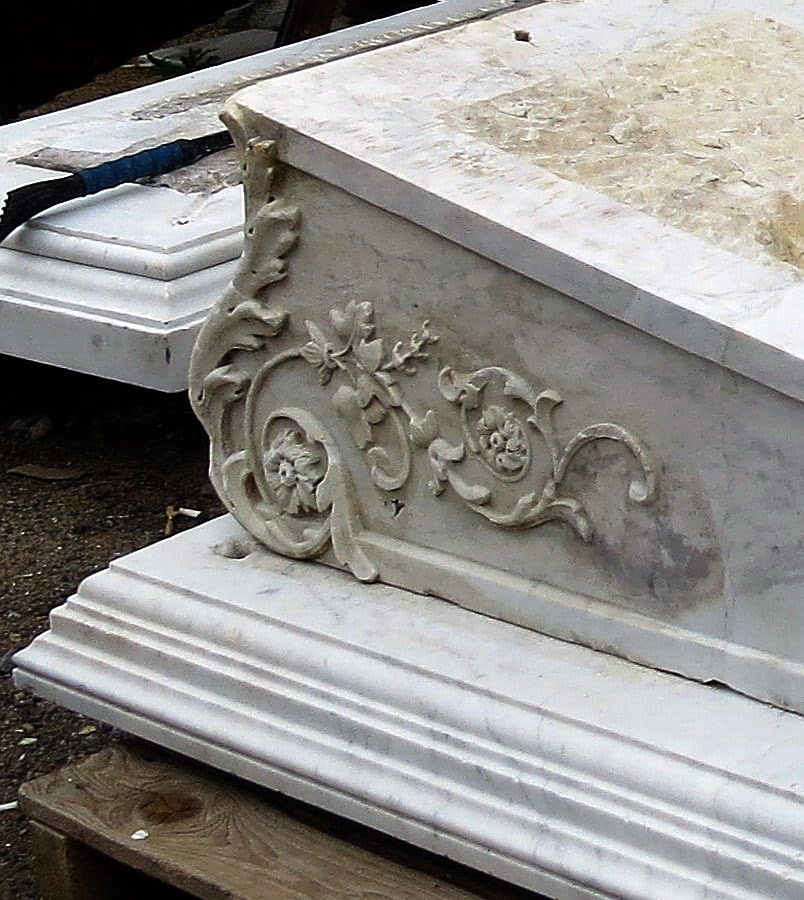
Despite the losses, there are still some high-quality granite and marble gravestones made by professional stonecutters: brothers Kolmanovich and D. Vishrubsky from Vilna (Lithuania), I. and B. Auerbach from Warsaw (Poland), Ioffe and P. Yatsyno from Mogilev (Belarus) with fine decor and poetic epitaphs in five different languages including acrostics and chronograms.
Here rest honored citizens and religious leaders (including noted rabbis) as well as public figures, engineers, businessmen, and home owners, whose entrepreneurial, building, organizational, and cultural activity still defines the specific features of cultural, economic and social history of the city — as well as its architecture: at the beginning of the 20th century nearly 90 percent of masonry buildings in the city center belonged to Jews.
What makes the oldest part of the cemetery especially peculiar is that the graves of different periods can be seen not far from each other, which allows us to trace how the art tradition as well as cultural and social conditions changed throughout quite a long period of the city history.
One of the most splendid gravestones at the Mogilev Jewish Cemetery marks the grave of Shmaryahu Ben Mordechai Zuckerman, who died in 1878 at the age of 61.
Made of Ural marble by Israel Auerbach from Warsaw it is decorated with sophisticated carvings in exquisite geometric and floral motifs complemented with bas-reliefs with the shield of King David.
The epitaph on the gravestone is no less complicated and refined than the decoration. The frame of the text recalls the Scroll of Torah, which denotes that the deceased was a highly intelligent and devoted person. A heraldic shield with a traditional abbreviation in Hebrew «here rests» is adorned with a crown. Such a kingly crown symbolizes his dignity and wisdom. The place where Zuckerman is buried (at the front part of the cemetery alongside the eminent people and rabbis) also proves his high social status.
His name is encrypted in the acrostic – a verse of praising, in which the first letters of the lines make up a name. The date of his death, 24 Tishrei 5639 (21.10.1878), is encrypted in a chronogram “as the sea big the grief,” which may be deciphered with the help of Gematria.
In 2014, we catalogized the burials at the cemetery. Now they are available on the Internet. And during the past year, with the help of local Jewish entrepreneurs and crowdfunding in the USA, we have managed to raise enough money to restore approximately one sixth of the cemetery. It is our fervent wish to continue the work!
Still, in 2018, the oldest part of the cemetery again came under the risk of destruction: a revised law “on burials and funeral business” allowed the demolition of gravestones defined as “beyond repair”.
Thankfully, through the great effort of the Jewish Community, the Mogilev Jewish cemetery was this year (2019) given the status of “Historical and Memorial burial place.” It is the only Jewish cemetery in Belarus that has been given this status.
Hopefully, for a while, this will suspend the destruction of this unique place of history and collective memory.
December 3, 2019
Access the Mogilev Jewish heritage web site
Access Go Fund Me crowdfunding web site for the cemetery
– – – – –
Ida Shenderovich as an educator and manager of social and charity projects at the Jewish Community of Mogilev, Belarus. She deals with the preservation of the heritage and collective memory of the Jewish community. She and her colleagues have found unique local historical evidence in many archives and libraries, as well as in hundreds of private archives, family albums and interviews with Mogilev-born people in Belarus, Russia, Poland, and Israel. This work has yielded seven books, and many articles, exhibitions and internet publications.